
























Bài 47 · Projects and Practice
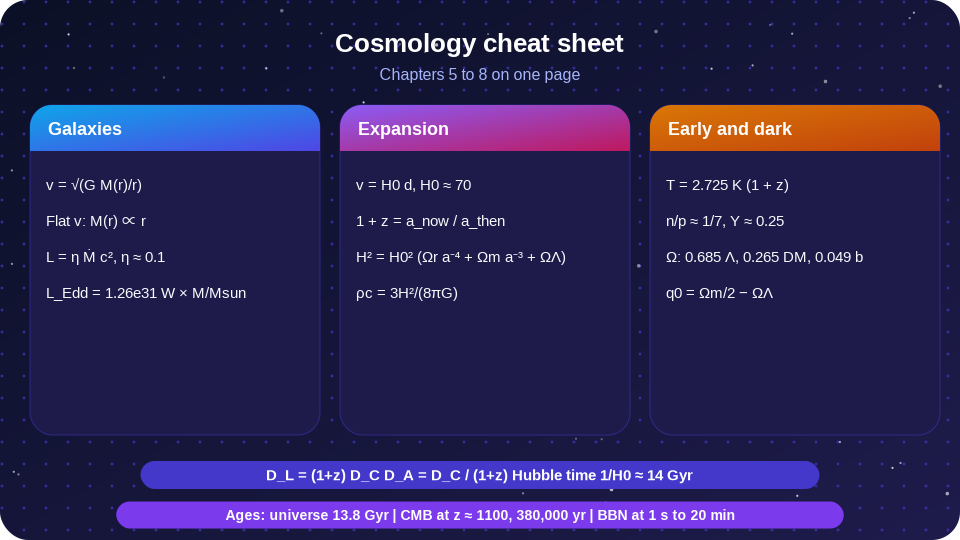
Cheat Sheet: Galaxies and Cosmology on One Page
A one-page recap of the key formulas, constants and numbers from galaxies, cosmological models, the early universe and the dark sector, plus a quick cosmology calculator in Python.
Here is everything from chapters 5 to 8 compressed onto one page: the formulas, the numbers to remember and a calculator that turns a redshift into the quantities you most often need. Print it, or keep it open while solving problems. Use it to recall, not to replace understanding: if a line looks unfamiliar, follow the lesson link in the table.
What you will learn
- The central formulas of each chapter and when to use them.
- The numbers worth memorizing, and the constants for calculations.
- How to compute many cosmological quantities for any redshift.
Key terms
Ω (omega): a density divided by the critical density.
H₀: the Hubble constant, about 70 km/s/Mpc.
a: the scale factor, 1/(1+z).
w: the equation-of-state ratio P/(ρc²).
ΛCDM: the standard cosmological model.
Formulas
| Topic | Formula | Notes |
|---|---|---|
| Orbital mass | M(r) = v² r / G |
Flat curve: M ∝ r |
| Elliptical type | n = 10 (1 − b/a) |
Type En |
| Accretion luminosity | L = η Ṁ c² |
η ≈ 0.1 |
| Eddington luminosity | L_Edd = 1.26×10³¹ W × (M/M☉) |
Radiation pressure = gravity |
| Schwarzschild radius | r_s = 2.95 km × (M/M☉) |
|
| Hubble law | v = H₀ d |
Small z |
| Redshift | 1 + z = a_now / a_emit |
Also T = 2.725 K (1+z) |
| Friedmann | H² = H₀² [Ω_r a⁻⁴ + Ω_m a⁻³ + Ω_k a⁻² + Ω_Λ] |
ΣΩ = 1 |
| Critical density | ρ_c = 3H² / (8πG) |
9.2×10⁻²⁷ kg/m³ at 70 |
| Acceleration | ä/a = −(4πG/3)(ρ + 3P/c²) |
w < −1/3 accelerates |
| Deceleration | q₀ = Ω_m/2 − Ω_Λ |
Flat, matter plus Λ |
| Comoving distance | D_C = c ∫ dz / H(z) |
|
| Luminosity distance | D_L = (1+z) D_C |
F = L / (4π D_L²) |
| Angular-diameter distance | D_A = D_C / (1+z) |
θ = s / D_A |
| Distance modulus | μ = m − M = 5 log₁₀(d/10 pc) |
|
| Neutron fraction | n/p = exp(−1.293 MeV / kT) |
Freeze-out about 1/6 |
| Helium fraction | Yₚ = 2x/(1 + x) |
x = n/p |
| Radiation era | T ≈ 1.5×10¹⁰ K / √(t/s) |
|
| Inflation | a ∝ e^(Ht), N ≥ 60 |
|
| Virial mass | M ≈ 3σ²R/G |
Clusters |
| Einstein radius | θ_E = √(4GM/c² · D_LS/(D_L D_S)) |
Numbers to remember
| Quantity | Value |
|---|---|
| Milky Way disk | about 30 kpc across; Sun at 8.2 kpc; 230 km/s; period 220 Myr |
| Sagittarius A* | about 4×10⁶ M☉ |
| Hubble constant | 67.4 (CMB) to 73.0 (local) km/s/Mpc; 1/H₀ ≈ 14 Gyr |
| Age of the universe | 13.8 Gyr |
| CMB | 2.725 K, z ≈ 1,100, 380,000 yr, 411 photons/cm³ |
| Helium | Yₚ ≈ 0.245; D/H ≈ 2.5×10⁻⁵ |
| Budget | Λ 0.685, dark matter 0.265, baryons 0.049 |
| Spectral index | nₛ ≈ 0.965 |
| Observable universe | radius 46 Gly (14 Gpc) |
| Constants | G = 6.674×10⁻¹¹ N m²/kg²; c = 2.998×10⁸ m/s; 1 M☉ = 1.989×10³⁰ kg; 1 pc = 3.086×10¹⁶ m |
A cosmology calculator
Press Run (or Ctrl + Enter) to see the result here.
Program input · what you'd type while the program runs
Type the answers before you press Run, one per line. Each time the program reads a line (with input()), it gets the next line from this box.
Press Run (or Ctrl + Enter) to see the console output here.
No output.
Common misconceptions
"A cheat sheet replaces understanding." The formulas hold only under stated conditions (for example v = H₀ d only for small z).
"All distances in cosmology are the same." Comoving, luminosity and angular-diameter distances differ by powers of 1 + z.
"The numbers are exact." Many (H₀, Ω, ages) have uncertainties and depend on the data set used.
Check your understanding
Quick check · 4 questions
of 4 answered You scored / 4 · perfect!
-
1. Which relation gives the mass inside an orbit?
From v^2 / r = G M / r^2. -
2. What is the CMB temperature at z = 9?
T = 2.725 x 10 = 27.25 K. -
3. Which pair of numbers gives the primordial helium mass fraction and the neutron-proton ratio used for it?
Y = 2x/(1+x) with x = 1/7 gives 0.25. -
4. Which is the correct pairing for the angular-diameter distance?
D_A = D_C / (1+z).
Summary
- The key formulas:
M = v²r/G,L = ηṀc²,v = H₀d, the Friedmann equation,ρ_c = 3H²/(8πG),D_L = (1+z)D_C,Y = 2x/(1+x). - Numbers:
H₀ ≈ 70, age 13.8 Gyr, CMB 2.725 K atz ≈ 1,100, Ω budget 0.685/0.265/0.049. - A short script can turn any redshift into distances, temperature and ages.
Next: Further study
Theo dõi tiến độ của bạn
Tạo tài khoản miễn phí để đánh dấu bài đã học và tiếp tục từ chỗ bạn dừng lại trên mọi thiết bị.