
























Bài 6 · Getting Started
Chapter 1 review: scales, light, brightness and gravity
Review chapter 1 of Astrophysics and Cosmology with a one-page cheat sheet, a recap table, a self-checking calculator and a ten-question quiz.
Chapter 1 gave you four tools. Units and scales tell you how big a number should be. Light and radiation connect colour and brightness to temperature and size. Magnitudes put brightness on a logarithmic scale and let you compare stars at a common distance. Gravity and Kepler's laws turn orbits into masses. Almost everything later in the course is a combination of these.
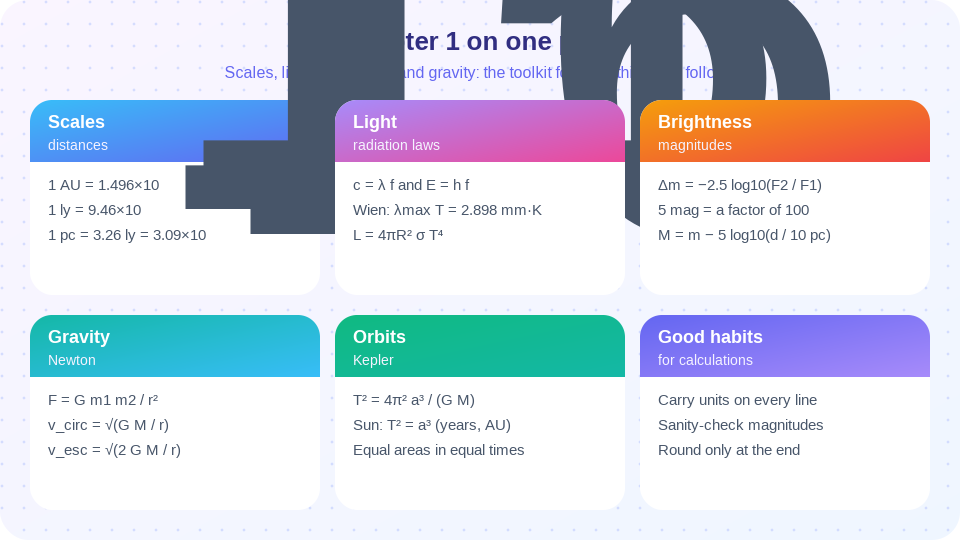
Recap table
| Lesson | Big idea | Formula to remember |
|---|---|---|
| Cosmic scales | Units fit the scale; parallax defines the parsec | d (pc) = 1 / p (arcsec) |
| Light and radiation | Temperature sets colour and power | λ_max T = 2.898 mm·K, L = 4πR²σT⁴ |
| Magnitudes | 5 mag = ×100; M is m at 10 pc | m − M = 5 log₁₀ d − 5 |
| Gravity and orbits | Orbits weigh worlds | M = 4π² a³ / (G T²) |
Common misconceptions
"Bigger magnitude means brighter." The reverse: smaller (even negative) magnitudes are brighter.
"The inverse-square law only applies to light." It applies to anything spreading out from a point: light, gravity, radio signals, neutrinos.
"Kepler's third law needs the planet's mass." For planets around the Sun, the planet's mass is negligible, and T² = a³ holds in years and AU.
Try it
This calculator chains the chapter's ideas for a hypothetical star: from temperature and radius to luminosity, absolute magnitude, and the distance at which it would be a naked-eye star. Try changing T and R to describe a red dwarf, then a blue giant.
Press Run (or Ctrl + Enter) to see the result here.
Program input · what you'd type while the program runs
Type the answers before you press Run, one per line. Each time the program reads a line (with input()), it gets the next line from this box.
Check your understanding
Quick check · 10 questions
of 10 answered You scored / 10 · perfect!
-
1. A star has a parallax of 0.1 arcseconds. Its distance is
d = 1 / p = 1 / 0.1 = 10 pc. -
2. Betelgeuse looks red and Rigel looks blue-white. The best conclusion is that
By Wien's law, blue peaks mean higher surface temperature. -
3. A star's radius doubles at constant temperature. Its luminosity
L = 4 pi R^2 sigma T^4, so doubling R gives four times the luminosity. -
4. Star A has magnitude 3 and star B magnitude 8. Star A is
Five magnitudes is a factor of 100, and the smaller magnitude is brighter. -
5. What is the absolute magnitude of a star with m = 5 at a distance of 10 pc?
At 10 pc, m equals M. -
6. A planet at 9 AU from a Sun-like star has a period of
T^2 = a^3 = 729, so T = 27 years. -
7. Which band is best observed from space rather than the ground?
The atmosphere absorbs X-rays, so X-ray astronomy needs satellites. -
8. The escape velocity from a planet is 10 km/s. A circular orbit just above its surface has speed
v_circ = v_esc / sqrt(2) = 7.07 km/s. -
9. Light from a galaxy 2 million light-years away shows the galaxy as it was
Light takes one year per light-year, so you see the past. -
10. Doubling the distance to a star changes the flux you receive by a factor of
Flux is proportional to 1/d^2, so doubling d gives one quarter.
Summary
- Choose units that fit the scale; parallax and logarithms are the first measuring tools.
- Wien's law and Stefan-Boltzmann tie colour and brightness to temperature and radius.
- Magnitudes are logarithmic; the distance modulus links apparent and absolute magnitude.
- Orbits give masses via
M = 4π² a³ / (G T²).
Theo dõi tiến độ của bạn
Tạo tài khoản miễn phí để đánh dấu bài đã học và tiếp tục từ chỗ bạn dừng lại trên mọi thiết bị.