
























Bài 16 · Titrations and Gravimetry
Chapter 4 overview: titrations and gravimetry
Preview chapter 4: how classical methods count moles with a burette or a balance, and how acid-base, complexometric, redox and gravimetric analyses work.
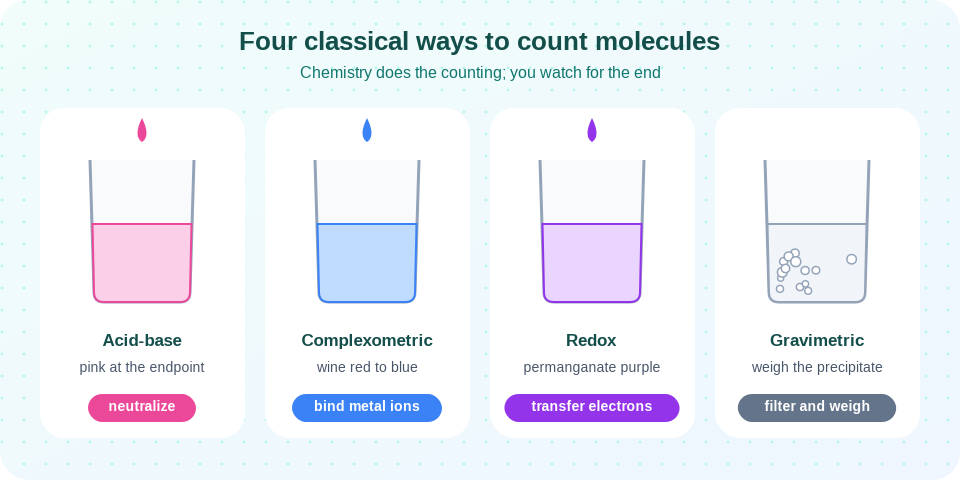
Before electronics, chemists measured amounts with two things: a burette and a balance. Both methods are still essential today because they are absolute: with a pure standard and a balanced equation, the answer follows from stoichiometry and needs no calibration curve. Titration counts moles by the volume of a reagent consumed; gravimetry counts moles by the mass of a product weighed.
What you will learn
- The vocabulary of titration: titrant, analyte, equivalence point, end point, standardization.
- How acid-base, complexometric, redox and precipitation titrations differ.
- How gravimetric analysis turns a weighed precipitate into an amount of analyte.
- Why these methods can reach about 0.1 % precision with simple equipment.
The chapter at a glance
Titration
Types
Gravimetry
Lessons in this chapter
- Titration basics: standards, standardization and the stoichiometry of a titration.
- Acid-base titration curves: pH versus volume, equivalence points and indicators.
- Complexometric and redox titrations: EDTA, permanganate and back titrations.
- Gravimetric analysis: precipitation, filtration, ignition and gravimetric factors.
- Chapter 4 review: recap and quiz.
Try it
Press Run (or Ctrl + Enter) to see the console output here.
No output.
Check your understanding
Quick check · 3 questions
of 3 answered You scored / 3 · perfect!
-
1. Why are titration and gravimetry called absolute methods?
Moles come directly from the balanced reaction and the measured volume or mass. -
2. In a titration the burette holds the
The titrant is the solution of known concentration added from the burette. -
3. What does gravimetric analysis measure?
The mass of a pure, well-defined product is converted to the amount of analyte.
Summary
- Titration and gravimetry count moles from volume or mass; they are absolute methods.
- Four common titration types: acid-base, complexometric, redox, and precipitation.
- Gravimetry weighs a pure product; careful technique gives about 0.1 % precision.
Next: Titration basics
Theo dõi tiến độ của bạn
Tạo tài khoản miễn phí để đánh dấu bài đã học và tiếp tục từ chỗ bạn dừng lại trên mọi thiết bị.