
























Bài 11 · Sampling and Calibration
Chapter 3 overview: sampling and calibration
Preview chapter 3: how a few grams can represent tonnes, how calibration turns signals into concentrations, and how detection limits and matrix effects are handled.
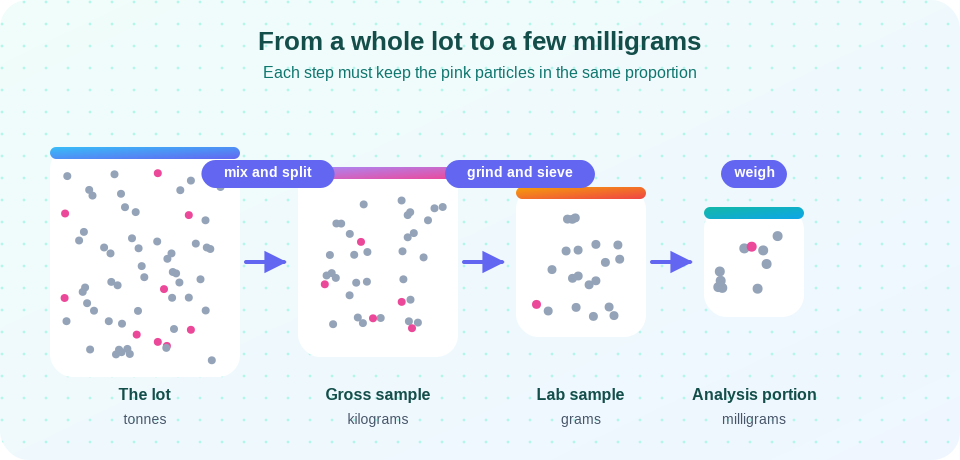
An analysis ends with a number, but it begins with a decision about what the number should describe. A truckload of wheat, a lake, a patient's blood: in each case you can analyze only a tiny fraction. This chapter first shows how to take that fraction so it represents the whole, then how to convert the instrument's signal into a concentration you can defend.
What you will learn
- Why sampling is usually the largest source of error and how to reduce it.
- How external calibration, standard addition and internal standards work.
- How detection and quantification limits are defined.
- How matrix effects distort signals and how to correct for them.
The chapter at a glance
Sample
Calibrate
Correct
Lessons in this chapter
- Sampling heterogeneous materials: sampling variance, particle size and sample mass.
- Calibration and detection limits: least squares, using the line, LOD and LOQ.
- Standard addition and internal standards: handling matrix effects and drift.
- Chapter 3 review: recap and quiz.
Try it
Press Run (or Ctrl + Enter) to see the console output here.
No output.
Check your understanding
Quick check · 3 questions
of 3 answered You scored / 3 · perfect!
-
1. Why is sampling often the largest error source?
Differences between portions of the material produce a sampling variance that can dwarf the measurement variance. -
2. A calibration relates
A calibration function converts the instrument's signal into a concentration. -
3. When is standard addition most useful?
Adding standard to the sample itself makes matrix effects the same for the sample and the additions.
Summary
- Representative sampling comes first; no instrument can fix a poor sample.
- Calibration converts signals into concentrations, with limits of detection and quantification.
- Standard addition and internal standards handle matrix effects and drift.
Theo dõi tiến độ của bạn
Tạo tài khoản miễn phí để đánh dấu bài đã học và tiếp tục từ chỗ bạn dừng lại trên mọi thiết bị.