
























Bài 15 · Survival Models and Life Tables
Chapter 3 review: Survival models
One-page recap of survival functions, force of mortality, life tables, fractional ages and select mortality, with practice calculators and a ten-question quiz.
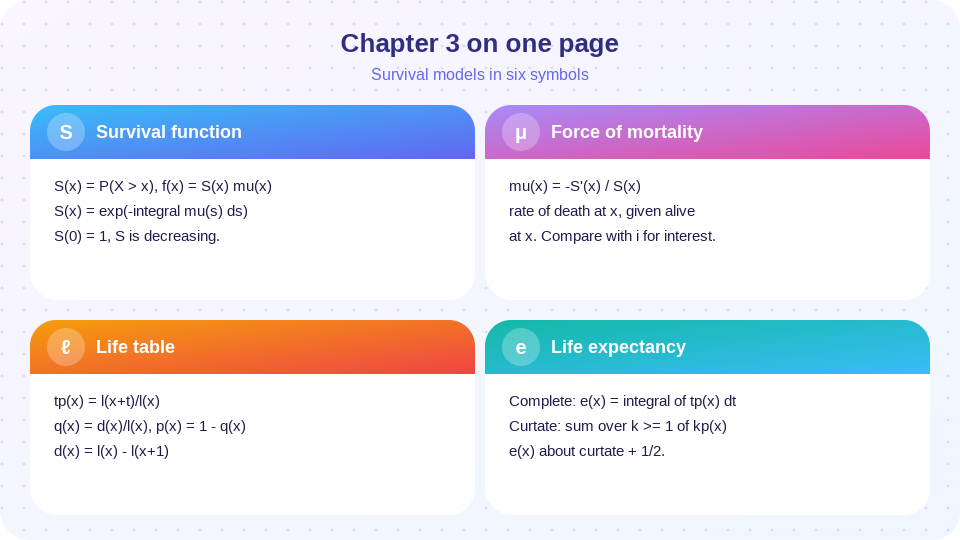
Chapter 3 turned the vague idea of "how long people live" into mathematics you can compute with: a survival function, a force of mortality, a table, and rules for the spaces between whole ages. Chapter 4 multiplies these probabilities by the discount factors of chapter 2 to price insurance, so each formula here will be used again within pages.
What you will learn
- How the survival function, force, density and table are linked.
- Which formula to use for each probability.
- Which assumptions you must state when working between whole ages.
Key terms
S(x), mu(x), f(x): survival function, force of mortality, density of age at death.
t p x, t q x: survive, or die within, t years from age x.
l(x), d(x): survivors and deaths in a life table.
UDD: uniform distribution of deaths within each year of age.
Select period: years after underwriting during which mortality is lower.
The chapter in a table
| Task | Formula |
|---|---|
| from force to survival | S(x) = exp(-integral of mu(s) ds from 0 to x) |
| force from survival | mu(x) = -S'(x) / S(x) |
survive t years |
t p x = S(x+t)/S(x) = l(x+t)/l(x) |
| die in a year | q x = d(x)/l(x) = 1 - p x |
survive t, die in next u |
(l(x+t) - l(x+t+u)) / l(x) |
| complete life expectancy | e x = integral of t p x dt |
| curtate life expectancy | sum over k >= 1 of k p x |
| UDD | s q x = s q x, l(x+s) = l(x) - s d(x) |
| constant force | s p x = (p x)^s |
Lessons: survival function, life tables, select tables and fractional ages.
Try it
Check a hand calculation with a short program. The first example computes the quantities from a tiny hand-made table, the kind of exercise you will meet in exams.
Press Run (or Ctrl + Enter) to see the result here.
Program input · what you'd type while the program runs
Type the answers before you press Run, one per line. Each time the program reads a line (with input()), it gets the next line from this box.
The second example verifies the integral formula for S(x) numerically, a useful habit when you work with a new force of mortality.
Press Run (or Ctrl + Enter) to see the result here.
Program input · what you'd type while the program runs
Type the answers before you press Run, one per line. Each time the program reads a line (with input()), it gets the next line from this box.
Common misconceptions
Dividing by the wrong l. Probabilities for a person aged x divide by l(x).
Confusing force with probability. mu(x) is a rate; q x is a probability.
Forgetting the assumption. Any fractional-age result needs UDD or constant force stated.
Check your understanding
Quick check · 10 questions
of 10 answered You scored / 10 · perfect!
-
1. If mu = 0.03 for all ages, what is 10 p x?
exp(-0.03 x 10) = exp(-0.3) = 0.7408. -
2. Given l(60) = 80,000 and l(70) = 64,000, 10 p 60 is
64,000 / 80,000 = 0.8. -
3. l(50) = 90,000 and l(51) = 89,400. What is q(50)?
d(50) = 600, q(50) = 600/90,000 = 0.006667. -
4. If S(x) = 1 - x/100 for 0 <= x < 100, then mu(40) equals
mu = -S'/S = (1/100) / 0.6 = 1/60 = 0.01667. -
5. With l(40) = 100, l(45) = 95, l(50) = 88 (in thousands), the probability a 40-year-old survives to 45 and dies before 50 is
(95 - 88) / 100 = 0.07. -
6. A cohort has l = 100, 90, 80, 70, 0 at ages x, x+1, x+2, x+3, x+4. The curtate expectation of life at x is
(90 + 80 + 70 + 0) / 100 = 2.4: the sum of l at later ages divided by l(x). -
7. Under UDD with q x = 0.05, the probability of dying within 0.4 years is
s q x = 0.4 x 0.05 = 0.02 under UDD. -
8. Which formula is correct for survival from the force of mortality?
Because mu = -d ln S / dx, so S = exp(-integral of mu). -
9. In a select-and-ultimate table with a 3-year select period, q [x] + 3 is
After the select period, mortality depends only on attained age. -
10. Which statement about T(x) is true?
T(x) is continuous; K(x) = floor(T(x)) is the curtate future lifetime.
Summary
S(x) = exp(-integral of mu);t p x = S(x+t)/S(x);q x = 1 - p x.- A life table gives all probabilities as ratios of
lvalues. - Life expectancy: complete
= integral of t p x, curtate= sum of k p x. - Fractions of a year need UDD or constant force; select tables reflect underwriting.
Theo dõi tiến độ của bạn
Tạo tài khoản miễn phí để đánh dấu bài đã học và tiếp tục từ chỗ bạn dừng lại trên mọi thiết bị.