
























Bài 8 · Interest and Annuities
Annuities-certain
Value streams of level payments with annuity-immediate and annuity-due formulas, accumulations, deferred annuities and perpetuities, with worked examples and code.
Many financial promises are streams of equal payments: rent, a pension of 20,000 a year, loan repayments, a retirement saving plan. An annuity-certain is such a stream of payments with fixed amounts and fixed dates (no uncertainty about whether they are made). Annuities-certain are the building block of life annuities in chapter 4: you will simply multiply each payment by the probability that it is made.
The formulas below come from one idea, the sum of a geometric series. Learn the derivation once and you can rebuild every formula in the lesson from memory.
What you will learn
- The formulas for annuity-immediate
a_nand annuity-dueä_n. - How to accumulate a stream to the end with
s_nands̈_n. - How to value deferred annuities and perpetuities.
- How to solve for the payment, the term or the rate.
Key terms
Annuity-immediate a_n: n payments of 1, at the end of each year; present value at time 0. Read "a angle n".
Annuity-due ä_n: n payments of 1, at the start of each year; present value at time 0.
Accumulated value s_n: the value at time n of the immediate annuity's payments.
Perpetuity: a payment stream that never ends.
Deferred annuity: an annuity whose first payment starts after a delay.
Annuity-immediate
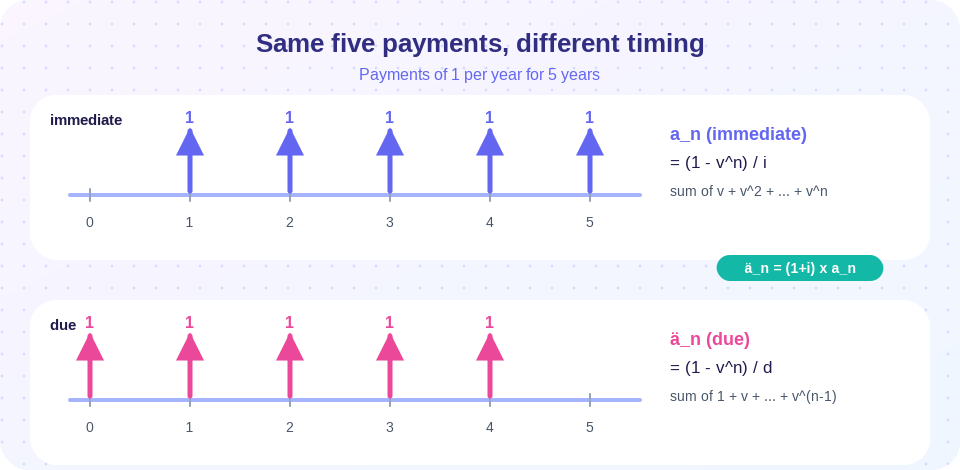
Payments of 1 at times 1, 2, ..., n. The present value is
a_n = v + v^2 + ... + v^n.
This is a geometric series with first term v, ratio v, and n terms, so a_n = v (1 - v^n)/(1 - v) = (1 - v^n)/i, using 1 - v = d = i v. Hence
a_n = (1 - v^n) / i.
Worked example. At i = 5% with n = 5: v^5 = 0.783526, so a_5 = (1 - 0.783526)/0.05 = 4.32948. Five payments of 1,000 are worth 4,329.48 today.
The accumulated value at time n is s_n = (1+i)^(n-1) + ... + (1+i) + 1 = ((1+i)^n - 1)/i, and the two are tied by s_n = a_n (1+i)^n. With the numbers above s_5 = (1.276282 - 1)/0.05 = 5.52563.
Annuity-due
Payments at times 0, 1, ..., n-1. Each payment comes a year earlier than in the immediate annuity, so the value is multiplied by (1+i):
ä_n = 1 + v + ... + v^(n-1) = (1 - v^n)/d = (1+i) a_n.
At 5%, ä_5 = 4.32948 x 1.05 = 4.54595. Equivalently ä_n = 1 + a_(n-1): the payment at time 0 plus an immediate annuity of n-1 payments. The accumulated value of the due annuity is s̈_n = (1+i) s_n.
Press Run (or Ctrl + Enter) to see the result here.
Program input · what you'd type while the program runs
Type the answers before you press Run, one per line. Each time the program reads a line (with input()), it gets the next line from this box.
Perpetuities and deferred annuities
If payments never stop, let n grow: v^n tends to 0 for i > 0, so
a_infinity = 1/i and ä_infinity = 1/d.
A payment of 1,000 a year forever at 4% is worth 1000/0.04 = 25,000. The intuition: invest 25,000 and withdraw the 4% interest each year without touching the capital.
A deferred annuity has its first payment later. A payment stream of n payments of 1 starting at time m + 1 has present value v^m a_n, or equivalently a_(m+n) - a_m. At 5%, 10 payments deferred by 5 years: v^5 a_10 = 0.783526 x 7.72173 = 6.0502.
Solving for the payment, the term and the rate
Often the unknown is not the present value. To find the level payment P that accumulates to a target F in n years: P = F / s_n. To find the term, solve a_n = PV/P for v^n, so n = -ln(1 - i PV/P) / ln(1+i). To find the rate, there is no closed form in general; solve numerically, which is what spreadsheets and the brentq function in code do.
Worked example. You want 100,000 in 15 years by saving at the end of each year at 4%. s_15 = (1.04^15 - 1)/0.04 = 20.02359, so P = 100,000/20.02359 = 4,994.11.
Press Run (or Ctrl + Enter) to see the result here.
Program input · what you'd type while the program runs
Type the answers before you press Run, one per line. Each time the program reads a line (with input()), it gets the next line from this box.
Increasing annuities (a brief look)
If the payments rise by 1 each year (1, 2, 3, ..., n at times 1 to n), the present value is (Ia)_n = (ä_n - n v^n)/i. At 5% with n = 5: ä_5 = 4.54595, n v^n = 5 x 0.783526 = 3.91763, so (Ia)_5 = (4.54595 - 3.91763)/0.05 = 12.5664. You can check this directly: v + 2v^2 + 3v^3 + 4v^4 + 5v^5.
Try it: how annuity values behave
Plot a_n against n for several rates. Each curve flattens towards the perpetuity value 1/i, and a higher rate means a lower, earlier-flattening curve.
Press Run (or Ctrl + Enter) to see the result here.
Program input · what you'd type while the program runs
Type the answers before you press Run, one per line. Each time the program reads a line (with input()), it gets the next line from this box.
Common misconceptions
"The annuity-due is the one that starts at time 1." The opposite: due payments are at the START of each period (time 0 first); immediate payments are at the END (time 1 first).
"A longer annuity is always worth proportionally more." Present value grows more and more slowly because distant payments are heavily discounted, and it can never exceed 1/i.
"s_n is the present value." s_n is the value at time n, the end of the term. Multiply by v^n to get back to time 0.
Check your understanding
Quick check · 5 questions
of 5 answered You scored / 5 · perfect!
-
1. At i = 5%, what is a_5 (to 3 decimals)?
a_5 = (1 - 1.05^-5)/0.05 = 4.329. (5.526 is s_5 and 4.546 is the annuity-due.) -
2. Which identity is correct?
Each due payment is made one year earlier, so the present value is larger by the factor (1 + i). -
3. What is the present value of 2,000 per year forever at 8%?
2,000 / 0.08 = 25,000. -
4. Ten payments of 1 each year start at the END of year 6 (i.e. times 6 to 15). The present value is
The annuity-immediate a_10 would start at time 1; delaying it by 5 years multiplies by v^5. -
5. How is s_n related to a_n?
Accumulating the present value forward n years gives the value at the end of the term.
Summary
a_n = (1 - v^n)/i,ä_n = (1 - v^n)/d = (1 + i) a_n,s_n = ((1+i)^n - 1)/i = a_n (1+i)^n.- Perpetuities:
a_infinity = 1/i,ä_infinity = 1/d. - A deferred annuity has value
v^m a_n. - Unknown payment, term or rate: rearrange the formula or solve numerically.
- Life annuities (chapter 4) multiply each payment by a survival probability.
Next: Loans and amortization
Theo dõi tiến độ của bạn
Tạo tài khoản miễn phí để đánh dấu bài đã học và tiếp tục từ chỗ bạn dừng lại trên mọi thiết bị.