
























Bài 10 · Interest and Annuities
Chapter 2 review: Interest and annuities
One-page summary of rates, discounting, annuities and loans with a formula picture, a self-checking calculator and a mixed ten-question quiz.
Chapter 2 gave you the time value of money: how to grow a sum, how to discount a future payment, how to value a stream of payments, and how to run a loan. These tools appear in every later chapter, so make sure the formulas are automatic before moving on to survival models.
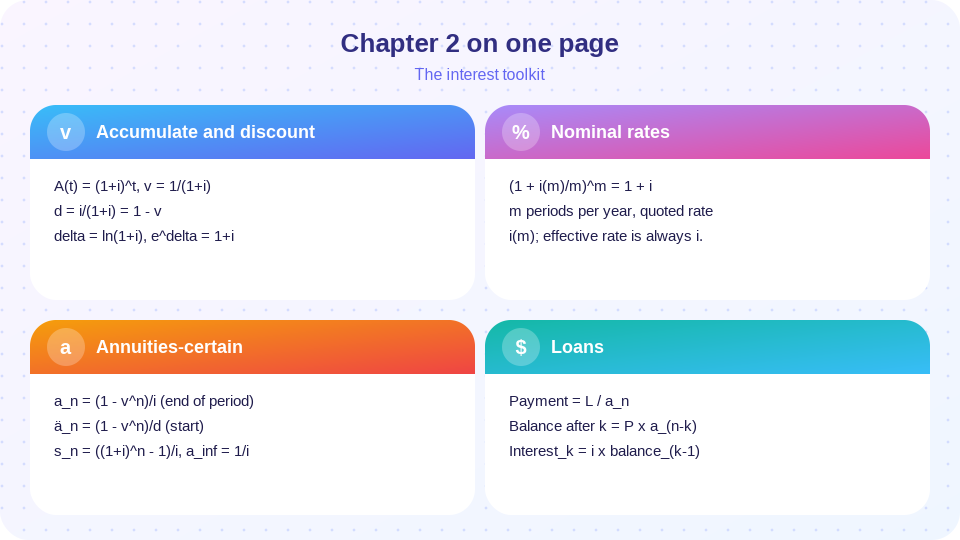
What you will learn
- The key formulas of the chapter and when to use each.
- How to check your own answers with an independent calculation.
- Which mistakes are most common and how to avoid them.
Key terms
v: discount factor, 1/(1+i). d: discount rate, i v. delta: force of interest, ln(1+i).
a_n, ä_n, s_n: present value (end payments), present value (start payments), accumulated value.
Equation of value: present value in equals present value out at a chosen date.
Balance B_k: loan outstanding after k payments, P a_(n-k).
The chapter in a table
| If you need... | Use | Notes |
|---|---|---|
value today of 1 at time t |
v^t = (1+i)^(-t) |
discounting |
| effective rate from nominal | 1 + i = (1 + i(m)/m)^m |
more compounding gives higher i |
| payments at the end of each year | a_n = (1 - v^n)/i |
"immediate" |
| payments at the start of each year | ä_n = (1 - v^n)/d = (1+i) a_n |
"due" |
| value at the end of the term | s_n = a_n (1+i)^n |
accumulation |
| payments for ever | 1/i (immediate), 1/d (due) |
perpetuity |
| a loan's level payment | P = L / a_n |
amortization |
balance after k payments |
P a_(n-k) |
prospective |
Lessons: compound interest and discount rates, annuities-certain and loans and amortization.
Try it
The first calculator evaluates the most-used quantities at once. Change the rate and watch the whole family move together, then check the inequality d < delta < i.
Press Run (or Ctrl + Enter) to see the result here.
Program input · what you'd type while the program runs
Type the answers before you press Run, one per line. Each time the program reads a line (with input()), it gets the next line from this box.
The second one checks a loan answer two independent ways. If the retrospective and prospective balances disagree, there is a mistake somewhere.
Press Run (or Ctrl + Enter) to see the result here.
Program input · what you'd type while the program runs
Type the answers before you press Run, one per line. Each time the program reads a line (with input()), it gets the next line from this box.
Common misconceptions
Mixing up immediate and due. Check the first payment: at time 1 it is immediate, at time 0 it is due.
Using the nominal rate as the effective rate. Always convert first: (1 + i(m)/m)^m - 1.
Forgetting to match the time unit. If payments are monthly, n and i must both be monthly.
Check your understanding
Quick check · 10 questions
of 10 answered You scored / 10 · perfect!
-
1. At i = 10%, v equals
v = 1/1.10 = 0.9091. (0.0909 is d.) -
2. The effective annual rate of 6% per year compounded monthly is
(1 + 0.06/12)^12 - 1 = 1.005^12 - 1 = 0.061678. -
3. At 4%, a_10 is about
a_10 = (1 - 1.04^-10)/0.04 = (1 - 0.675564)/0.04 = 8.111. -
4. At 4%, the annuity-due ä_10 is about
ä_10 = (1.04)(8.111) = 8.435. -
5. A perpetuity-immediate pays 500 a year at 5%. Its value is
500 / 0.05 = 10,000. -
6. At 10%, s_3 equals
s_3 = (1.1^3 - 1)/0.1 = 0.331/0.1 = 3.31. -
7. A loan of 1,000 is repaid in two equal year-end payments at 10%. Each payment is about
a_2 = 1/1.1 + 1/1.21 = 1.73554, so P = 1000/1.73554 = 576.19. -
8. In that loan, the balance just after the first payment is about
Balance = 1,000 x 1.1 - 576.19 = 523.81, which also equals P a_1 = 576.19/1.1. -
9. For i = 25%, d equals
d = i/(1+i) = 0.25/1.25 = 0.2. -
10. A force of interest delta = 1 (unrealistic, but a good test) corresponds to the effective annual rate
i = e^delta - 1 = e - 1 = 1.71828.
Summary
- Rates:
i,v,d,deltadescribe one rate;d < delta < i. - Annuities:
a_n,ä_n,s_nare geometric sums; perpetuities are1/iand1/d. - Loans:
P = L / a_n, balanceP a_(n-k), interesti x balance. - Always match time units and convert nominal rates first.
Next: Survival models overview
Theo dõi tiến độ của bạn
Tạo tài khoản miễn phí để đánh dấu bài đã học và tiếp tục từ chỗ bạn dừng lại trên mọi thiết bị.