
























Bài 16 · Analysis of Statically Determinate Structures
Chapter 3 review: statically determinate structures
Review truss analysis, shear and moment diagrams and beam deflection with a recap table, a one-page checklist, practice code and a ten-question quiz.
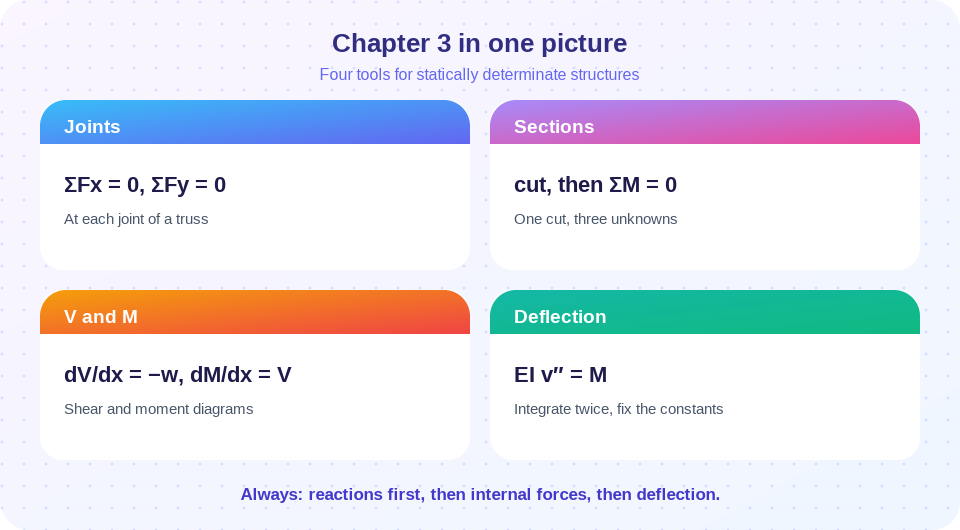
You can now take a determinate structure and answer all three analysis questions: what are the reactions, what are the internal forces and how far does it move? This review collects the formulas, links the methods together and finishes with a quiz.
What you will learn
- A single summary of every method in the chapter.
- How the Mmax of a beam depends on its supports and load pattern.
- What to practise before moving on to indeterminate structures.
Chapter in one table
| Lesson | Tool | Key results |
|---|---|---|
| Chapter overview | Count: m + r = 2j; r = 3 for a beam | Determinate, unstable or indeterminate |
| Trusses | Joints: ΣFx = ΣFy = 0. Sections: cut and take moments | Tension positive; negative means compression |
| Shear and moment diagrams | dV/dx = −w, dM/dx = V | Mmax where V = 0; wL²/8, PL/4, wL²/2, PL |
| Beam deflection | EI v″ = M; superposition | 5wL⁴/(384EI), PL³/(48EI), PL³/(3EI), wL⁴/(8EI) |
A one-page checklist
- Sketch the structure and idealize supports and loads.
- Count: is it determinate and stable?
- Reactions by equilibrium of the whole body; check with a second moment equation.
- Trusses: method of joints for everything, method of sections for one or two members.
- Beams: cut, write V and M on each segment, find zeros of V, draw both diagrams.
- Peak values size the member; deflection from tables or integration is checked against a limit.
- Verify: the sum of member or reaction forces closes, the diagrams close at the free ends, areas under V match changes of M.
Try it
Press Run (or Ctrl + Enter) to see the result here.
Program input · what you'd type while the program runs
Type the answers before you press Run, one per line. Each time the program reads a line (with input()), it gets the next line from this box.
Spreading the load and supporting the beam at both ends gives the smallest moment. A cantilever with a tip load needs eight times the moment capacity of a simple beam with a uniform load of the same total.
Press Run (or Ctrl + Enter) to see the result here.
Program input · what you'd type while the program runs
Type the answers before you press Run, one per line. Each time the program reads a line (with input()), it gets the next line from this box.
Notice that the 8 m beam fails the deflection check with the same load per metre as the 6 m beam that passed. That is the fourth-power effect of the span.
Common misconceptions
"The method of joints always starts at a support." It starts at any joint with two unknowns, which is often but not always a support.
"A zero in the moment diagram means no load there." M = 0 at a pin or roller end is just a boundary condition. Zero moment can also occur at a point of contraflexure in the middle of a loaded beam.
Check your understanding
Quick check · 10 questions
of 10 answered You scored / 10 · perfect!
-
1. A plane truss has 9 members, 6 joints and 3 reactions. Which is true?
m + r = 12 and 2j = 12, so the count matches. -
2. In the method of joints, a negative result for a member force assumed in tension means
You assumed tension; a negative result means the member is actually in compression. -
3. A simply supported 4 m beam carries 12 kN/m. Mmax is
wL²/8 = 12 × 16 / 8 = 24 kN·m. -
4. Where is the maximum moment on a beam?
Since dM/dx = V, extremes occur at V = 0. -
5. The shear diagram of a cantilever with a tip load P is
Without any other load, V is constant, equal to P, between the fixed end and the tip. -
6. A 5 kN/m load acts over a 6 m simple span. The end shear is
Total load 30 kN, shared equally, gives 15 kN at each support. -
7. The deflection of a uniformly loaded simple beam becomes how many times larger when the span grows by 50%?
1.5⁴ = 5.0625. -
8. A pin-jointed square with one diagonal and three reactions has m + r = 8 and 2j = 8. It is
The count matches and the diagonal makes the square rigid. -
9. For an 'applied couple' at a point on a beam, what happens to the diagrams?
A pure couple changes M abruptly by its value and does not change V. -
10. Which is the best way to reduce the deflection of a rectangular beam?
I grows with the cube of depth, so depth is the most effective change.
Summary
- Determinate analysis is reactions, then internal forces, then deflection, always in that order.
- Trusses: assume tension, solve joint by joint, cut sections for single members.
- Beams: V and M from cuts, linked by dV/dx = −w and dM/dx = V; Mmax at V = 0.
- Deflection follows from EI v″ = M or from tables, and is checked against a span fraction.
- Support type and load pattern change moments dramatically.
Theo dõi tiến độ của bạn
Tạo tài khoản miễn phí để đánh dấu bài đã học và tiếp tục từ chỗ bạn dừng lại trên mọi thiết bị.