
























Bài 16 · Doping and Conduction
Chapter 3 Review: Doping and Conduction
Review chapter 3: donors and acceptors, carrier densities from charge neutrality, the Fermi level, drift, diffusion and the Einstein relation, with a ten-question quiz.
You can now take a piece of silicon, specify its doping, and predict its carrier densities, Fermi level, conductivity and diffusion behavior. That toolbox is exactly what the PN junction needs: two such pieces placed side by side.
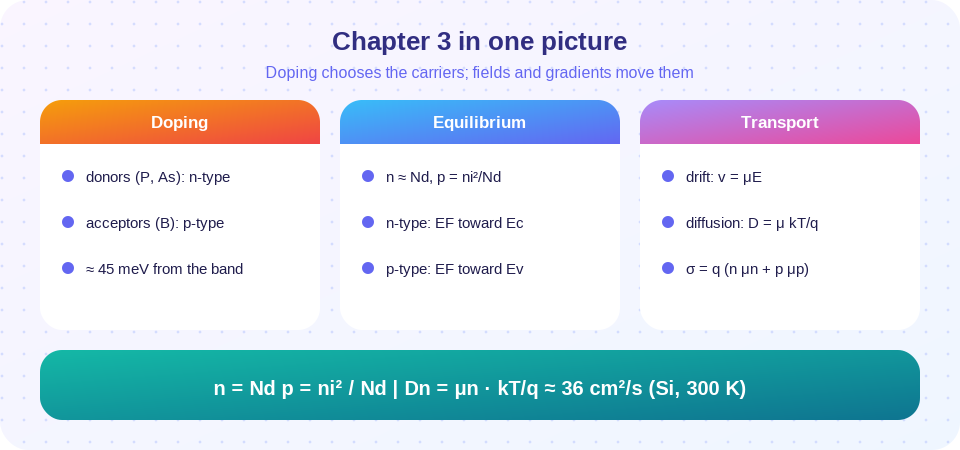
Recap table
| Lesson | Key idea | Formula |
|---|---|---|
| Donors and acceptors | Group V donates, group III accepts; levels about 45 meV from a band | E_ion = 13.6 eV (m*/m₀)/εr² |
| Carriers at equilibrium | Charge neutrality plus mass action | n ≈ Nd − Na, p = ni²/n, EF − Ei = kT ln(n/ni) |
| Drift and diffusion | Field-driven and gradient-driven currents | J = q(nμn + pμp)E + qDn dn/dx; D = μkT/q |
Try it
The first example practices the whole chapter in one calculation: from doping to resistivity, minority density and Fermi level.
Press Run (or Ctrl + Enter) to see the result here.
Program input · what you'd type while the program runs
Type the answers before you press Run, one per line. Each time the program reads a line (with input()), it gets the next line from this box.
Press Run (or Ctrl + Enter) to see the console output here.
No output.
Check your understanding
Quick check · 10 questions
of 10 answered You scored / 10 · perfect!
-
1. Which atom is a donor in silicon?
Phosphorus has five valence electrons and donates one. -
2. In n-type silicon with n = 10¹⁷ cm⁻³ and ni = 10¹⁰ cm⁻³, the hole density is
p = ni²/n = 10²⁰/10¹⁷ = 10³ cm⁻³. -
3. Charge neutrality for a uniform crystal reads
The total of positive charges (holes and ionized donors) equals negative charges (electrons and ionized acceptors). -
4. As n-type doping rises from 10¹⁶ to 10¹⁷ cm⁻³, EF moves
A factor of ten in n shifts EF − Ei by kT ln 10 = 59.5 mV toward Ec. -
5. Which describes diffusion?
Random motion produces a net flux down a concentration gradient. -
6. The Einstein relation says
At 300 K, D (cm²/s) ≈ μ (cm²/V·s) × 0.0259. -
7. As doping rises, mobility in silicon generally
Ionized impurity scattering grows with doping. -
8. In the extrinsic regime of n-type silicon at room temperature, n is approximately
All donors are ionized and thermal generation is negligible. -
9. Why does p-type silicon of the same doping have a higher resistivity than n-type?
ρ = 1/(q p μp); μp is about a third of μn. -
10. With Dn = 36 cm²/s and τ = 1 µs, the diffusion length is about
L = √(Dτ) = 6 × 10⁻³ cm = 60 µm.
Summary
- Doping chooses the majority carrier; n·p = ni² fixes the minority carrier.
- EF follows the majority carrier's band, one decade of doping per 59.5 mV.
- Drift current ∝ field, diffusion current ∝ gradient, linked by D = μkT/q.
- These are the ingredients of the PN junction in chapter 4.
Theo dõi tiến độ của bạn
Tạo tài khoản miễn phí để đánh dấu bài đã học và tiếp tục từ chỗ bạn dừng lại trên mọi thiết bị.