
























Bài 12 · Doping and Conduction
Chapter 3 Overview: Doping and Conduction
Preview chapter 3: how a few impurity atoms create n-type and p-type silicon, where the Fermi level goes, and how drift and diffusion move the carriers.
Pure silicon is a poor conductor with about 10¹⁰ carriers per cm³. Add one phosphorus atom for every five million silicon atoms and the crystal has 10¹⁶ free electrons per cm³: a million times more. Add boron instead and you get free holes. This control, by a trace of the right impurity, is what turns a crystal into an engineering material.
This chapter shows how doping works, how to calculate the carrier densities and the Fermi level that result, and how those carriers move under a field or a concentration gradient.
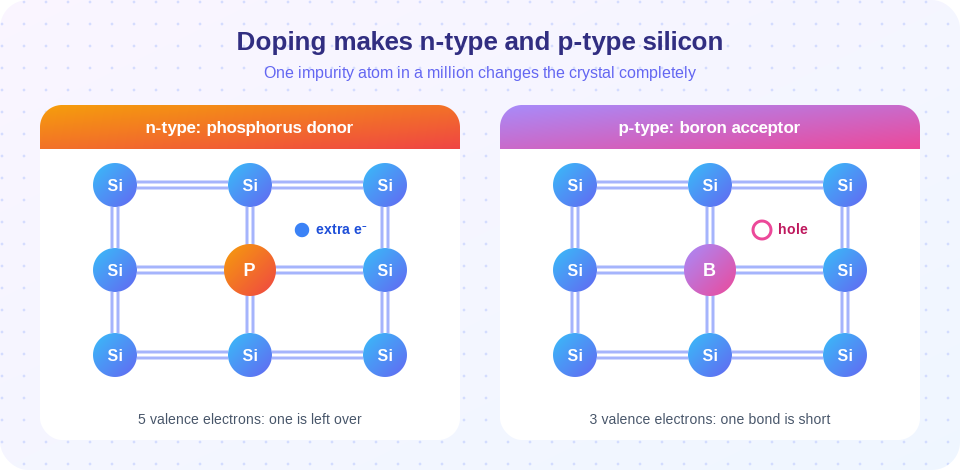
What you will learn
- What each lesson in the chapter covers and why the order matters.
- How a donor or an acceptor changes which carrier dominates.
- The two transport mechanisms, drift and diffusion, in one sentence each.
- The numbers that you should be able to recall: dopant range, ionization energy and the thermal-equilibrium formulas.
The big picture
Add a dopant
Carriers follow
The Fermi level moves
Carriers move
What each lesson covers
- Donors and acceptors: which atoms dope silicon, why their energy levels sit so close to a band edge, and what compensation means.
- Carriers at equilibrium: how to compute n, p and the Fermi level for a given doping, and the three temperature regimes.
- Drift and diffusion: mobility, resistivity versus doping, the diffusion current and the Einstein relation.
- Chapter review: a ten-question test and a formula sheet.
The chapter feeds directly into chapter 4: a PN junction is simply a p-type region touching an n-type region, and the current in it is a balance of drift and diffusion.
Try it
The first demo shows how small the doping is as a fraction of the crystal: slide the doping and see "one dopant per N silicon atoms".
Press Run (or Ctrl + Enter) to see the console output here.
No output.
Common misconceptions
"Doping makes silicon charged." An n-type crystal is electrically neutral: each free electron is balanced by a positively charged donor ion fixed in the lattice.
"Heavy doping means a different material." Even at 10¹⁹ cm⁻³ the crystal is still more than 99.9 percent silicon.
Check your understanding
Quick check · 4 questions
of 4 answered You scored / 4 · perfect!
-
1. Which lesson explains how to find n and p from the doping?
The equilibrium lesson combines doping, charge neutrality and n·p = ni². -
2. A phosphorus atom in silicon makes the crystal
Phosphorus has five valence electrons, so it donates one extra electron. -
3. Which two mechanisms move carriers?
A field causes drift and a concentration gradient causes diffusion. -
4. A donor-doped crystal with Nd = 10¹⁶ cm⁻³ is
Free electrons and ionized donors balance, so the crystal is neutral.
Summary
- Donors (group V) make n-type silicon; acceptors (group III) make p-type silicon.
- At equilibrium n·p = ni² still holds, with n or p set by the doping.
- The Fermi level moves toward the majority carrier's band.
- Drift (field) and diffusion (gradient) are the two current mechanisms.
Next: Donors and Acceptors: The Impurities That Dope Silicon
Theo dõi tiến độ của bạn
Tạo tài khoản miễn phí để đánh dấu bài đã học và tiếp tục từ chỗ bạn dừng lại trên mọi thiết bị.