
























Bài 10 · From Schematic to Board
Chapter 2 Review: From Schematic to Board
Review schematic capture, netlists, ERC, BOM and board setup with a recap table, a one-picture summary and a ten-question quiz for chapter 2.
This chapter followed one idea: the schematic says what connects, the board says where. You learned to capture a circuit, to read what it produces and to set up a board so that the factory can build it. The picture below shows the five steps in order.
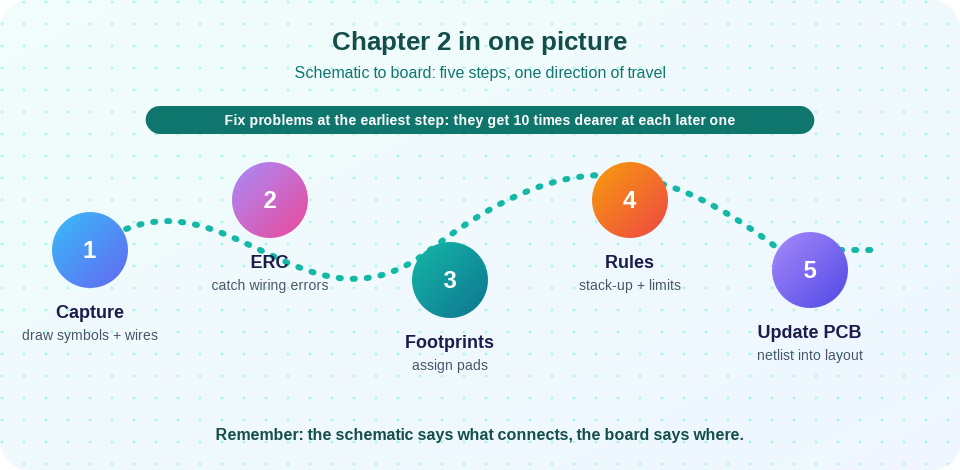
Recap table
| Topic | Key points |
|---|---|
| Schematic capture | Symbols, unique reference designators (R, C, D, U, J), values, junction dots, labels, power symbols |
| LED resistor | R = (Vsupply − Vf) / I, round to E12, check power |
| Netlist | Nets as groups of pins; the input to layout |
| ERC | Catches rule violations; cannot catch wrong values or pinouts |
| BOM | One line per part type, with quantity, footprint and MPN |
| Board setup | Outline, mounting holes, layers, stack-up from the fab |
| Design rules | 0.2 mm trace and clearance, 0.3/0.6 mm via, ring ≥ 0.15 mm |
| DRC | Checks geometry against your rules |
Lessons in this chapter
Check your understanding
Quick check · 10 questions
of 10 answered You scored / 10 · perfect!
-
1. Which letter prefix is used for a capacitor?
C is the standard reference designator prefix for capacitors. -
2. Two schematic wires cross without a junction dot. What does that mean?
Only a junction dot makes a connection. -
3. A 9 V supply, a green LED with Vf = 2.2 V at 10 mA. Which resistor is closest to the calculated value from the E12 series?
(9 − 2.2) / 0.010 = 680 Ω, which is an E12 value. -
4. What is a netlist?
It describes connectivity. -
5. Which error will ERC NOT find?
Value correctness is a design question that needs human review. -
6. In the BOM, three identical 10k 0603 resistors appear as
Identical parts are grouped. -
7. Where should you change a component value?
The schematic is the single source of truth. -
8. A via with a 0.5 mm pad and 0.3 mm drill has what annular ring?
(0.5 − 0.3) / 2 = 0.1 mm, below a typical 0.15 mm minimum. -
9. Why set design rules before routing?
Late rules mean rerouting and mistakes. -
10. A clean DRC means
DRC is only a geometry check.
Summary
- Schematic, netlist and board describe one circuit in three forms.
- ERC and DRC are useful but limited; careful review fills the gaps.
- Set the outline, stack-up and rules from your fab before the first trace.
Theo dõi tiến độ của bạn
Tạo tài khoản miễn phí để đánh dấu bài đã học và tiếp tục từ chỗ bạn dừng lại trên mọi thiết bị.