
























Bài 41 · Projects and Practice
Practice problems: impedance, power, copper and assembly
Ten PCB design practice problems with worked solutions: impedance, reflections, termination, decoupling, copper width, vias, stencils and a buck inductor, with a runnable answer checker.
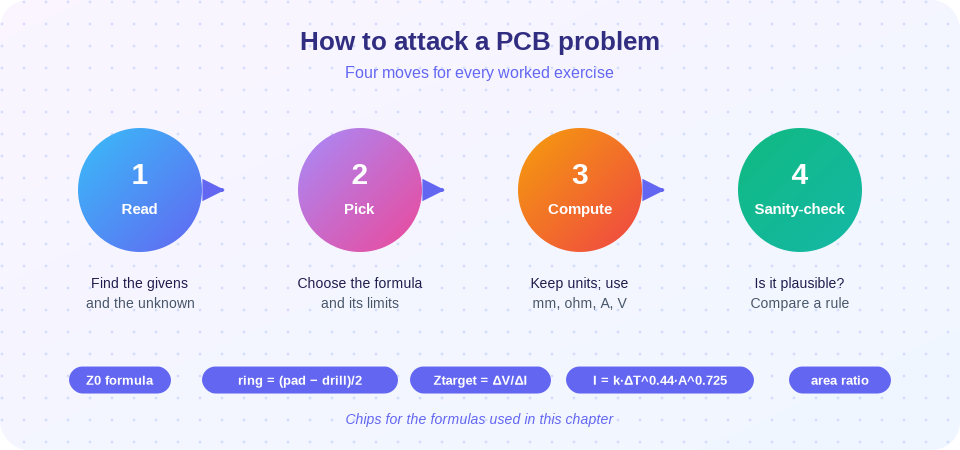
Reading about formulas is not the same as using them. This set gives you ten short problems that cover Chapters 5 to 8. Try each on paper first, then run the answer checker to compare. Every problem has a fixed method: read the givens, choose the formula, compute with units, then sanity-check the answer against a rule of thumb.
What you will learn
- Apply the course's formulas to concrete numbers.
- Check results with orders of magnitude and rules of thumb.
- Recognize which formula a problem calls for.
Key terms
Given: a number stated in the problem.
Unknown: what you are asked for.
Sanity check: a quick plausibility test (is 49 Ω reasonable for a 50 Ω design?).
Order of magnitude: the power of ten of an answer.
The problems
Use FR-4 with εr = 4.3, copper t = 0.035 mm unless stated.
- Impedance. A microstrip has
w = 0.30 mm,h = 0.15 mm. ComputeZ0withZ0 ≈ 87/√(εr+1.41)·ln(5.98h/(0.8w+t)). - Reflection. A 50 Ω line ends in a 75 Ω load. What is
Γ, and what fraction of the incident voltage amplitude returns? - Termination. A driver has 15 Ω output resistance and drives a 50 Ω line. What series resistor matches it?
- Critical length. A 2 ns edge on a surface trace (6 ns/m). What length makes the one-sixth rule apply?
- Decoupling. A 10 nF capacitor has
ESL = 0.5 nH. What is its self-resonant frequency? A 1.8 V rail allows 3 % deviation for a 1 A step: what isZtarget? - Copper. What minimum width carries 2 A on an inner 1 oz layer with a 10 °C rise (IPC-2221,
k = 0.024)? - Via. A 0.25 mm drill with 0.55 mm pad on a 1.6 mm board: annular ring and aspect ratio?
- Stencil. A 0.3 × 0.8 mm aperture in 0.10 mm foil: area ratio?
- Buck. 24 V to 5 V, 1 A, 400 kHz, ripple 30 % of Iout: duty cycle and inductor value?
- Loop ringing. 4 nH of loop inductance with 150 pF: ring frequency?
Worked solutions
0.8w + t = 0.24 + 0.035 = 0.275;5.98h = 0.897; ratio 3.262;ln = 1.182;87/√5.71 = 36.4;Z0 ≈ 43 Ω. Plausible: a narrow trace on a thin dielectric is below 50 Ω. (Check with the checker.)Γ = (75 − 50)/(75 + 50) = 0.2: 20 % of the amplitude is reflected.Rs = 50 − 15 = 35 Ω.- Flight time limit =
2 ns / 6 = 0.33 ns; length =0.33 / 6 ns/m = 0.056 m ≈ 5.6 cm. f0 = 1/(2π√(0.5e-9 · 10e-9)) ≈ 71 MHz.Ztarget = 1.8·0.03/1 = 0.054 Ω.- Area
A = (I/(k·ΔT^0.44))^(1/0.725)in mil², then width =A / 1.378 mil→ about 80 mil ≈ 2.0 mm. Inner layers need much more copper than outer ones for the same current. - Ring
(0.55 − 0.25)/2 = 0.15 mm; aspect1.6/0.25 = 6.4. 0.24 / (2·1.1·0.10) = 1.09: prints well.D = 5/24 = 0.208;ΔIL = 0.3 A;L = (24 − 5)·0.208 / (0.3 · 400 000) ≈ 33 µH.f = 1/(2π√(4e-9·150e-12)) ≈ 205 MHz.
Common misconceptions
"If the formula gives a number, it must be right." Check the validity range: the microstrip formula assumes 0.1 < w/h < 2.
"Units do not matter if I am consistent." They do: the IPC-2221 formula uses mil² and amperes; mixing mm gives nonsense.
"My answer matched the book, so I understand it." Change a given and predict the direction of the change before computing.
Try it
Press Run (or Ctrl + Enter) to see the result here.
Program input · what you'd type while the program runs
Type the answers before you press Run, one per line. Each time the program reads a line (with input()), it gets the next line from this box.
Check your understanding
Quick check · 4 questions
of 4 answered You scored / 4 · perfect!
-
1. A 50 ohm line ends in 150 ohm. What is Γ?
(150 − 50)/(150 + 50) = 0.5. -
2. A driver with 12 ohm output resistance, 50 ohm line. Series resistor?
50 − 12 = 38 ohm. -
3. Why is the inner-layer width larger for the same current?
IPC-2221 uses k = 0.024 for inner layers (0.048 outer). -
4. Ring frequency of 4 nH and 150 pF is closest to:
1/(2π√(4e-9·150e-12)) ≈ 205 MHz.
Summary
- Read, pick, compute, sanity-check.
- Formulas have validity ranges and units; check both.
- Use the answer checker, then change a given and predict the result.
Next: Mini projects
Theo dõi tiến độ của bạn
Tạo tài khoản miễn phí để đánh dấu bài đã học và tiếp tục từ chỗ bạn dừng lại trên mọi thiết bị.