
























Bài 10 · Design Process and Loads
Chapter 2 Review: Design Process and Loads
Review chapter 2 of Machine Design: the design loop, load types and cycles, gear and impact forces, stress concentration Kt and Kf, safety factors and reliability, with a ten-question quiz.
This chapter replaced the tidy single load of a textbook problem with the messier reality of a machine: a process that loops, loads that cycle and shock, geometry that concentrates stress, and uncertainty that has to be covered by a margin. Use this page to pull it together, run one combined calculation, and test yourself.
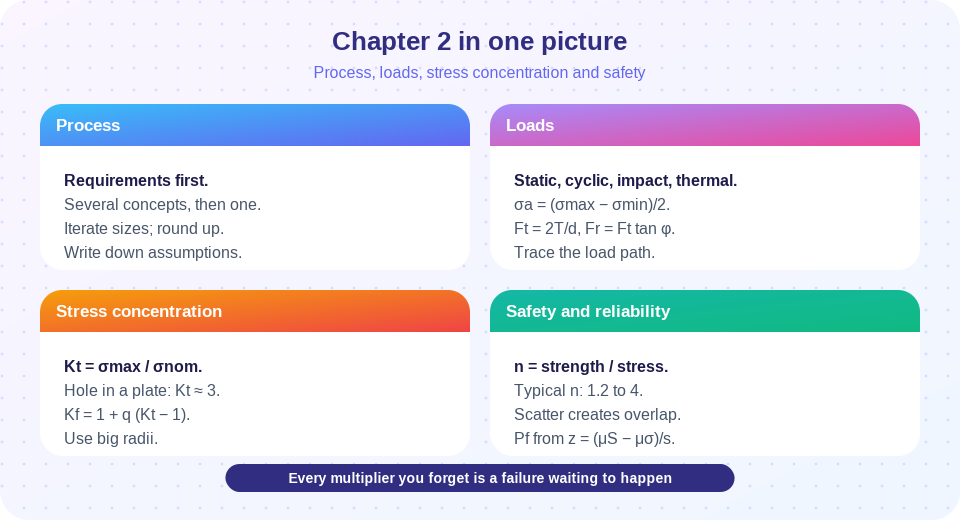
What you should now be able to do
- Turn a need into measurable requirements and iterate on a size, rounding up to a standard size.
- Classify loads, and compute
σa,σmandR, gear forces and impact factors. - Find
Ktfor a plate with a hole, and decide whether to applyKtorKf. - Choose a design factor, and estimate a failure probability from stress and strength scatter.
Recap table
| Lesson | Key ideas | Formulas |
|---|---|---|
| Design process | Requirements, concepts, iteration, documentation | d = (16 T n / (π Ssy))^(1/3), round up |
| Loads and load paths | Static, cyclic, impact, thermal; trace forces | σm = (σmax+σmin)/2, Ft = 2T/d, impact factor 1 + √(1 + 2h/δst) |
| Stress concentration | Peaks at holes, shoulders, notches | Kt = σmax/σnom, Kf = 1 + q (Kt − 1) |
| Safety factors and reliability | n = S/σ, interference, series reliability |
z = (μS − μσ)/√(sS² + sσ²) |
How the chapter fits together
Think of a real project, such as a hand winch for a well. The design process starts with the requirements: lift 500 N with a worst case of 1,500 N if the bucket jams, for 10,000 lifts, for under $120. The loads lesson then asks which loads the drum shaft will see: the rope force is static in direction but the shaft turns, so the bending stress at each point reverses once per turn. A jam is an impact load, which can double the force. Next, stress concentration warns you that the groove for the retaining ring at the shaft end is a notch with a Kt of about 3 to 5, so it must not sit at the section with the highest moment. Last, safety factors and reliability tell you how much margin the winch needs. Because a failure could drop a person's bucket or injure a user, you choose a larger design factor than for a toy, and you cannot rely on the material being as strong as the average value in the handbook.
The same chain applies to any machine. When you meet a new problem, ask the four questions in order: what are the requirements, what are the loads, where does the geometry raise the stress, and how much margin do I need?
Self-check list
You are ready for chapter 3 if you can do each of these without looking at the lessons:
- Write three measurable requirements for a machine you know.
- Compute the mean stress, amplitude and ratio for a stress cycle, and say whether it is reversed, repeated or fluctuating.
- State the stress concentration factor of a small circular hole in a wide plate, and say when to apply it.
- Explain why a factor of safety of 2 does not guarantee that a part will not fail.
Putting it together
A steel plate (width 50 mm, thickness 6 mm, yield strength 300 MPa) has a 10 mm hole and carries a static tension of 18 kN. It is lifted by a crane that may jerk the load suddenly. Compute the stress with the net area, apply a factor of 2 for the sudden load, and find the factor of safety against yielding. (Ductile material, static: Kt is ignored, but the net section and the dynamic factor are not.) Then see what happens if the material were a brittle casting with Su = 200 MPa, where Kt has to be applied.
Press Run (or Ctrl + Enter) to see the result here.
Program input · what you'd type while the program runs
Type the answers before you press Run, one per line. Each time the program reads a line (with input()), it gets the next line from this box.
The same geometry is comfortable in a ductile steel and unsafe in a brittle one. The difference is entirely in how the material handles the local peak.
Press Run (or Ctrl + Enter) to see the console output here.
No output.
Common misconceptions
- "Iteration means I made a mistake." Sizing is circular; iteration is the method.
- "If the static factor of safety is above 1, the part is safe." Impact, fatigue, stress concentration and scatter can erase a margin that looks comfortable.
- "Kt applies everywhere." For ductile static loads you ignore it; for brittle materials you use it; for fatigue you use
Kf.
Check your understanding
Quick check · 9 questions
of 9 answered You scored / 9 · perfect!
-
1. A shaft must carry 120 N·m. The shear yield strength is 200 MPa and the required factor is 2. What is the minimum diameter, from τ = 16T/(πd³)?
Allowed τ = 200/2 = 100 MPa. d³ = 16 × 120,000 / (π × 100) = 6,112 mm³, so d = 18.3 mm. In practice you would round up to a standard size such as 20 mm. -
2. σmax = 150 MPa and σmin = −50 MPa. What is R?
R = σmin / σmax = −50 / 150 = −0.33. -
3. What is the impact factor when a load is applied suddenly, without dropping?
With h = 0 the factor is 1 + √1 = 2. -
4. A plate 100 mm wide with a 10 mm hole (d/w = 0.1) has Kt of about
Kt = 3.00 − 0.314 + 0.037 − 0.002 = 2.72. -
5. Which is the best way to reduce stress concentration at a shaft shoulder?
A generous radius lets the force flow bend smoothly. -
6. A part has n = 1.8 on average. Reducing the scatter of strength and load will most directly
Narrower distributions overlap less. -
7. Four independent parts in series each have R = 0.97. What is the system reliability?
0.97⁴ = 0.885. -
8. Which load type is most dangerous for a rotating shaft over millions of turns?
Reversing stress cycles cause fatigue cracks. -
9. A fully restrained steel bar is heated by 80 K (E = 200 GPa, α = 12×10⁻⁶ per K). The thermal stress is about
σ = E α ΔT = 200,000 × 12×10⁻⁶ × 80 = 192 MPa.
Summary
- The process loops: requirements, concepts, sizing, evaluation, detail.
- Loads are static, cyclic, impact or thermal; stress cycles are described by
σa,σmandR. Ktconcentrates stress; use it for brittle parts,Kffor fatigue, and the net section always.- Safety factors cover uncertainty; reliability shows what scatter does.
Theo dõi tiến độ của bạn
Tạo tài khoản miễn phí để đánh dấu bài đã học và tiếp tục từ chỗ bạn dừng lại trên mọi thiết bị.