
























Bài 37 · Vibrations
Chapter 7 review: vibrations
A one-picture summary and ten mixed questions on free, damped and forced vibration of one-degree-of-freedom systems, with a quick design calculator.
One equation, m ẍ + c ẋ + k x = F(t), gave you three kinds of behavior: a steady ring at ωn, a decay controlled by ζ, and a driven response controlled by the frequency ratio r. Before starting the applications chapter, check that you can move between them.
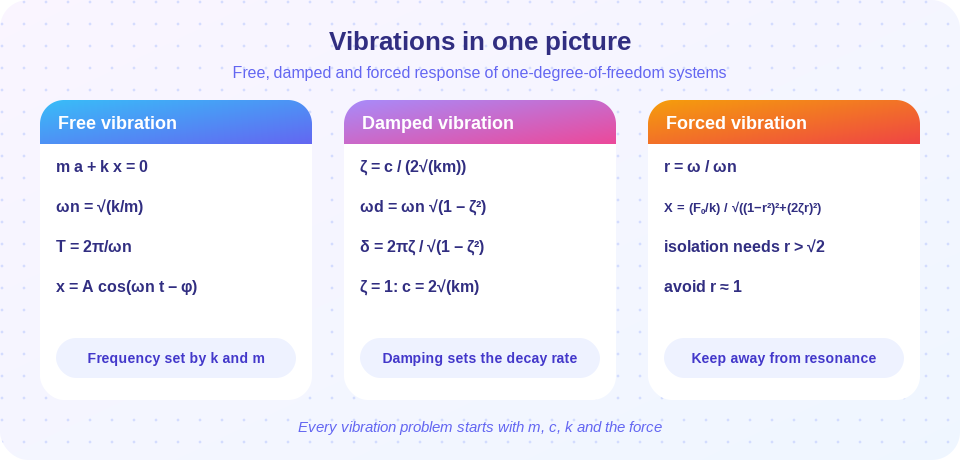
Recap table
| Concept | Formula | Remember |
|---|---|---|
| Natural frequency | ωn = √(k/m), T = 2π/ωn |
Independent of amplitude |
| Static deflection | δ_st = mg/k, ωn = √(g/δ_st) |
Gravity only shifts equilibrium |
| Damping ratio | ζ = c/(2√(km)) |
ζ < 1 oscillates |
| Damped frequency | ωd = ωn√(1 − ζ²) |
Slightly below ωn |
| Log decrement | δ = ln(x₁/x₂) = 2πζ/√(1 − ζ²) |
Measure ζ from a record |
| Forced amplitude | X = (F₀/k)/√((1−r²)²+(2ζr)²) |
Peak near r = 1 |
| Resonance | X = δ_st/(2ζ) at r = 1 |
Damping limits it |
A good routine
- Identify
m,c,k(orI,c_t,k_t) and the force. - Compute
ωn, thenζ. - If the question is about the free response, use
ωdand the envelope; if it is about a driving frequency, computer. - Check limits:
r → 0gives the static deflection,r → ∞gives a small, out-of-phase response.
Common mistakes
Mixing rad/s and Hz. Use ω in rad/s inside formulas; f = ω/2π.
Forgetting to compare c with c_cr. ζ, not c, tells you the damping level.
Using the free-vibration formula for a driven system. The steady response is at the driving frequency.
Using ζ in the formula as c/(2m ωn) with a wrong mass. Use the total moving mass.
Try it
A short design helper: given a machine mass, running speed and a target frequency ratio, it computes the mount stiffness and static deflection, and checks the response to a harmonic force.
Press Run (or Ctrl + Enter) to see the result here.
Program input · what you'd type while the program runs
Type the answers before you press Run, one per line. Each time the program reads a line (with input()), it gets the next line from this box.
The second tool is a general solver. It takes m, c, k, initial conditions and a force, integrates the response, and prints the main quantities.
Press Run (or Ctrl + Enter) to see the result here.
Program input · what you'd type while the program runs
Type the answers before you press Run, one per line. Each time the program reads a line (with input()), it gets the next line from this box.
Check your understanding
Quick check · 10 questions
of 10 answered You scored / 10 · perfect!
-
1. A 5 kg mass on a spring of 500 N/m has ωn of:
ωn = √(500/5) = 10 rad/s. -
2. A spring sags 25 mm under a mass. The natural frequency is about:
fn = 0.498/√0.025 = 3.15 Hz. -
3. ζ = 0.25 and ωn = 40 rad/s. What is ωd?
ωd = 40√(1 − 0.0625) = 38.7 rad/s. -
4. The magnification at resonance for ζ = 0.02 is about:
M = 1/(2ζ) = 1/0.04 = 25. -
5. Successive peaks of 6 mm and 3 mm give δ =
δ = ln 2 = 0.693. -
6. For r = 2 and light damping, the response is approximately:
M ≈ 1/(r² − 1) = 1/3 with phase near 180°. -
7. Which change lowers ωn?
ωn = √(k/m). -
8. A critically damped system has ζ =
By definition c = c_cr = 2√(km). -
9. A rotor unbalance force is 50 N at 100 rad/s. At 200 rad/s it is:
The force scales with ω², so doubling speed quadruples it: 200 N. -
10. Which statement about the steady forced response is true?
After the transient dies out, the system follows the force.
Summary
ωn,ζandrare the three numbers that describe a 1-DOF vibration.- Free:
x = x₀ cos ωn t + …; damped: envelopee^(−ζωn t); forced:Xfrom the magnification curve. - Avoid resonance by moving
rfar from 1; damp where you cannot. - Chapter 8 puts this to work in simulations and real mechanisms.
Theo dõi tiến độ của bạn
Tạo tài khoản miễn phí để đánh dấu bài đã học và tiếp tục từ chỗ bạn dừng lại trên mọi thiết bị.