
























Bài 9 · Kinematics of Particles
Normal-Tangential and Polar Components
Describe curved motion with moving axes: tangential and normal acceleration (v²/ρ), polar velocity and acceleration components, with worked numbers and code.
Cartesian axes are fixed. That is perfect for a projectile, but awkward for a car on a bend or a bead on a spinning rod. For those, engineers use axes that travel with the particle. Two systems do most of the work: normal-tangential (n-t) axes for motion along a known path, and polar axes for motion described by a distance and an angle from a fixed point.
What you will learn
- How to resolve acceleration into tangential and normal parts, and why
a_n = v²/ρ. - How to find the radius of curvature for a simple path.
- The polar velocity and acceleration components, including the Coriolis-type term.
- How to choose between Cartesian, n-t and polar axes.
Key terms
Tangential unit vector e_t: points along the velocity, tangent to the path.
Normal unit vector e_n: perpendicular to e_t, pointing toward the center of curvature.
Radius of curvature ρ: the radius of the circle that best fits the path at that point.
Radial and transverse components: along the line from the origin to the particle (e_r) and perpendicular to it (e_θ).
Angular velocity ω = dθ/dt, angular acceleration α = dω/dt.
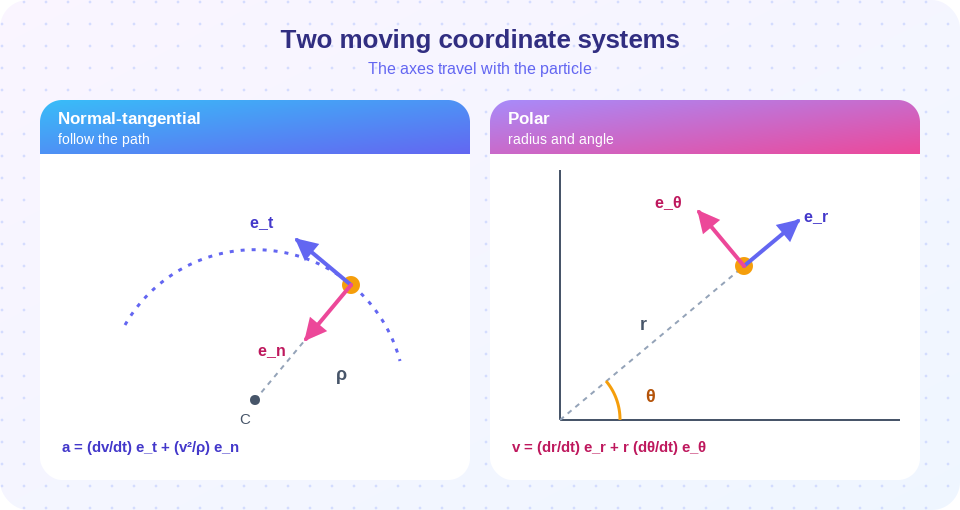
Normal and tangential components
The velocity always points along the path: v = v e_t. Differentiating, the acceleration has two parts:
a = (dv/dt) e_t + (v²/ρ) e_n
- The tangential part
a_t = dv/dtchanges the speed. - The normal part
a_n = v²/ρchanges the direction. It always points to the concave side of the path, toward the center of curvature.
On a circle of radius r, ρ = r. On a straight road, ρ = ∞, so a_n = 0. For a path given as y(x), ρ = (1 + y′²)^(3/2) / |y″|; for example y = x² at x = 0 has y′ = 0 and y″ = 2, so ρ = 0.5.
Worked example. A car is on a curve of radius 80 m. At the instant of interest it travels at 20 m/s and is speeding up at 3 m/s².
a_t = 3 m/s²a_n = v²/ρ = 400 / 80 = 5 m/s²|a| = √(3² + 5²) = 5.83 m/s², atatan(5/3) = 59.0°from the tangent, tilted toward the center.
Since ΣF = m a, a 1,200 kg car needs a sideways (inward) force of 1200 × 5 = 6,000 N from the tires. That sets the limit of cornering, which we explore in Chapter 3.
Polar components
When a particle is described by r(t) and θ(t):
v_r = dr/dt,v_θ = r ωa_r = d²r/dt² − r ω²a_θ = r α + 2 (dr/dt) ω
The term −r ω² is the familiar inward (centripetal) acceleration. The term 2 (dr/dt) ω appears whenever something moves radially while the line rotates; it is the same effect that makes a skater spin faster when pulling the arms in.
Worked example. A collar slides outward along an arm that rotates at constant ω = 2 rad/s. At r = 0.6 m the collar moves outward at 0.3 m/s with a steady radial speed.
v_r = 0.3 m/s,v_θ = 0.6 × 2 = 1.2 m/s, speed= √(0.09 + 1.44) = 1.24 m/s.a_r = 0 − 0.6 × 4 = −2.4 m/s²(inward).a_θ = 0 + 2 × 0.3 × 2 = 1.2 m/s².
Choosing coordinates
| Situation | Best system |
|---|---|
| Projectile, ramp, anything under constant force | Cartesian |
| Car on a road, train on a track, bead on a wire | Normal-tangential |
| Rotating arm, orbit, radar tracking | Polar |
Common misconceptions
"Normal acceleration only exists when the speed changes." It exists whenever the path bends, even at constant speed.
"Centripetal force is a new kind of force." It is just the name for the net inward force that produces v²/ρ. It is never drawn on the free-body diagram as an extra arrow.
"In polar coordinates a_r is just d²r/dt²." The −r ω² term is just as important, and it is what remains if r is constant.
Try it
The first script makes a car follow a circle of radius 50 m while the speed ramps up at 1.5 m/s². It plots the tangential and normal parts and shows how a_n grows with v².
Press Run (or Ctrl + Enter) to see the result here.
Program input · what you'd type while the program runs
Type the answers before you press Run, one per line. Each time the program reads a line (with input()), it gets the next line from this box.
The second script checks the polar formulas against numerical differentiation of Cartesian coordinates. A good formula should agree with brute force.
Press Run (or Ctrl + Enter) to see the result here.
Program input · what you'd type while the program runs
Type the answers before you press Run, one per line. Each time the program reads a line (with input()), it gets the next line from this box.
Check your understanding
Quick check · 5 questions
of 5 answered You scored / 5 · perfect!
-
1. A car travels at a constant 15 m/s around a bend of radius 45 m. Its acceleration is
a_n = v²/ρ = 225/45 = 5 m/s² toward the center; a_t = 0 at constant speed. -
2. Which component of acceleration changes the speed?
a_t = dv/dt changes the speed; a_n only turns the velocity vector. -
3. A particle moves on a straight line. Its normal acceleration is
a_n = v²/ρ → 0 as ρ → ∞. -
4. In polar coordinates with r constant and ω = 3 rad/s at r = 2 m, the radial acceleration is
a_r = −r ω² = −2 × 9 = −18 m/s², directed inward. -
5. The term 2 (dr/dt) ω in a_θ arises because
Radial speed combined with rotation changes the direction of the transverse velocity and the radial direction.
Summary
- n-t axes follow the path:
a = (dv/dt) e_t + (v²/ρ) e_n. ρis the radius of curvature; on a circle it is the radius.- Polar:
v_r = ṙ,v_θ = r ω,a_r = r̈ − r ω²,a_θ = r α + 2 ṙ ω. - Choose the system that makes the unknown acceleration components easy to write.
Next: Relative Motion
Theo dõi tiến độ của bạn
Tạo tài khoản miễn phí để đánh dấu bài đã học và tiếp tục từ chỗ bạn dừng lại trên mọi thiết bị.