
























Bài 35 · Vibrations
Damped vibration
Learn underdamped, critically damped and overdamped responses, compute the damping ratio and damped frequency, and measure damping from a decay record.
Real vibrations die out. A struck bell rings for seconds, a car bounces once or twice after a bump, a door-closer lets the door settle without slamming. The mechanism that removes the energy is damping: friction, air drag, the fluid in a shock absorber, internal losses in a material.
How fast the motion dies, and whether it overshoots, depends on a single dimensionless number, the damping ratio ζ. Learning to read and design it is the central skill of this lesson.
What you will learn
- Compute
ωn,ζandωdfromm,candk. - Recognize and write the three response types.
- Use the logarithmic decrement to measure damping.
- Estimate energy loss per cycle.
Key terms
Damping ratio ζ = c / (2√(k m)): damping relative to the critical value.
Critical damping c_cr = 2√(k m): the smallest damping at which the system does not oscillate.
Damped frequency ωd = ωn √(1 − ζ²): the frequency of the decaying oscillation.
Logarithmic decrement δ = ln(x₁/x₂): natural log of the ratio of successive peaks.
The equation
Divide m ẍ + c ẋ + k x = 0 by m:
ẍ + 2 ζ ωn ẋ + ωn² x = 0 with ωn = √(k/m), ζ = c / (2 √(k m))
Try x = e^(s t): the characteristic equation s² + 2ζωn s + ωn² = 0 has the roots s = −ζ ωn ± ωn √(ζ² − 1). Their nature sets the response.
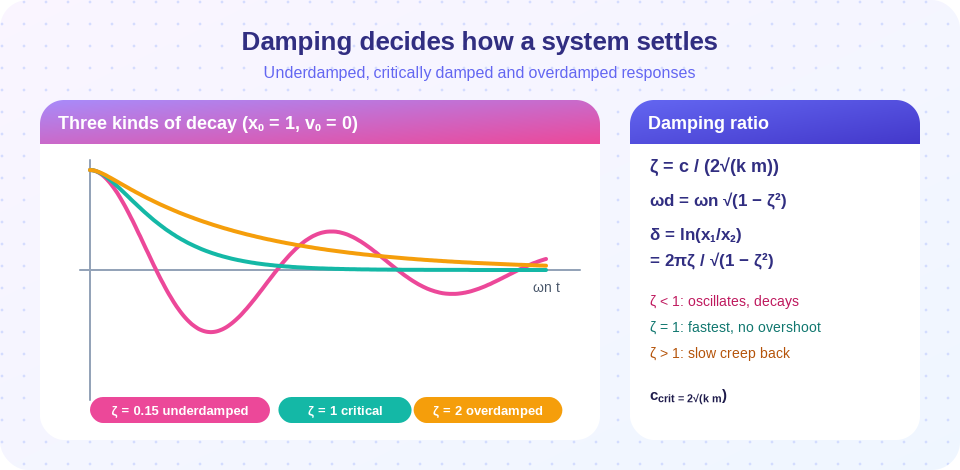
Underdamped, ζ < 1. The roots are complex, the motion oscillates inside a decaying exponential envelope:
x(t) = e^(−ζ ωn t) [ x₀ cos ωd t + ((v₀ + ζ ωn x₀)/ωd) sin ωd t ]
The envelope is e^(−ζ ωn t); the oscillation frequency ωd is slightly below ωn. For ζ = 0.1 the reduction is only 0.5 %, so ωd ≈ ωn.
Critically damped, ζ = 1. A double root s = −ωn: x = (x₀ + (v₀ + ωn x₀) t) e^(−ωn t). It returns to equilibrium in the shortest time without crossing it (for a pull-and-release start). Door closers and gauge needles are designed near this value.
Overdamped, ζ > 1. Two real negative roots; the motion is a sum of two decaying exponentials and creeps back slowly. More damping makes the return slower, because the slow root approaches zero.
Worked example
A system has m = 2 kg, k = 800 N/m, c = 16 N·s/m. Then ωn = 20 rad/s, c_cr = 2√(800 × 2) = 80 N·s/m, so ζ = 16/80 = 0.2. The damped frequency is ωd = 20 √(1 − 0.04) = 19.60 rad/s, and T_d = 2π/ωd = 0.321 s. The amplitude shrinks by the factor e^(−ζ ωn T_d) = e^(−1.283) = 0.277 per cycle: about 28 % remains after one cycle, 8 % after two.
Logarithmic decrement
If you can record the vibration, you can find ζ without knowing c. The ratio of two peaks one period apart is
x₁ / x₂ = e^(ζ ωn T_d) → δ = ln(x₁/x₂) = 2π ζ / √(1 − ζ²)
Solving for ζ: ζ = δ / √(4π² + δ²). For small ζ, ζ ≈ δ/2π. Measuring over n cycles reduces noise: δ = (1/n) ln(x₀/x_n).
For example, suppose the peaks drop from 8.0 mm to 2.0 mm in 3 cycles. Then δ = ln(4)/3 = 0.462 and ζ = 0.462/√(39.48 + 0.21) = 0.073.
Energy lost per cycle
The energy is proportional to the amplitude squared, so the fraction lost in one cycle is 1 − e^(−2δ). With δ = 0.462 that is about 60 %: a lightly damped system can still lose most of its energy in a cycle.
Common misconceptions
"More damping always settles faster." Beyond critical damping, the response gets slower.
"Damping coefficient c alone tells you how damped it is." Compare it with c_cr: the same c is heavy for a small mass and light for a large one.
"The damped frequency equals the natural frequency." ωd = ωn √(1 − ζ²), always lower.
"The peaks fall linearly." They fall exponentially: a constant percentage per cycle.
Try it
Change the damping ratio and see the response. The black dashed curves are the exponential envelope.
The next program generates a synthetic decay record, finds the peaks, and recovers ζ from the logarithmic decrement, the way you would analyze a measured ring-down.
Press Run (or Ctrl + Enter) to see the result here.
Program input · what you'd type while the program runs
Type the answers before you press Run, one per line. Each time the program reads a line (with input()), it gets the next line from this box.
Check your understanding
Quick check · 5 questions
of 5 answered You scored / 5 · perfect!
-
1. A system has m = 10 kg, k = 1000 N/m and c = 100 N·s/m. What is ζ?
c_cr = 2√(1000 × 10) = 200 N·s/m, so ζ = 100/200 = 0.5. -
2. Which damping ratio gives the fastest return to equilibrium without overshoot?
Critical damping is the borderline: any less overshoots, any more is slower. -
3. With ζ = 0.6 and ωn = 10 rad/s, the damped frequency is:
ωd = 10 √(1 − 0.36) = 10 × 0.8 = 8 rad/s. -
4. Successive peaks are 10 mm and 5 mm. What is the logarithmic decrement?
δ = ln(10/5) = ln 2 = 0.693. -
5. Why is an overdamped system slow?
The root −ζωn + ωn√(ζ²−1) approaches zero as ζ grows.
Summary
ζ = c/(2√(km)); below 1 the system oscillates, at 1 it returns fastest, above 1 it creeps.ωd = ωn √(1 − ζ²); the envelope ise^(−ζ ωn t).δ = ln(x₁/x₂) = 2πζ/√(1 − ζ²)measures damping from a decay record.- More damping than critical makes the response slower, not faster.
Theo dõi tiến độ của bạn
Tạo tài khoản miễn phí để đánh dấu bài đã học và tiếp tục từ chỗ bạn dừng lại trên mọi thiết bị.