
























Bài 11 · Kinematics of Particles
Chapter 2 Review: Kinematics of Particles
Review particle kinematics: constant acceleration, projectiles, normal-tangential and polar components, and relative motion, with a recap table and ten questions.
You can now describe motion in a line, in a parabola, along any curved path and from any moving observer. This review ties the chapter together with a one-page summary, a recap table and a ten-question quiz.
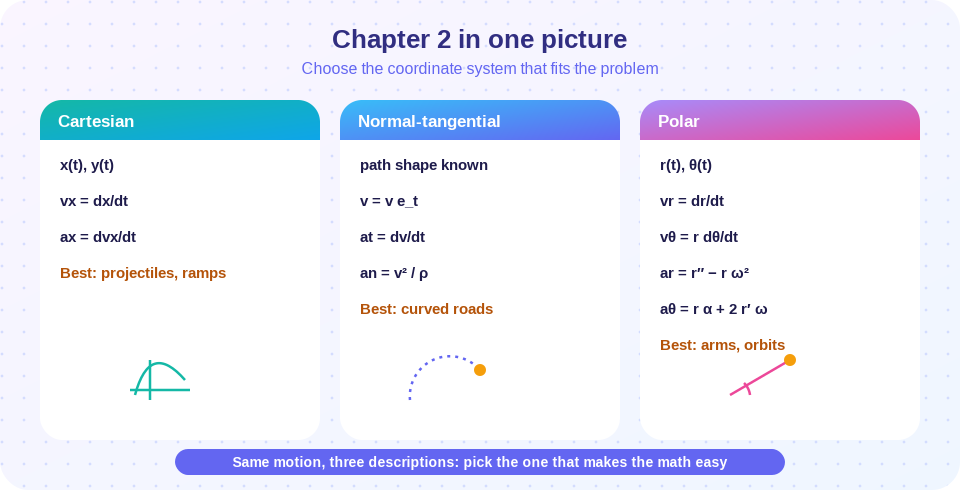
What you will learn
- The key formulas of Chapter 2 in one place.
- How to decide which coordinates and equations suit a problem.
- A mixed self-test covering all four lessons.
Key terms
Rectilinear: along a straight line.
Projectile: moves under gravity alone.
Normal acceleration: v²/ρ, toward the center of curvature.
Relative velocity: v_B/A = v_B − v_A.
Recap table
| Topic | Key formulas |
|---|---|
| Constant acceleration | v = v0 + a t, s = s0 + v0 t + ½ a t², v² = v0² + 2 a Δs |
| Variable acceleration | v = ∫a dt, v dv = a ds, dt = dv / a(v) |
| Projectile (level ground) | T = 2 v0 sin θ / g, H = v0² sin² θ / 2g, R = v0² sin 2θ / g |
| Normal-tangential | a_t = dv/dt, a_n = v²/ρ |
| Polar | v_r = ṙ, v_θ = r ω, a_r = r̈ − r ω², a_θ = r α + 2 ṙ ω |
| Relative motion | v_B = v_A + v_B/A |
Decision guide
- Straight line? Use rectilinear equations; pick the one missing the unwanted quantity.
- Constant acceleration vector (gravity)? Cartesian components.
- Known curved path (road, track)? Normal-tangential.
- Rotating line or central point (arm, orbit)? Polar.
- Moving observer or fluid? Relative velocity with a vector triangle.
Common misconceptions
"Constant speed means constant velocity." Velocity is a vector; direction counts.
"Constant-acceleration formulas are universal." They are the special case; start from the definitions otherwise.
Try it
A mixed calculator: one function per topic, so you can check any homework answer quickly.
Press Run (or Ctrl + Enter) to see the console output here.
No output.
A second box shows the time and place where two particles meet, using relative motion in Python.
Press Run (or Ctrl + Enter) to see the result here.
Program input · what you'd type while the program runs
Type the answers before you press Run, one per line. Each time the program reads a line (with input()), it gets the next line from this box.
Check your understanding
Quick check · 10 questions
of 10 answered You scored / 10 · perfect!
-
1. A train brakes uniformly from 30 m/s to rest in 150 m. Its deceleration is
a = v²/(2 d) = 900 / 300 = 3 m/s². -
2. A ball is thrown at 20 m/s, 30° above the horizontal from level ground. The time of flight is (g = 9.81)
T = 2 × 20 × 0.5 / 9.81 = 2.04 s. -
3. At the top of a projectile's path, the acceleration is
Gravity does not switch off; ay = −g throughout the flight. -
4. A cyclist rides at 8 m/s on a circle of radius 16 m. The normal acceleration is
a_n = v²/ρ = 64 / 16 = 4 m/s². -
5. A particle starts from rest with a = 2t (SI). Its velocity at t = 3 s is
v = ∫ 2t dt = t² = 9 m/s. -
6. In polar coordinates, a bead at r = 0.5 m turns at constant ω = 4 rad/s with no radial motion. Its radial acceleration is
a_r = −r ω² = −0.5 × 16 = −8 m/s², inward. -
7. A plane flies at 200 km/h airspeed north with a 50 km/h west wind (from the west). Its ground speed is about
√(200² + 50²) = 206 km/h, tracking about 14° east of north. -
8. Two cars on a straight road travel at 30 and 20 m/s in the same direction. The faster one is 500 m behind. It catches up after
Closing speed 10 m/s: 500/10 = 50 s. -
9. Which pair gives equal ranges on level ground without drag?
Angles adding to 90° give equal ranges. -
10. The slope of a position-time graph is
v = ds/dt.
Summary
- Rectilinear, projectile, n-t, polar and relative motion are tools for describing the same physical reality.
- Pick the representation that makes the unknown simple.
- Always check units, signs and limiting cases.
Theo dõi tiến độ của bạn
Tạo tài khoản miễn phí để đánh dấu bài đã học và tiếp tục từ chỗ bạn dừng lại trên mọi thiết bị.