
























Bài 16 · Kinetics: Force and Acceleration
Chapter 3 Review: Force and Acceleration
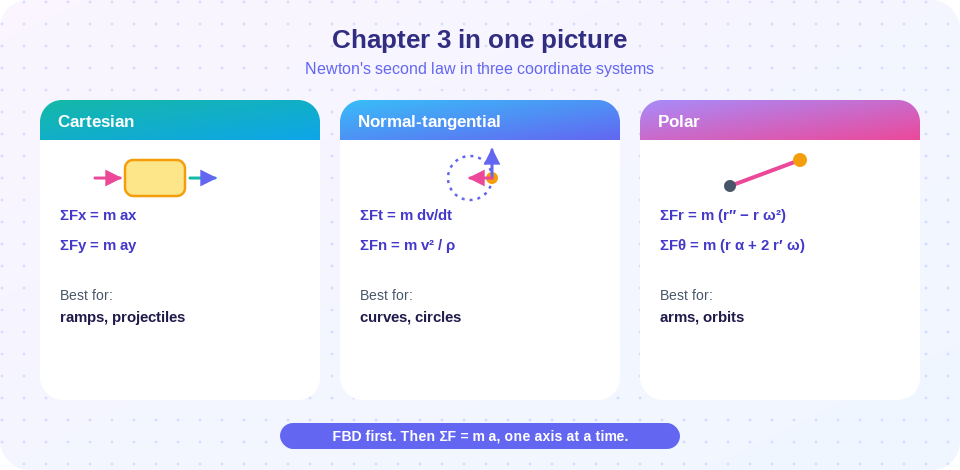
Review Newton's second law in Cartesian, normal-tangential and polar axes, with a recap table, a ramp-to-drag toolbox and a ten-question mixed quiz.
Chapter 3 gave you the second law as a working tool: draw, write, solve, check. You applied it to crates, pulleys, curves and falling objects. This review gathers the formulas and tests your recall.
What you will learn
- The key results of Chapter 3 on one page.
- How to pick the equation form that fits each problem.
- A mixed self-test.
Key terms
Equation of motion: ΣF = m a along an axis.
Centripetal force: net inward force m v²/r.
Terminal velocity: speed at which drag equals weight.
Constraint equation: links the accelerations of connected bodies.
Recap table
| Topic | Result |
|---|---|
| Elevator | N = m (g + a) (up positive) |
| Crate pulled at angle θ | N = m g − F sin θ, best angle tan θ = μ |
| Atwood machine | a = (m1 − m2) g/(m1 + m2), T = 2 m1 m2 g/(m1 + m2) |
| Flat curve | v_max = √(μs g r) |
| Banked curve (no friction) | tan θ = v²/(r g) |
| Hill crest | N = m (g − v²/r) |
| Vertical circle top | v_min = √(g r) |
| Linear drag | v_t = m g/k, τ = m/k |
| Quadratic drag | v_t = √(m g/k) |
Common misconceptions
"Centrifugal force is real in the ground frame." It is a feeling caused by inertia.
"Terminal velocity is constant for every object." It depends on mass and drag area.
Try it
A toolbox of Chapter 3 formulas. Change the inputs to check your own answers.
Press Run (or Ctrl + Enter) to see the console output here.
No output.
A second simulation puts curve and drag together: a car brakes on a flat circular curve, and the program finds the speed at which it starts to slide.
Press Run (or Ctrl + Enter) to see the result here.
Program input · what you'd type while the program runs
Type the answers before you press Run, one per line. Each time the program reads a line (with input()), it gets the next line from this box.
Check your understanding
Quick check · 10 questions
of 10 answered You scored / 10 · perfect!
-
1. A 70 kg person in an elevator accelerating upward at 2 m/s² feels a normal force of (g = 9.81 m/s²)
N = 70 × 11.81 = 827 N. -
2. Two masses of 5 kg and 3 kg hang over a pulley. The acceleration is
a = (5 − 3) × 9.81 / 8 = 2.45 m/s². -
3. A car's maximum speed on a flat curve of radius 60 m with μs = 0.6 is about
√(0.6 × 9.81 × 60) = 18.8 m/s. -
4. Doubling a car's speed on the same curve requires the friction force to be
Required friction = m v²/r grows with v². -
5. A frictionless banked road is designed for 20 m/s on a radius of 80 m. tan θ =
tan θ = v²/(r g) = 400/784.8 = 0.51, θ ≈ 27°. -
6. A hill crest of radius 40 m: the car loses contact with the road at about
v = √(g r) = √392 = 19.8 m/s. -
7. A parachutist (m = 80 kg, k = 15 kg/m, quadratic drag) lands at about
v_t = √(80 × 9.81 / 15) = 7.2 m/s. -
8. In an Atwood machine the tension is always
The heavy mass accelerates down (T < m1 g) and the light mass accelerates up (T > m2 g). -
9. Which statement about centripetal force is correct?
It is the net inward force from real contacts and fields. -
10. The time constant of linear drag is
τ = m/k; the terminal speed is m g/k.
Summary
- Newton's second law is the engine of kinetics, whichever axes you pick.
- Curved motion needs a net inward force
m v²/ρ; friction and banking supply it. - Speed-dependent forces make
avary; solve by calculus or numerically.
Theo dõi tiến độ của bạn
Tạo tài khoản miễn phí để đánh dấu bài đã học và tiếp tục từ chỗ bạn dừng lại trên mọi thiết bị.