
























Bài 6 · History and Vehicle Types
History and vehicle types: chapter overview
A guided overview of aerospace history from balloons to reusable rockets and the main families of aerospace vehicles, with a timeline and interactive calculator.
In 1903 two brothers flew for twelve seconds. Sixty-six years later, people walked on the Moon. That span, shorter than a long human life, is one of the fastest bursts of engineering progress in history. This chapter tells the story and then turns it into a map of the vehicles you will study for the rest of the course.
What you will learn
- The ten milestones that define aerospace history
- Why progress came in bursts, driven by new engines, materials and funding
- How the chapter's lessons are organized
Key terms
Milestone is a first that opens a new capability, such as the first powered flight.
Turbojet is a gas-turbine engine that makes thrust from a fast exhaust jet.
Reusable launch vehicle is a rocket whose parts can fly more than once.
Orbit is a path around a body where gravity and sideways speed balance.
The story in one picture
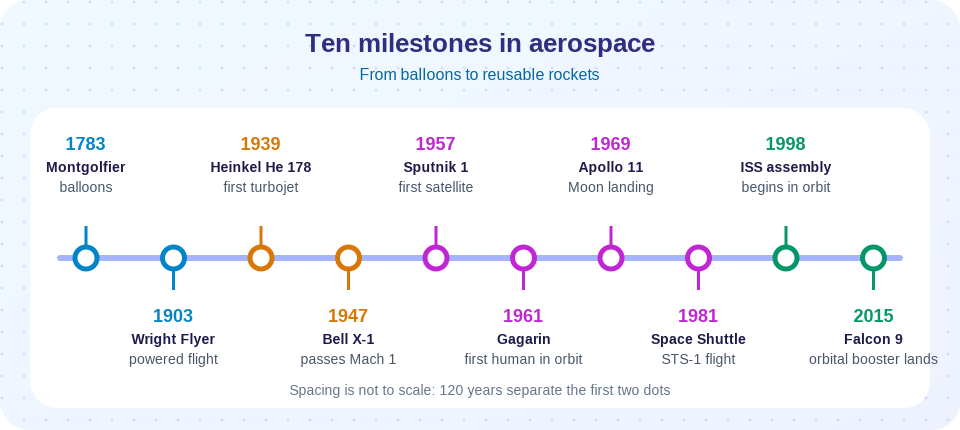
Read the timeline from left to right. Notice what the first dots have in common: each depended on a new technology that arrived just before it. Balloons needed cheap lightweight fabric and varnish. The Wright Flyer needed a light gasoline engine and a wind tunnel to test wing shapes. The first turbojet needed heat-resistant metals. Sputnik needed a long-range ballistic missile, the R-7 rocket. Reusable boosters needed computers fast enough to land a rocket on a pad.
Three eras of aerospace
1783 to 1969 and beyond
What drove progress?
Vehicle families
What is in this chapter
- Early aviation: balloons, gliders, the Wright brothers and the first airplanes
- The jet and space ages: turbojets, supersonic flight, Sputnik, Apollo, the Shuttle and the ISS
- A tour of aerospace vehicles: aircraft, launchers and spacecraft and the environment each is built for
- Chapter 2 review: a one-page recap and a 9-question quiz
Try it
Press Run (or Ctrl + Enter) to see the console output here.
No output.
Press Run (or Ctrl + Enter) to see the result here.
Program input · what you'd type while the program runs
Type the answers before you press Run, one per line. Each time the program reads a line (with input()), it gets the next line from this box.
Common misconceptions
"The Wrights simply built an engine with wings." They solved control first, with wing warping and a rudder, and built their own wind tunnel to test wing shapes before the first flight.
"The space age began with the Moon landing." It began on 4 October 1957 with Sputnik 1. Apollo 11 came twelve years later.
Check your understanding
Quick check · 4 questions
of 4 answered You scored / 4 · perfect!
-
1. Which milestone came first?
The Wright Flyer flew in 1903, before the others. -
2. What technology made Sputnik possible?
The Soviet R-7 missile could lift a satellite to orbit. -
3. How many years passed between the Wright Flyer and Apollo 11?
1969 minus 1903 is 66 years. -
4. Which of these is a reusable-launcher milestone?
In December 2015 a Falcon 9 first stage landed upright after an orbital launch.
Summary
- Aerospace history runs through balloons, powered flight, jets, rockets and reusable launchers.
- Each leap followed a technology: engines, materials, computers and funding.
- Vehicle families (aircraft, launchers, spacecraft) are set by the environment they work in.
- The next lessons tell the story in detail.
Next: Early aviation
Theo dõi tiến độ của bạn
Tạo tài khoản miễn phí để đánh dấu bài đã học và tiếp tục từ chỗ bạn dừng lại trên mọi thiết bị.