
























Bài 44 · Projects and Practice
Cheat Sheet: The One-Page Formula Sheet
A one-page cheat sheet of the key equations from orbital mechanics, rocket propulsion and spacecraft design, with constants, units, worked numbers and a calculator.
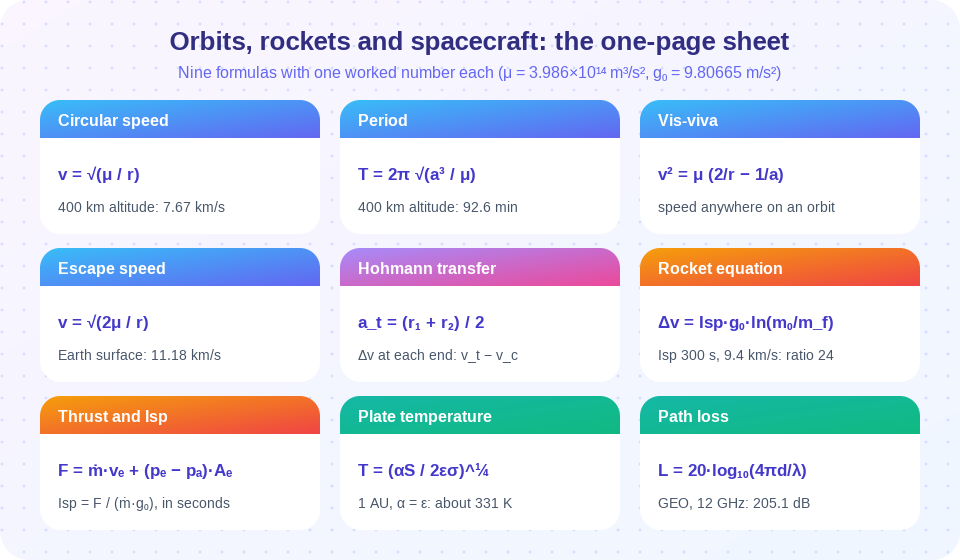
This page is the quick reference for chapters 5 to 8. It has the nine formulas you will use most, the constants and unit conversions, a short guide for picking the right formula, and a calculator that applies them. Keep it open when you work through problems; the goal is that you understand where each formula comes from, so the sheet only reminds you.
What you will learn
- Find the right equation for an orbit, rocket or spacecraft question quickly.
- Use consistent units and the correct constants.
- Check answers with known benchmark numbers.
- Apply the formulas in a calculator.
Key terms
Benchmark number: a well-known result you can use to check a calculation, such as 7.67 km/s at 400 km.
SI units: meters, kilograms, seconds; always convert km to m before using μ in m³/s².
Order of magnitude: a rough size check, such as expecting a LEO period near 90 minutes.
Dimensional analysis: checking that both sides of an equation have the same units.
Constants and conversions
| Quantity | Value |
|---|---|
Earth μ |
3.986004418×10¹⁴ m³/s² |
| Earth equatorial radius | 6,378.137 km |
Standard gravity g₀ |
9.80665 m/s² |
Sun μ |
1.32712440018×10²⁰ m³/s² |
| Astronomical unit | 1.495978707×10¹¹ m |
| Solar constant at 1 AU | 1361 W/m² |
Stefan-Boltzmann σ |
5.670374×10⁻⁸ W/(m²·K⁴) |
Boltzmann k |
1.380649×10⁻²³ J/K |
Speed of light c |
299,792,458 m/s |
| Sidereal day | 86,164.09 s |
| GEO radius | 42,164 km (altitude 35,786 km) |
Which formula do I need?
- "How fast is it going?" Circular orbit:
√(μ/r). Any point of any orbit: vis-vivav² = μ(2/r − 1/a). - "How long is one orbit?"
T = 2π√(a³/μ); for a circle,a = r. - "Can it escape?" Compare speed with
√(2μ/r), or check whetherε = v²/2 − μ/ris positive. - "What does it cost to change orbit?" Hohmann: compute both transfer speeds with vis-viva and subtract the circular speeds; plane change
2v sin(Δi/2). - "How much propellant?"
Δv = Isp g₀ ln(m₀/m_f); invert for the mass ratio. For several stages, add the stage Δv values. - "How big a nozzle or engine?" Thrust
F = ṁ vₑ + (pₑ − pₐ) Aₑ;Isp = F/(ṁ g₀). - "How hot will it get?" Balance
α S A_sun + Q = ε σ A_rad T⁴. - "Does the radio link close?"
Pr = Pt + Gt − L + Gr(dB); compare with noisek T B; limitC = B log₂(1 + SNR). - "When do we go?" Synodic period
1/S = abs(1/T₁ − 1/T₂); phase angle180° − n₂ t_transfer.
Benchmark numbers
| Situation | Value |
|---|---|
| Circular speed at 400 km altitude | 7.67 km/s, period 92.6 min |
| Escape speed at Earth's surface | 11.18 km/s |
| GPS orbit (26,560 km radius) | 11.97 h period |
| LEO to GEO by Hohmann | 3.89 km/s, 5.28 h |
| Mass ratio for 9.4 km/s at Isp 300 s | 24.4 (96% propellant) |
| Earth to Mars Hohmann | 259 days, v∞ = 2.94 km/s, 3.61 km/s from LEO |
| Free-space loss to GEO at 12 GHz | 205.1 dB |
| Equilibrium of a flat plate at 1 AU | about 331 K |
Common misconceptions
"Units will sort themselves out." Use meters in μ formulas; a stray kilometer gives an answer off by a factor of a thousand or its square root.
"One formula fits all orbits." Circular speed formulas are only for circles; use vis-viva whenever the orbit is not circular.
"Round numbers are exact." 9.4 km/s to orbit and 3.9 km/s to GEO are typical values with real-mission variations.
Try it
Press Run (or Ctrl + Enter) to see the result here.
Program input · what you'd type while the program runs
Type the answers before you press Run, one per line. Each time the program reads a line (with input()), it gets the next line from this box.
Check your understanding
Quick check · 5 questions
of 5 answered You scored / 5 · perfect!
-
1. Which formula gives the speed at any point of an elliptical orbit?
Vis-viva works for every conic. √(μ/r) is only for circular orbits and √(2μ/r) only for the parabolic escape case. -
2. You are given a distance in kilometers and want to use μ = 3.986×10¹⁴ m³/s². What must you do?
μ is in m³/s², so radii must be in meters. -
3. How many sidereal seconds are in one sidereal day?
A sidereal day is 23 h 56 min 4 s, about 86,164 seconds. -
4. A mass ratio of 24.4 at Isp 300 s corresponds to a Δv of about
Δv = 300 × 9.80665 × ln 24.4 ≈ 9.4 km/s. -
5. Which benchmark is correct for the circular speed at 400 km altitude?
7.67 km/s with a period near 92.6 minutes.
Summary
- Nine formulas cover most of chapters 5 to 8: circular speed, period, vis-viva, escape, Hohmann, rocket equation, thrust and Isp, plate temperature and path loss.
- Always use SI base units with the constants, then convert for display.
- Check your answers against benchmark numbers before you trust them.
Theo dõi tiến độ của bạn
Tạo tài khoản miễn phí để đánh dấu bài đã học và tiếp tục từ chỗ bạn dừng lại trên mọi thiết bị.