
























Lecția 42 · Failure Theories and Design
Chapter 8 review: failure theories and design
Review failure modes, Tresca and von Mises, fatigue, notches and factors of safety with a recap table, a shaft audit tool and a nine-question quiz.
This chapter turned stresses into decisions. A part can fail by yielding, fracture, fatigue, buckling or excessive deflection; each has a rule, and the factor of safety is the smallest margin over all of them. Here it is on one page.
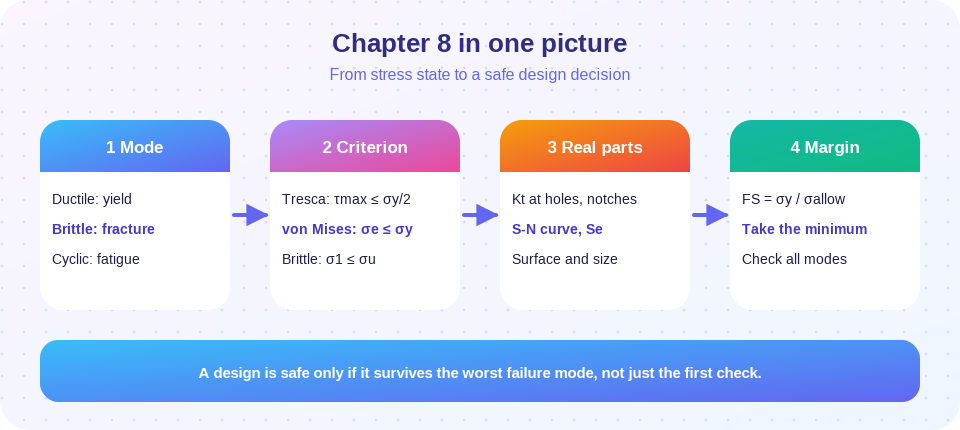
Recap table
| Topic | Rule | Remember |
|---|---|---|
| Ductile yielding | Tresca: σ1 − σ3 ≤ σy |
Include σ3 = 0 in plane stress |
| Ductile yielding | von Mises: σe = √(σ1² − σ1σ2 + σ2²) ≤ σy |
τy = 0.577 σy in pure shear |
| Brittle fracture | σ1 ≤ σut (and Coulomb–Mohr) |
Strong in compression, weak in tension |
| Fatigue cycle | σa = (σmax − σmin)/2, σm = (σmax + σmin)/2 |
Check cycles, not just peaks |
| S-N and endurance | Steel Se' ≈ 0.5 σu in the lab |
Correct for surface, size and loading |
| Notches | Kf = 1 + q(Kt − 1), local stress Kf σa |
Round the corners |
| Goodman | σa/Se + σm/σu = 1/n |
Tensile mean stress hurts |
| Factor of safety | FS = strength / applied, σallow = σy/FS |
Weakest mode governs |
| LRFD | φ Rn ≥ Σ γᵢ Qᵢ |
Larger factors on uncertain loads |
Try it
This audit checks a shaft that carries a fully reversed bending moment and a steady torque against both static yielding and fatigue, then names the governing mode. The fatigue part uses a simple Goodman combination with the equivalent von Mises stresses and illustrative correction factors.
Press Run (or Ctrl + Enter) to see the result here.
Program input · what you'd type while the program runs
Type the answers before you press Run, one per line. Each time the program reads a line (with input()), it gets the next line from this box.
The weakest mode decides the size. This plot shows how both margins grow with the diameter (both scale as d³), and where the 2.0 requirement is met.
Press Run (or Ctrl + Enter) to see the result here.
Program input · what you'd type while the program runs
Type the answers before you press Run, one per line. Each time the program reads a line (with input()), it gets the next line from this box.
Check your understanding
Quick check · 9 questions
of 9 answered You scored / 9 · perfect!
-
1. Plane stress has σ1 = 100 MPa and σ2 = −50 MPa. What is the von Mises equivalent stress?
σe = √(100² − 100 × (−50) + (−50)²) = √(10 000 + 5 000 + 2 500) = √17 500 = 132 MPa. -
2. For the same state, what is the Tresca equivalent (σ1 − σ3 with σ3 = −50 as the smallest)?
The principal stresses are 100, 0 and −50, so the largest difference is 100 − (−50) = 150 MPa. -
3. A notch has Kt = 3 and q = 0.5. What is the fatigue notch factor Kf?
Kf = 1 + 0.5 × (3 − 1) = 2.0. -
4. The Goodman line with σa = 120 MPa, σm = 0 and Se = 240 MPa gives a factor of safety of...
n = 1/(σa/Se) = 240/120 = 2.0. -
5. A part has n = 3.0 against yield and n = 1.4 against buckling. Its factor of safety is...
The weakest failure mode governs. -
6. A steel has σu = 800 MPa. What is the rule-of-thumb laboratory endurance limit?
Se' ≈ 0.5 σu = 400 MPa for steels with σu up to about 1400 MPa, before the correction factors. -
7. Which pure-shear yield stress does von Mises give for σy = 400 MPa?
τy = σy/√3 = 400/1.732 = 231 MPa. -
8. Which criterion is normally used for a brittle material such as cast iron?
Brittle failure starts from the largest tensile normal stress. -
9. A fatigue crack in a shaft most often starts...
Cracks start where the stress is highest, usually at the surface and at stress concentrations.
Summary
- Failure modes: yielding, fracture, fatigue, buckling and deflection. Each needs its own check.
- Ductile metals: Tresca or von Mises with
σy; brittle materials: maximum normal stress withσut. - Fatigue depends on cycles: use
σa,σm, the S-N curve, correctedSe, notch factorKfand the Goodman line. - The factor of safety is the smallest margin of all modes, and codes set the required value.
Urmărește-ți progresul
Creează un cont gratuit ca să bifezi lecțiile și să reiei de unde ai rămas, pe orice dispozitiv.