
























Bài 40 · Applications: Solar, EVs and Power Supplies
Chapter 8 review: solar, EVs and power supplies
Review solar I-V curves and MPPT, EV drivetrain and charging, and PFC and flyback supplies with a recap table, an efficiency-chain calculator and a ten-question quiz.
Three applications, one recipe. Whether the source is a sunlit panel, a battery pack or the mains, the design always has four parts: a source with its own personality, a converter that transforms it, a control loop that holds the result steady, and a thermal budget that keeps everything cool. You can now read a block diagram of a solar inverter, an electric-vehicle powertrain or a USB-C charger and say what each block does and what limits it.
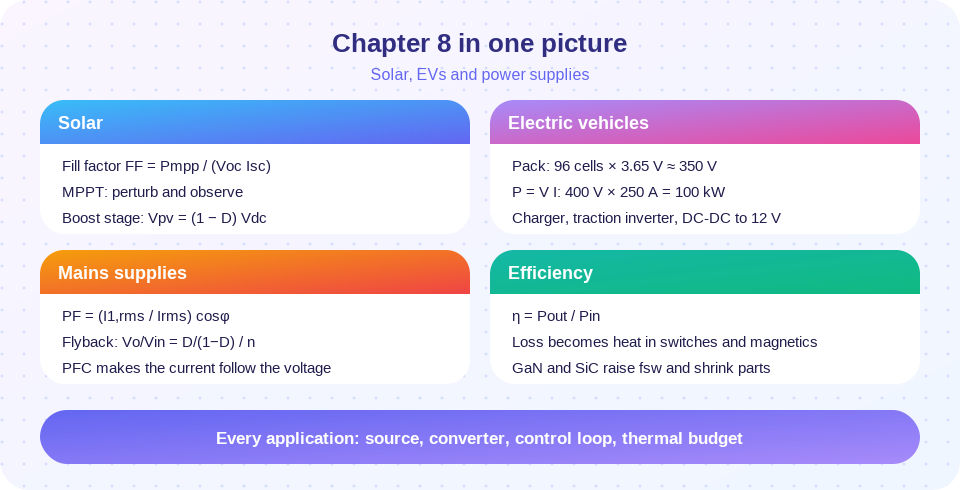
Recap table
| Topic | Key result | Lesson |
|---|---|---|
| Single-diode PV model | I = Iph − I0(e^((V+IRs)/(nNsVt)) − 1) − (V+IRs)/Rsh |
Solar power and MPPT |
| Fill factor | FF = Pmpp / (Voc · Isc) |
same |
| Irradiance, temperature | Isc ∝ G; Voc falls about 0.3 %/°C |
same |
| Boost as MPPT | Rin = (1 − D)² · RL; perturb and observe |
same |
| Single-phase grid inverter | DC link absorbs 2f power ripple | same |
| EV pack voltage | Vpack = Ns · Vcell (96 × 3.65 V ≈ 350 V) |
EV power electronics |
| Charging | P = V · I; t = ΔE / (P · η) |
same |
| Road load | ½ρCdA·v³ + Crr·m·g·v, regeneration recovers a share |
same |
| Power factor | PF = cos φ / √(1 + THDi²) |
Power supplies and PFC |
| Flyback | Vor = n(Vo + Vf), D = Vor / (Vor + Vin), Lp = Vin·D/(Ip·fsw) |
same |
Efficiency chains
When converters are in series their efficiencies multiply, and the lost power becomes heat in each stage. A string inverter with a 99.5 % MPPT stage and a 98 % inverter stage is 0.995 × 0.98 = 97.5 % efficient end to end; a 6 kW system loses 150 W as heat. A charging chain of a 98.5 % PFC, a 97 % isolated DC-DC and a battery that is 95 % efficient on charge gives 0.985 × 0.97 × 0.95 = 90.8 % from the wall to stored energy: the rest warms the car, the charger and the battery. The tool below multiplies any chain and shows where the heat appears.
Try it
The first example computes the end-to-end efficiency and the heat produced by each stage for the three applications in this chapter. The stage efficiencies are typical round numbers for illustration, not measurements of a product.
Press Run (or Ctrl + Enter) to see the result here.
Program input · what you'd type while the program runs
Type the answers before you press Run, one per line. Each time the program reads a line (with input()), it gets the next line from this box.
The second example is a practice drill. For each scenario choose the converter or concept that fits; the explanation appears after your answer.
Check your understanding
Quick check · 10 questions
of 10 answered You scored / 10 · perfect!
-
1. A module has Voc = 38 V, Isc = 9.5 A and Pmpp = 270 W. What is its fill factor?
FF = 270 / (38 × 9.5) = 270 / 361 = 0.748. -
2. A boost converter with D = 0.6 feeds a 50 Ω load. What resistance does the PV array see?
Rin = (1 − D)² RL = 0.16 × 50 = 8 Ω. -
3. A 150 kW charger works at 800 V. What is the charging current?
I = 150,000 / 800 = 187.5 A. -
4. How long does it take to add 36 kWh at 50 kW with 95 % efficiency?
36 / (50 × 0.95) = 0.76 h = 45 minutes. -
5. A rectifier has THDi = 80 % and cos φ = 0.95. What is the power factor?
PF = 0.95 / √(1 + 0.64) = 0.95 / 1.28 = 0.742. -
6. A flyback has Vo = 5 V, Vf = 0.5 V and n = 6. What is the reflected voltage?
Vor = 6 × 5.5 = 33 V. -
7. With Vor = 33 V and a minimum input of 100 V, what is the duty cycle at boundary conduction?
D = 33 / (33 + 100) = 0.248. -
8. A module's cell temperature rises from 25 °C to 65 °C. About how much maximum power is lost (0.4 % per °C)?
40 °C × 0.4 %/°C = 16 %. -
9. A 98 % PFC stage feeds a 96 % isolated DC-DC stage. What is the combined efficiency?
0.98 × 0.96 = 0.941. -
10. What happens in the traction inverter during regenerative braking?
The motor generates and the inverter rectifies its output into the DC link and battery.
Summary
- Solar: model the module, find the MPP, steer it with
Rin = (1 − D)²·RL, track with perturb and observe, and buffer the 2f ripple. - EVs: four converters, higher voltage to cut current, SiC at 1200 V, charging time
ΔE/(P·η), regeneration through the inverter. - Supplies: PFC makes the current follow the voltage; a flyback gives isolation with
Vor = n(Vo + Vf); GaN and high frequency shrink the parts. - Efficiency multiplies along a chain, and every lost watt becomes heat to manage.
Theo dõi tiến độ của bạn
Tạo tài khoản miễn phí để đánh dấu bài đã học và tiếp tục từ chỗ bạn dừng lại trên mọi thiết bị.