
























Leçon 32 · Manufacturing and Assembly
Chapter 6 review: manufacturing and assembly
Review stackups, vias, design rules, fabrication files, stencils, reflow and defects with a poster, a recap table and a ten-question quiz.
You have followed a board from a CAD project to a soldered assembly. The same few numbers kept coming back: a 1.6 mm board, 35 µm copper, 0.15 mm trace and ring limits, a 0.12 mm stencil and a 217 °C liquidus. This review gathers them on one page.
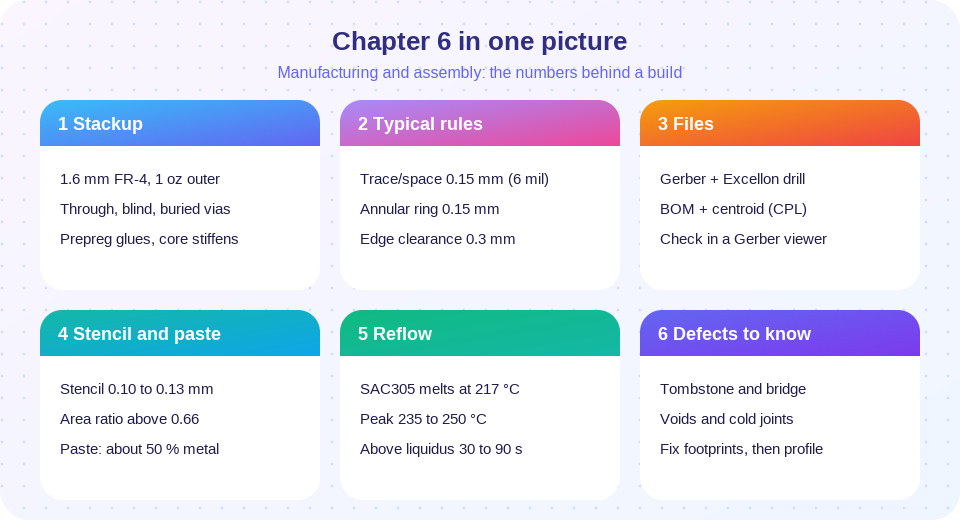
The chapter in one table
| Topic | Key point | Numbers |
|---|---|---|
| Stackup | Copper and prepreg/core laminated | 1.6 mm, 1 oz = 35 µm |
| Vias | Through, blind, buried, micro | Aspect ratio ≤ 8 to 10 |
| Rules | Set by etch and drill tolerance | 0.15 mm trace/space, 0.15 mm ring, 0.3 mm edge |
| Files | Gerber, drill, BOM, centroid | Check in an independent viewer |
| Stencil | Thin steel foil, apertures | 0.10 to 0.13 mm, area ratio > 0.66 |
| Reflow | Four zones | Peak 235 to 250 °C, 30 to 90 s above 217 °C |
| Defects | Tombstone, bridge, void, cold joint | Fix footprints, then profile |
Lessons: How a board is made, Gerbers and fabrication files, Assembly, soldering and reflow.
Try it
Press Run (or Ctrl + Enter) to see the result here.
Program input · what you'd type while the program runs
Type the answers before you press Run, one per line. Each time the program reads a line (with input()), it gets the next line from this box.
Press Run (or Ctrl + Enter) to see the console output here.
No output.
Check your understanding
Quick check · 10 questions
of 10 answered You scored / 10 · perfect!
-
1. What bonds the layers together during lamination?
Prepreg melts and cures under heat and pressure. -
2. Which via type connects only inner layers?
A buried via is invisible from both outer surfaces. -
3. Annular ring for a 0.7 mm pad and a 0.3 mm drill?
(0.7 − 0.3) / 2 = 0.2 mm. -
4. Which file holds hole positions?
Excellon files list tools and X, Y positions. -
5. Solder paste by volume is roughly:
About half the volume is solder spheres, the rest flux and solvent. -
6. Which stencil aperture prints most reliably?
Ratios above about 0.66 release paste cleanly. -
7. What is a likely cause of tombstoning?
One pad wets first and lifts the part. -
8. Typical peak temperature for a lead-free reflow?
The peak must exceed 217 °C by a safe margin without harming parts. -
9. Why preview a centroid file against the assembler's viewer?
Different tools define zero rotation differently. -
10. Which finish is best for fine-pitch BGAs?
ENIG is flat and durable.
Summary
- Know your fab's limits and design inside them.
- Deliver clean, checked files and unambiguous part numbers.
- Design symmetric pads and follow land patterns to avoid assembly defects.
Suivez votre progression
Créez un compte gratuit pour cocher vos leçons et reprendre où vous vous étiez arrêté, sur n'importe quel appareil.