
























Bài 22 · The Second Law and Entropy
Chapter 4 Review: The Second Law and Entropy
Review chapter 4: Kelvin-Planck and Clausius, thermal efficiency and COP, Carnot limits, entropy change, entropy generation and isentropic efficiency, with a 9-question quiz.
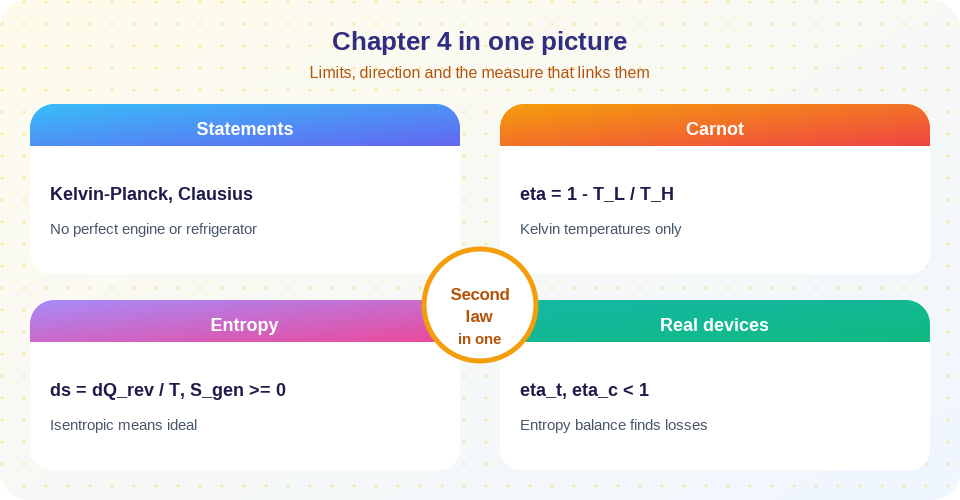
You have reached the end of the theory half of the course. The first law taught you to count energy; the second law taught you that conversions have a direction and a limit, and entropy gave you a number to measure it. Chapters 5 to 9 use both laws on real cycles and mixtures. This review gathers the second-law results on one page and tests them.
What you will learn
- The second-law formulas in one table.
- How to check whether a machine or process is possible.
- A test of the whole chapter.
Recap table
| Topic | Key result |
|---|---|
| Heat engine | η = W_net/Q_H = 1 − Q_L/Q_H |
| Refrigerator / heat pump | COP_R = Q_L/W, COP_HP = Q_H/W = COP_R + 1 |
| Kelvin-Planck | No cyclic engine converts all heat to work |
| Clausius | No cyclic device moves heat from cold to hot without work |
| Carnot | η = 1 − T_L/T_H; COP_R = T_L/(T_H − T_L); COP_HP = T_H/(T_H − T_L) |
| Entropy | dS = δQ_rev/T; ΔS_isolated ≥ 0 |
| Ideal gas | Δs = c_p ln(T₂/T₁) − R ln(P₂/P₁); isentropic: T₂/T₁ = (P₂/P₁)^((k−1)/k) |
| Entropy balance | ΔS = Σ Q/T + S_gen, S_gen ≥ 0 |
| Isentropic efficiency | η_t = Δh_actual/Δh_s; η_c = Δh_s/Δh_actual |
A three-question possibility test
For any claimed machine or process:
- First law: does the energy balance close?
- Second law (Carnot): is the efficiency (or COP) at or below the Carnot limit, with temperatures in kelvin?
- Entropy: is
S_gen ≥ 0, with the right boundary temperatures?
Worked review. An inventor claims an engine between 500 K and 300 K that takes 200 kJ and produces 90 kJ. First law: Q_L = 110 kJ, fine. Carnot limit: 1 − 300/500 = 0.40 and the claim is 90/200 = 0.45 > 0.40. It violates the second law. Entropy check: S_gen = Q_L/T_L − Q_H/T_H = 110/300 − 200/500 = 0.367 − 0.400 = −0.033 kJ/K < 0. Impossible, in agreement.
Try it
Press Run (or Ctrl + Enter) to see the result here.
Program input · what you'd type while the program runs
Type the answers before you press Run, one per line. Each time the program reads a line (with input()), it gets the next line from this box.
Check your understanding
Quick check · 9 questions
of 9 answered You scored / 9 · perfect!
-
1. An engine takes 400 kJ and rejects 250 kJ. Its efficiency is
W = 150 kJ and eta = 150/400 = 0.375. -
2. The Carnot efficiency between 900 K and 300 K is
1 - 300/900 = 0.667. -
3. A heat pump with COP 5 delivers 10 kW. The power input is
W = Q_H/COP = 10/5 = 2 kW. -
4. Which statement is equivalent to the Kelvin-Planck statement?
Violating either statement would allow violating the other. -
5. Air (cp = 1.005) is heated from 300 K to 600 K at constant pressure. The entropy change per kg is about
1.005 ln 2 = 0.697 kJ/kg K. -
6. S_gen for a process is found to be -0.05 kJ/K. This means the process
Entropy generation cannot be negative. -
7. A turbine has h1 = 3200, h2s = 2300 and h2 = 2500 kJ/kg. The isentropic efficiency is
(3200 - 2500)/(3200 - 2300) = 700/900 = 0.778. -
8. The thermodynamic reason a heat pump works better in mild weather is
COP_HP = T_H/(T_H - T_L) rises as the lift shrinks. -
9. 1200 kJ flows from 600 K to 400 K. The entropy generated is
1200/400 - 1200/600 = 3 - 2 = 1 kJ/K.
Summary
- Engines reject heat;
η ≤ 1 − T_L/T_Hand COPs follow the same Carnot logic. - Entropy is a property with
ΔS ≥ ΣQ/TandS_gen ≥ 0; isentropic means reversible and adiabatic. - Isentropic efficiency compares real turbines and compressors with the ideal.
- Use the three-question test (first law, Carnot limit, entropy generation) on any claim.
Theo dõi tiến độ của bạn
Tạo tài khoản miễn phí để đánh dấu bài đã học và tiếp tục từ chỗ bạn dừng lại trên mọi thiết bị.