
























Bài 16 · The First Law
Chapter 3 Review: The First Law
Review chapter 3: heat and work signs, boundary work, closed-system balance, enthalpy and the steady-flow energy equation for turbines, compressors, nozzles and valves, with a 9-question quiz.
You now own the first law in both forms: for a fixed mass (Q − W = ΔU) and for a flowing stream (q − w = Δh + ΔKE + ΔPE). This review puts them next to each other, adds a decision routine for choosing between them and gives you a nine-question quiz covering the whole chapter.
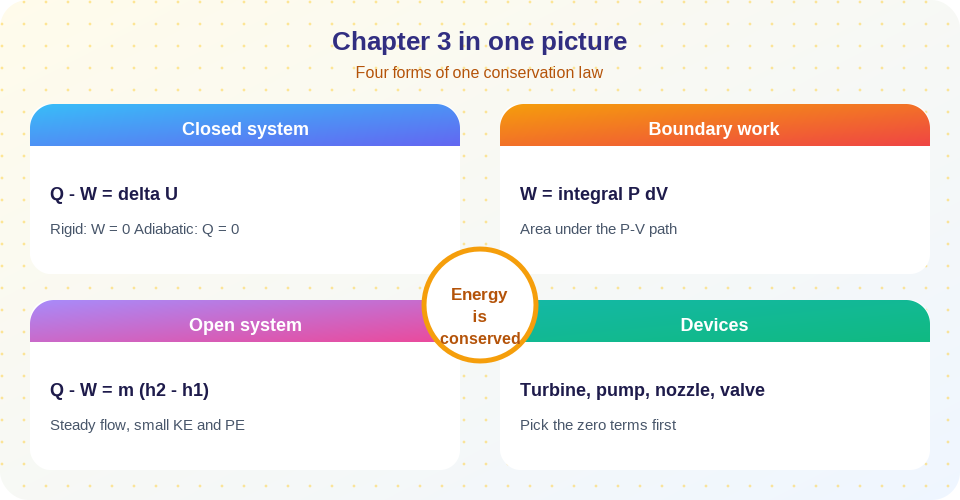
What you will learn
- How to choose closed-system or control-volume form of the first law.
- The key equation for each device in one table.
- A checklist for avoiding the usual first-law mistakes.
Recap table
| Case | Equation | Notes |
|---|---|---|
| Closed system | Q − W = ΔU + ΔKE + ΔPE |
Q in +, W out + |
| Boundary work | W = ∫ P dV |
area under P-V path |
| Isobaric / isothermal / polytropic | P ΔV, P₁V₁ ln(V₂/V₁), (P₂V₂ − P₁V₁)/(1 − n) |
ideal gas for the middle one |
| Ideal gas | Δu = c_v ΔT, Δh = c_p ΔT |
c_p − c_v = R |
| Constant pressure heating | Q = ΔH |
boundary work only |
| Mass balance | Σ ṁ_in = Σ ṁ_out |
ṁ = A V / v |
| Steady flow | q − w = Δh + ΔKE + ΔPE |
h = u + P v |
| Turbine / compressor | w = h₁ − h₂ / w_in = h₂ − h₁ |
adiabatic |
| Nozzle | V₂ = √(2 Δh) |
inlet speed negligible |
| Throttle | h₁ = h₂ |
no work, no heat |
Choosing the form
- Does mass cross the boundary? If not, use the closed form and track
ΔU. - If mass flows through a fixed region, use a control volume and track
h. - Write the full equation, then cross out terms with reasons: rigid (no
W), insulated (Q = 0), steady (no storage), small speeds (noΔKE). - Look up or compute properties (
u,h) and solve; check the sign and size.
Review problem. Air flows steadily through a compressor at ṁ = 0.2 kg/s, entering at 100 kPa and 290 K and leaving at 480 K. Heat loss is 4 kW. KE and PE are negligible. Find the power input. Energy balance: Q̇ − Ẇ = ṁ c_p ΔT with Q̇ = −4 kW (heat leaves): −4 − Ẇ = 0.2 × 1.005 × 190 = 38.19 kW, so Ẇ = −42.2 kW: the compressor needs 42.2 kW.
Try it
Press Run (or Ctrl + Enter) to see the result here.
Program input · what you'd type while the program runs
Type the answers before you press Run, one per line. Each time the program reads a line (with input()), it gets the next line from this box.
Check your understanding
Quick check · 9 questions
of 9 answered You scored / 9 · perfect!
-
1. A closed rigid vessel of gas receives 120 kJ of heat. Its internal energy change is
Rigid means W = 0, so delta U = Q = 120 kJ. -
2. A gas expands from 0.2 to 0.5 m3 at constant 400 kPa. The work done by the gas is
W = P dV = 400 x 0.3 = 120 kJ. -
3. Which statement about enthalpy is correct?
Enthalpy is u + Pv, the energy carried by flowing fluid. -
4. An adiabatic compressor with air going 300 K to 500 K (cp = 1.005) has w_in of
w_in = cp dT = 1.005 x 200 = 201 kJ/kg. -
5. A throttling valve changes
Throttling is an isenthalpic pressure drop. -
6. Which device has no shaft work, no heat and an increasing KE?
A nozzle converts enthalpy into kinetic energy. -
7. Over a cycle, a heat engine takes in 800 kJ and rejects 500 kJ. Net work is
delta U = 0, so W_net = 800 - 500 = 300 kJ. -
8. For an ideal gas, which is correct?
From h = u + RT. -
9. Steady flow of 2 kg/s of water through a heater gains 4.18 x 2 x 30 = 250.8 kW. The water temperature rises by
Q = m c dT with m = 2 kg/s and c = 4.18 gives dT = 30 K.
Summary
- Closed:
Q − W = ΔU; open steady:q − w = Δh + ΔKE + ΔPE. - Write the full equation first, then strike out zero terms with reasons.
- Turbine, compressor, pump, nozzle, throttle and heat exchanger are all special cases.
- The first law counts energy; the second law decides what is possible.
Theo dõi tiến độ của bạn
Tạo tài khoản miễn phí để đánh dấu bài đã học và tiếp tục từ chỗ bạn dừng lại trên mọi thiết bị.