
























Bài 32 · Refrigeration Cycles
Chapter 6 review: refrigeration cycles
Review refrigeration and heat pump basics: COP definitions, the vapor-compression cycle on a P-h diagram, refrigerants and a ten-question quiz.
Chapter 6 turned the heat engine upside down. Work goes in, heat moves from cold to warm, and the measure of success is the COP rather than an efficiency below 100 %. This review collects the formulas and the way they connect.
Recap table
| Topic | Key result |
|---|---|
| First law for a refrigeration cycle | Q_H = Q_L + W |
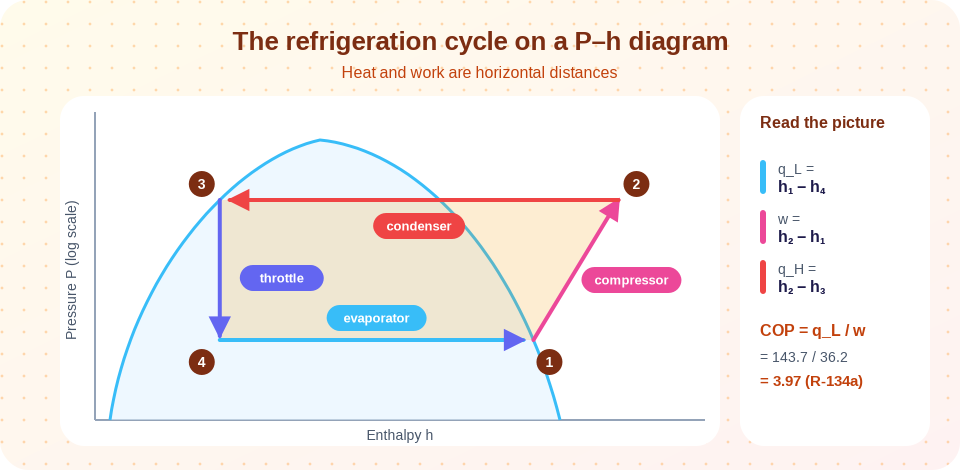
| Refrigerator COP | COP_R = Q_L / W = (h₁ − h₄) / (h₂ − h₁) |
| Heat pump COP | COP_HP = Q_H / W = COP_R + 1 |
| Reversed Carnot limits | T_L/(T_H − T_L) and T_H/(T_H − T_L) |
| Expansion valve | h₄ = h₃, adiabatic and no work |
| Compressor loss | h₂ = h₁ + (h₂s − h₁) / η_c |
| R-134a example | COP_R = 3.97, COP_HP = 4.97 |
| Absorption cycle | driven by heat, COP about 0.5 to 0.8 |
How the pieces connect
Reading a P–h diagram is the single most useful skill of the chapter. The cycle's horizontal edges are the heat and work: the evaporator is the bottom edge (h₄ → h₁), the compressor is the sloped side (h₁ → h₂), the condenser is the top edge (h₂ → h₃) and the throttle is the vertical drop at constant h. Moving the pressures changes the shape: raising the condenser pressure lengthens the compressor segment (more work, lower COP), lowering the evaporator pressure does the same.
Key terms. COP: useful transfer over work. Saturation dome: the region where liquid and vapor coexist. Subcooling: cooling liquid below its saturation temperature. Superheating: heating vapor above its saturation temperature. GWP: global warming potential.
Try it
Press Run (or Ctrl + Enter) to see the result here.
Program input · what you'd type while the program runs
Type the answers before you press Run, one per line. Each time the program reads a line (with input()), it gets the next line from this box.
Press Run (or Ctrl + Enter) to see the console output here.
No output.
Check your understanding
Quick check · 10 questions
of 10 answered You scored / 10 · perfect!
-
1. A refrigerator removes 450 W from the cold space with a COP of 3. What is the compressor power?
W = Q_L / COP = 450 / 3 = 150 W. -
2. How are COP_HP and COP_R of the same cycle related?
Q_H = Q_L + W, so dividing by W gives COP_HP = COP_R + 1. -
3. Where does the refrigerant temperature drop most abruptly?
Pressure drops at constant enthalpy and some liquid flashes to vapor, taking the mixture to the evaporator temperature. -
4. In a P-h diagram, the compressor work is...
w_in = h₂ − h₁. -
5. What does raising the condenser pressure do to COP?
The compressor must raise the vapor to a higher pressure, so w_in grows while q_L barely changes. -
6. A Carnot refrigerator runs between 270 K and 300 K. What is its COP?
270 / (300 − 270) = 9. -
7. Which treaty set a schedule to reduce HFC production?
The Kigali Amendment (2016) to the Montreal Protocol addresses HFCs. -
8. Which is true for a heat pump in colder weather?
Carnot and real COPs both decrease as T_H − T_L increases. -
9. Absorption refrigeration replaces the compressor with...
The generator uses heat to separate refrigerant from the solution. -
10. A throttling valve changes the refrigerant's...
Throttling is a constant-enthalpy process.
Summary
Q_H = Q_L + W,COP_R = Q_L/W,COP_HP = COP_R + 1.- The vapor-compression cycle on a P–h diagram has four processes with enthalpy differences giving heat and work.
- Compressor losses, higher lift and fouled coils all reduce COP.
- Refrigerant choice balances safety, pressure and climate impact.
Theo dõi tiến độ của bạn
Tạo tài khoản miễn phí để đánh dấu bài đã học và tiếp tục từ chỗ bạn dừng lại trên mọi thiết bị.