
























레슨 32 · Refrigeration Cycles
Chapter 6 review: refrigeration cycles
Review refrigeration and heat pump basics: COP definitions, the vapor-compression cycle on a P-h diagram, refrigerants and a ten-question quiz.
Chapter 6 turned the heat engine upside down. Work goes in, heat moves from cold to warm, and the measure of success is the COP rather than an efficiency below 100 %. This review collects the formulas and the way they connect.
Recap table
| Topic | Key result |
|---|---|
| First law for a refrigeration cycle | Q_H = Q_L + W |
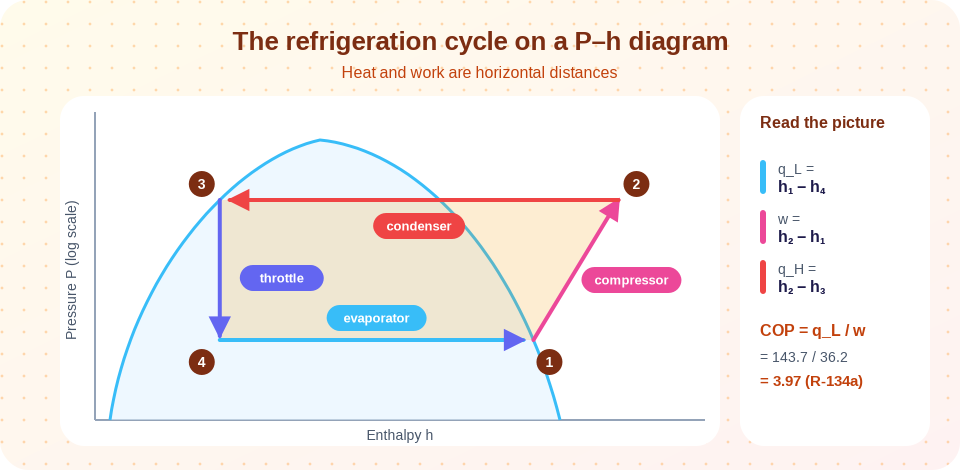
| Refrigerator COP | COP_R = Q_L / W = (h₁ − h₄) / (h₂ − h₁) |
| Heat pump COP | COP_HP = Q_H / W = COP_R + 1 |
| Reversed Carnot limits | T_L/(T_H − T_L) and T_H/(T_H − T_L) |
| Expansion valve | h₄ = h₃, adiabatic and no work |
| Compressor loss | h₂ = h₁ + (h₂s − h₁) / η_c |
| R-134a example | COP_R = 3.97, COP_HP = 4.97 |
| Absorption cycle | driven by heat, COP about 0.5 to 0.8 |
How the pieces connect
Reading a P–h diagram is the single most useful skill of the chapter. The cycle's horizontal edges are the heat and work: the evaporator is the bottom edge (h₄ → h₁), the compressor is the sloped side (h₁ → h₂), the condenser is the top edge (h₂ → h₃) and the throttle is the vertical drop at constant h. Moving the pressures changes the shape: raising the condenser pressure lengthens the compressor segment (more work, lower COP), lowering the evaporator pressure does the same.
Key terms. COP: useful transfer over work. Saturation dome: the region where liquid and vapor coexist. Subcooling: cooling liquid below its saturation temperature. Superheating: heating vapor above its saturation temperature. GWP: global warming potential.
Try it
Press Run (or Ctrl + Enter) to see the result here.
Program input · what you'd type while the program runs
Type the answers before you press Run, one per line. Each time the program reads a line (with input()), it gets the next line from this box.
Press Run (or Ctrl + Enter) to see the console output here.
No output.
Check your understanding
Quick check · 10 questions
of 10 answered You scored / 10 · perfect!
-
1. A refrigerator removes 450 W from the cold space with a COP of 3. What is the compressor power?
W = Q_L / COP = 450 / 3 = 150 W. -
2. How are COP_HP and COP_R of the same cycle related?
Q_H = Q_L + W, so dividing by W gives COP_HP = COP_R + 1. -
3. Where does the refrigerant temperature drop most abruptly?
Pressure drops at constant enthalpy and some liquid flashes to vapor, taking the mixture to the evaporator temperature. -
4. In a P-h diagram, the compressor work is...
w_in = h₂ − h₁. -
5. What does raising the condenser pressure do to COP?
The compressor must raise the vapor to a higher pressure, so w_in grows while q_L barely changes. -
6. A Carnot refrigerator runs between 270 K and 300 K. What is its COP?
270 / (300 − 270) = 9. -
7. Which treaty set a schedule to reduce HFC production?
The Kigali Amendment (2016) to the Montreal Protocol addresses HFCs. -
8. Which is true for a heat pump in colder weather?
Carnot and real COPs both decrease as T_H − T_L increases. -
9. Absorption refrigeration replaces the compressor with...
The generator uses heat to separate refrigerant from the solution. -
10. A throttling valve changes the refrigerant's...
Throttling is a constant-enthalpy process.
Summary
Q_H = Q_L + W,COP_R = Q_L/W,COP_HP = COP_R + 1.- The vapor-compression cycle on a P–h diagram has four processes with enthalpy differences giving heat and work.
- Compressor losses, higher lift and fouled coils all reduce COP.
- Refrigerant choice balances safety, pressure and climate impact.