
























लेसन 33 · Deflection and Buckling
Chapter 7 overview: deflection and buckling
See why stiffness and stability matter as much as strength, and preview the methods for beam deflection and Euler column buckling in this chapter.
A beam can be strong enough and still be a bad beam. A floor that sags by a centimeter cracks its plaster and makes the dishes rattle. A shaft that deflects too much wears out its bearings. A machine-tool bed that bends by a hundredth of a millimeter ruins the accuracy of every part it makes. And a slender column can collapse suddenly at a load far below what its material strength predicts, with no warning at all. This chapter covers the two checks that sit beside strength: stiffness (how much does it deflect?) and stability (will it buckle?).
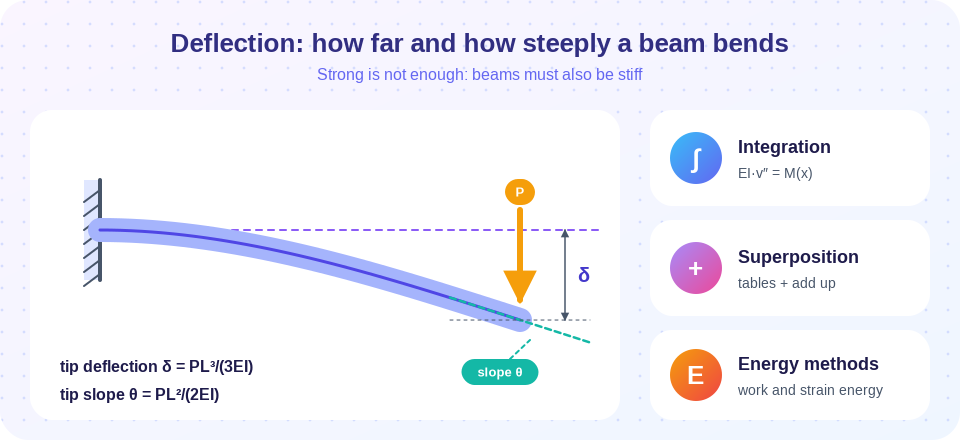
What you will learn
- Why the same moment gives more curvature in a less stiff beam:
1/ρ = M/(EI). - The idea behind the three main methods for deflections.
- Why columns fail by buckling, and what controls the buckling load.
- Typical serviceability limits and how to check them.
Strength, stiffness, stability
Engineers check three separate things:
| Check | Question | Typical limit |
|---|---|---|
| Strength | Is σ below the allowable stress? |
σ ≤ σallow |
| Stiffness | Is the deflection δ small enough? |
δ ≤ L/360 for many floors (the design code decides) |
| Stability | Is the compressive load below the buckling load? | P ≤ Pcr / FS |
Deflection formulas always contain EI, called the flexural rigidity. E measures the material's stiffness; I measures the section's. Steel and aluminum beams of the same shape differ by a factor of three in deflection because E differs by about that much. And since I grows with the cube of depth, the cheapest way to make a beam stiffer is to make it deeper.
Why deflection matters
Three methods
Why columns buckle
What sets Pcr
Try it
Deflection grows with the cube of the span. This console tool takes a simply supported steel beam (100 × 200 mm, E = 200 GPa) with a 20 kN center load and reports δ = PL³/(48EI) and the ratio L/δ for spans from 2 m to 8 m.
Press Run (or Ctrl + Enter) to see the console output here.
No output.
A taller version of the same beam is much stiffer. Try changing 200 (the depth) to 300 and see the deflections shrink by a factor of (300/200)³ = 3.4.
What each lesson covers
| Lesson | Key question |
|---|---|
| The elastic curve and the integration method | How do I get slope and deflection from M(x)? |
| Superposition and standard cases | How do I use tables and add effects, even for statically indeterminate beams? |
| Euler buckling of columns | What load makes a slender column buckle? |
| Chapter 7 review | Can I check strength, stiffness and stability together? |
Check your understanding
Quick check · 3 questions
of 3 answered You scored / 3 · perfect!
-
1. What does the product EI represent?
E is the material stiffness and I the section stiffness; together they set how much a beam curves for a given moment. -
2. A simply supported beam's span doubles with the same center load. Its deflection is multiplied by...
δ = PL³/(48EI), so δ grows with L³: 2³ = 8. -
3. Which failure mode can happen at a load far below the crushing strength of the material?
Slender columns bow sideways (buckle) at a load that depends on stiffness and length, not strength.
Summary
- Beams and columns need checking for strength, stiffness (deflection) and stability (buckling).
- Deflection formulas carry
1/(EI); the depth of the section is the strongest lever becauseIgrows withh³. - Deflection grows with
L³orL⁴, so long spans are very sensitive to the span. - Three methods give deflections: integration, standard tables, and superposition.
- Columns fail by sudden sideways buckling when the load reaches
Pcr.
अपनी प्रगति ट्रैक करें
मुफ़्त अकाउंट बनाएँ, लेसन पूरे के रूप में चिह्नित करें और किसी भी डिवाइस पर वहीं से शुरू करें जहाँ छोड़ा था।