
























लेसन 43 · Dark Matter, Dark Energy and Frontiers
Chapter 8 review: Dark matter, dark energy and frontiers
Review chapter 8 with a one-picture summary, a recap table, practice calculations on the cosmic budget and lensing, and a ten-question quiz.
Chapter 8 asked what the universe is made of and why we trust the answer. Dark matter, with its many independent lines of evidence, is a gravitational mystery. Dark energy, discovered by supernovae, is a cosmological one. Both sit inside a model, ΛCDM, that works well but is now being tested in new ways. Check yourself here.
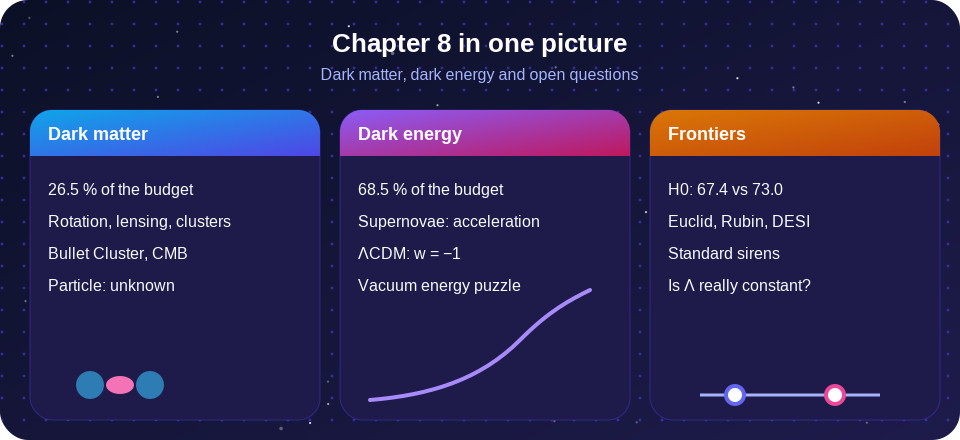
Recap table
| Idea | Key statement | Lesson |
|---|---|---|
| Budget | 68.5 % dark energy, 26.5 % dark matter, 4.9 % atoms | Overview |
| Cluster mass | M ≈ 3σ²R/G, about 10¹⁵ solar masses for rich clusters |
Dark matter evidence |
| Lensing | θ_E = √(4GM/c² × D_LS/(D_L D_S)) |
Dark matter evidence |
| Bullet Cluster | Mass separated from gas: collisionless dark matter | Dark matter evidence |
| Supernovae | Distant Type Ia are fainter: acceleration | Dark energy |
| Cosmological constant | w = −1, q₀ = Ω_m/2 − Ω_Λ ≈ −0.55 |
Dark energy |
| Vacuum energy problem | Predicted value too large by tens to 120 orders | Dark energy |
| Hubble tension | 73.0 vs 67.4 km/s/Mpc, about 5σ | Tensions |
| Standard sirens | Distance from the gravitational waveform | Tensions |
Try it
Press Run (or Ctrl + Enter) to see the result here.
Program input · what you'd type while the program runs
Type the answers before you press Run, one per line. Each time the program reads a line (with input()), it gets the next line from this box.
Press Run (or Ctrl + Enter) to see the console output here.
No output.
Check your understanding
Quick check · 10 questions
of 10 answered You scored / 10 · perfect!
-
1. Which fraction of the universe's energy is ordinary matter?
Atoms make up about 4.9 percent. -
2. A cluster has velocity dispersion 1,200 km/s and radius 2 Mpc. Roughly what mass does the virial estimate give? (G = 4.3e-9 Mpc (km/s)^2/Msun)
M = 3 × 1200^2 × 2 / 4.3e-9 is about 2×10^15. -
3. What did the Bullet Cluster show?
The mass peaks passed through each other; the gas lagged. -
4. Why is dark matter not made mostly of MACHOs?
Microlensing surveys find too few, and baryons are limited to 5 percent by BBN and the CMB. -
5. In a flat universe with Omega_Lambda = 0.7, q0 equals:
q0 = 0.3/2 - 0.7 = -0.55. -
6. At z = 0.5, supernovae in an accelerating universe are:
They are farther away than a decelerating universe predicts, so fainter. -
7. What is w for the cosmological constant?
P = -rho c^2. -
8. What is the size of the Hubble tension, in standard deviations?
(73.0 - 67.4)/sqrt(1.0^2 + 0.5^2) is about 5. -
9. A standard siren measures distance using:
The waveform gives the luminosity distance directly. -
10. Which would be the strongest hint of new physics in dark energy?
A reproducible detection of evolving w would be inconsistent with a cosmological constant.
Summary
- Dark matter (26.5 %) is supported by rotation curves, clusters, lensing, the Bullet Cluster and the CMB; its nature is unknown.
- Dark energy (68.5 %) makes the expansion accelerate; a cosmological constant (
w = −1) fits, but the vacuum energy problem is unsolved. - The Hubble tension and other puzzles are being tested by Euclid, Rubin, DESI, JWST and gravitational-wave astronomy.
अपनी प्रगति ट्रैक करें
मुफ़्त अकाउंट बनाएँ, लेसन पूरे के रूप में चिह्नित करें और किसी भी डिवाइस पर वहीं से शुरू करें जहाँ छोड़ा था।