
























레슨 39 · Combustion and Applications
Combustion stoichiometry
Balance combustion equations for hydrocarbon fuels, compute theoretical and excess air, air-fuel ratio, product composition and the dew point of exhaust, with worked examples.
Before you can ask how much heat a fuel releases, you need to know what the reaction looks like: how many moles of air reach each mole of fuel, and what comes out. This bookkeeping is called stoichiometry, and it rests on one principle, conservation of atoms. Every atom of carbon, hydrogen, oxygen and nitrogen that enters the combustion chamber must leave it. Learn to balance a combustion equation once and you can do it for any fuel.
What you will learn
- Balance a hydrocarbon combustion equation with theoretical air.
- Compute air-fuel ratio, excess air and equivalence ratio.
- Find product composition on a wet and on a dry basis.
- Find the dew point of the exhaust and explain why it matters.
Key terms
Theoretical (stoichiometric) air is the minimum air for complete combustion. Excess air is air above the theoretical amount, as a percentage. Air-fuel ratio AF is the mass of air divided by the mass of fuel. Equivalence ratio φ is the actual fuel-air ratio divided by the stoichiometric fuel-air ratio; φ < 1 is lean, φ > 1 is rich. Dry-basis analysis gives the exhaust composition after removing the water.
Balancing a combustion equation
For a hydrocarbon C_x H_y burned completely with theoretical air, the products are only CO₂, H₂O and N₂:
C_x H_y + a_th (O₂ + 3.76 N₂) → x CO₂ + (y/2) H₂O + 3.76 a_th N₂
and the theoretical oxygen is a_th = x + y/4. Check with methane (x = 1, y = 4): a_th = 1 + 1 = 2.
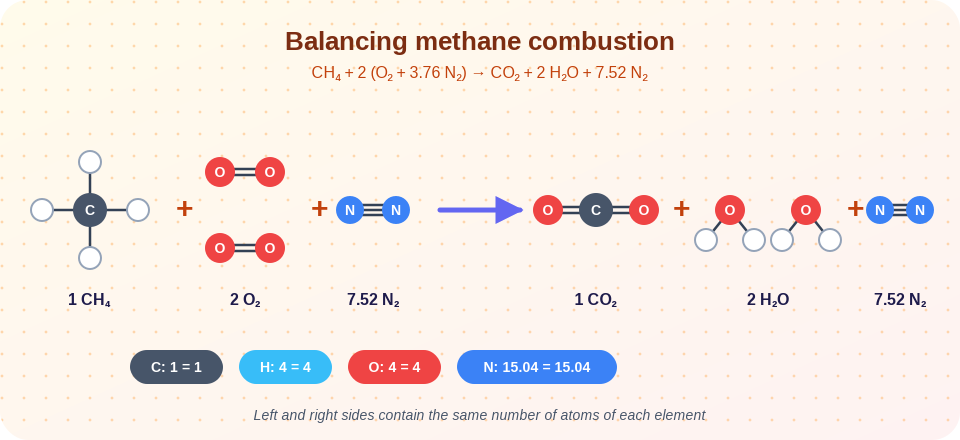
CH₄ + 2 (O₂ + 3.76 N₂) → CO₂ + 2 H₂O + 7.52 N₂
Count atoms: carbon 1 = 1; hydrogen 4 = 4; oxygen 4 = 2 + 2; nitrogen 7.52 = 7.52. For octane (x = 8, y = 18): a_th = 8 + 4.5 = 12.5.
C₈H₁₈ + 12.5 (O₂ + 3.76 N₂) → 8 CO₂ + 9 H₂O + 47 N₂
Air-fuel ratio
Convert moles to mass with molar masses (air: 28.97 kg/kmol):
AF = (a_th × 4.76 × 28.97) / M_fuel
- Methane:
AF = 2 × 4.76 × 28.97 / 16.043 = 17.19 kg air per kg fuel. - Propane (
a_th = 5,M = 44.097):AF = 15.64. - Octane (
M = 114.23):AF = 15.09.
These stoichiometric values are why petrol engines target roughly 14.7 kg of air per kg of fuel for commercial gasoline, which is a blend slightly richer in carbon than octane.
Excess air
Real burners use more air than the theory demands, to be sure every fuel molecule finds oxygen. With 20 % excess air, the air supply is 1.2 × a_th. The extra oxygen passes through unburnt, and the extra nitrogen comes along. For methane with 20 % excess air:
CH₄ + 2.4 (O₂ + 3.76 N₂) → CO₂ + 2 H₂O + 0.4 O₂ + 9.024 N₂
The actual air-fuel ratio is 1.2 × 17.19 = 20.63. Too little air gives incomplete combustion (carbon monoxide, soot, unburned fuel), while too much air carries heat out of the stack and lowers efficiency. Gas boilers typically run with 5 to 20 % excess air; gas turbines with 200 to 300 % to keep the combustor below the temperature limit of the turbine blades.
Product composition
Wet basis counts all products. Dry basis removes the water, which is what a typical exhaust gas analyzer reports. For methane with 20 % excess air, the dry products total 1 + 0.4 + 9.024 = 10.424 kmol, so by mole the dry exhaust is 9.6 % CO₂, 3.8 % O₂ and 86.6 % N₂.
This is useful in reverse: from a measured O₂ percentage in a dry sample you can estimate how much excess air a burner is using. In methane combustion a dry O₂ reading of 2 % corresponds to about 9 % excess air, 4 % to about 21 %, and 6 % to about 36 %.
Dew point of the products
The combustion products contain water vapor. If the exhaust cools below the dew point, that water condenses and the acidic condensate corrodes chimneys and heat exchangers. Treat products as an ideal-gas mixture: the vapor partial pressure is P_v = y_H₂O × P_total, and the dew point is the saturation temperature at P_v.
- Stoichiometric methane:
y_H₂O = 2 / 10.52 = 0.190, so at 101.325 kPaP_v = 19.3 kPaandT_dp ≈ 59 °C. - 20 % excess air:
y_H₂O = 2 / 12.424 = 0.161,P_v = 16.3 kPaandT_dp ≈ 56 °C.
More excess air means more diluted water vapor and a lower dew point. A condensing boiler deliberately cools the flue gas below this temperature and recovers the latent heat of the water, which lifts its efficiency, measured on the lower heating value, above 100 %.
Common misconceptions
"Stoichiometric means everything burns perfectly." It means the right proportion; mixing quality and temperature still decide whether combustion is complete. "Excess air percent equals the O₂ percent in the exhaust." The relation is nonlinear and depends on the fuel. "Nitrogen does not matter, it is inert." It dominates the product mole count and sets the flame temperature.
Try it
Press Run (or Ctrl + Enter) to see the result here.
Program input · what you'd type while the program runs
Type the answers before you press Run, one per line. Each time the program reads a line (with input()), it gets the next line from this box.
Press Run (or Ctrl + Enter) to see the result here.
Program input · what you'd type while the program runs
Type the answers before you press Run, one per line. Each time the program reads a line (with input()), it gets the next line from this box.
Check your understanding
Quick check · 6 questions
of 6 answered You scored / 6 · perfect!
-
1. How many kmol of O2 does 1 kmol of propane (C3H8) need for complete combustion?
a_th = x + y/4 = 3 + 2 = 5. -
2. Burning 1 kmol of CH4 with theoretical air produces how many kmol of N2?
3.76 × 2 = 7.52. -
3. A burner uses 30 % excess air. How many times the theoretical air is supplied?
Excess of 30 % means 1 + 0.3 = 1.3 times the theoretical amount. -
4. What does a lean mixture mean?
Equivalence ratio below 1: air is in excess. -
5. Why does more excess air lower the exhaust dew point?
P_v = y_H2O P, and y_H2O falls as extra air adds moles. -
6. What is the stoichiometric air-fuel ratio of methane by mass, roughly?
2 × 4.76 × 28.97 / 16.043 = 17.19.
Summary
- For
C_x H_y:a_th = x + y/4; productsx CO₂,y/2 H₂O,3.76 a N₂(plus leftover O₂ with excess air). AF = a × 4.76 × 28.97 / M_fuel; methane 17.19, propane 15.64, octane 15.09.- Dry-basis analysis reveals excess air from the O₂ reading.
- The exhaust dew point (about 59 °C for stoichiometric methane) decides whether flue gas condenses.