
























Bài 36 · Advanced and Functional Materials
Chapter Review: Advanced and Functional Materials
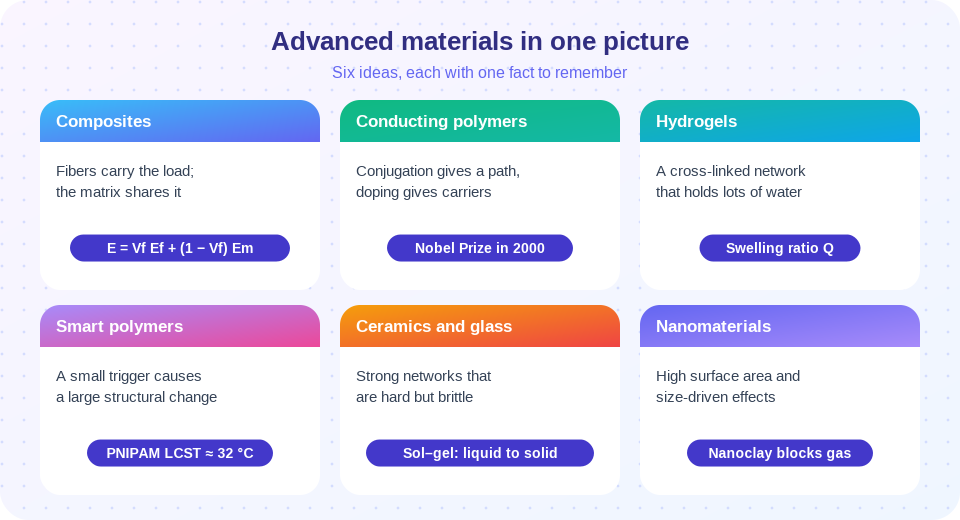
Review composites, conducting polymers, hydrogels, smart polymers, ceramics and nanomaterials with a summary picture, key equations and a ten-question quiz.
This chapter showed how structure is turned into function: aligned fibers for stiffness, conjugated and doped chains for conduction, cross-linked networks that swell and collapse, and inorganic or nanoscale components that add hardness, heat resistance or barrier properties. Here are the main ideas, the equations worth memorizing and a quiz that mixes the whole chapter.
Try the self-test habit again: pick a product (a phone screen, a diaper, a bicycle frame) and say which of the six families is at work and what the structural reason is.
Key equations
Composite along fibers:   E = Vf Ef + (1 − Vf) Em
Composite across fibers:  1/E = Vf/Ef + (1 − Vf)/Em
Critical fiber length:    lc = σf d / (2 τ)
Conductivity:             σ = n q μ
Swelling ratio:           Q = Ws / Wd
Polyacid ionization:      α = 1 / (1 + 10^(pKa − pH))
Photon wavelength:        λ (nm) ≈ 1240 / E (eV)
How the lessons connect
The three lessons of this chapter look different, but they use the same few ideas. In a composite, a stiff phase and a soft phase share load, and the answer depends on whether they act in parallel or in series. In a conducting polymer, a conjugated backbone provides a pathway and doping provides carriers, and in a filled composite the pathway is built by particles touching, which is why percolation matters. In a hydrogel, a cross-linked network balances mixing, elasticity and ionic osmotic pressure, and a small change in temperature or pH tips the balance. In every case the lesson is the same: write down which structural feature supplies the function, then ask what could remove it.
Look also at the trade-offs. More fiber raises stiffness but eventually starves the matrix. More doping raises conductivity but can reduce stability. More cross-links make a gel stronger but let it swell less. Good design is the art of choosing a point on each trade-off curve that suits the application.
Self-check list
Before the quiz, make sure you can do each of these without notes:
- Compute the Voigt and Reuss moduli for a given fiber fraction, and explain in one sentence why they differ.
- Explain why a doped polymer conducts and an undoped one barely does, using the words band gap, polaron and carrier.
- Convert a pair of weights into a swelling ratio and a water content.
- Explain why PNIPAM collapses on heating even though most solids dissolve better when warm.
- Describe how a nanofiller such as clay can lower the permeability of a film.
- State one benefit and one weakness of ceramics and glass.
If one of these stalls you, reopen the matching lesson and redo the calculation in the Try it cell.
A mini-case to reason through
Imagine a wearable skin patch that must stay flexible, carry a small electrical signal and release a drug when the skin warms slightly. No single polymer does all three, so the design combines ideas from this chapter: a hydrogel matrix swollen with water for softness and comfort, a thermoresponsive component such as a PNIPAM copolymer whose transition sits near skin temperature, and a conductive pathway such as a PEDOT:PSS network above its percolation threshold. Each requirement points to a different structural feature, and the trade-offs (more conductor makes the gel stiffer, a higher transition temperature delays release) are exactly the ones you practiced.
Try it
Re-compute the chapter's headline numbers. Predict each before you run it.
Press Run (or Ctrl + Enter) to see the result here.
Program input · what you'd type while the program runs
Type the answers before you press Run, one per line. Each time the program reads a line (with input()), it gets the next line from this box.
Check your understanding
Quick check · 10 questions
of 10 answered You scored / 10 · perfect!
-
1. A composite has Vf = 0.5, Ef = 200 GPa and Em = 4 GPa. Its modulus along the fibers (Voigt) is:
0.5 × 200 + 0.5 × 4 = 102 GPa. -
2. For the same composite, the Reuss (transverse) modulus is about:
1/E = 0.5/200 + 0.5/4 = 0.0025 + 0.125 = 0.1275, so E ≈ 7.8 GPa. -
3. Why are fiber composites called anisotropic?
Stiffness along the fibers is much higher than across them. -
4. In a conducting polymer, what does doping do?
Doping creates polarons and bipolarons, which carry current. -
5. A film has n = 10²¹ cm⁻³ and μ = 0.1 cm²/(V s). Its conductivity is about:
σ = 1e21 × 1.602e-19 × 0.1 ≈ 16 S/cm. -
6. The percolation threshold is:
Below it, particles are isolated; above it, they connect across the sample. -
7. A gel weighs 0.4 g dry and 8 g swollen. Its swelling ratio is:
Q = 8 / 0.4 = 20. -
8. PNIPAM gels collapse when warmed above about:
That is its lower critical solution temperature. -
9. A polyacrylic acid gel (pKa about 4.5) swells most at:
At pH 8 nearly all acid groups are ionized, so charge repulsion and osmotic pressure are highest. -
10. Nanoclay reduces gas permeability mainly because it:
Exfoliated platelets create a tortuous diffusion path.
Summary
- Composites: fibers carry load, the matrix transfers it; properties are directional and follow the Voigt and Reuss bounds.
- Conducting polymers need conjugation plus doping;
σ = n q μ; percolation governs filled composites. - Hydrogels and smart polymers respond through swelling balance: temperature (LCST), pH (ionization), light and more.
- Ceramics, glass and nanofillers add hardness, heat resistance and barrier properties when well dispersed and bonded.
- Next: environmental responsibility, from biopolymers to recycling and life-cycle thinking.
Theo dõi tiến độ của bạn
Tạo tài khoản miễn phí để đánh dấu bài đã học và tiếp tục từ chỗ bạn dừng lại trên mọi thiết bị.