
























Bài 45 · Projects and Practice
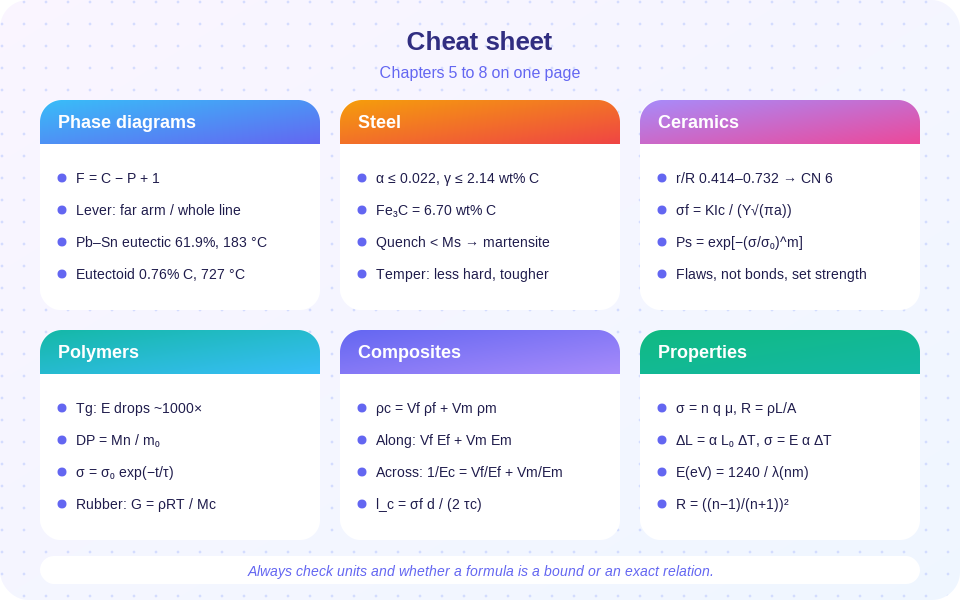
Cheat sheet: chapters 5 to 8 on one page
A one-page recap of phase diagrams, steel, ceramics, polymers, composites and functional properties: the key numbers, equations and decision rules in one place.
When you are solving a problem or revising before a test, you want the essentials on one page. This cheat sheet collects the numbers and equations from chapters 5 to 8. It is a memory aid, not a replacement for understanding: each line points back to a lesson.
What you will learn
- Recall the key numbers for Fe–C, Pb–Sn and Cu–Ni problems.
- Choose the right equation for a given problem.
- Convert between common units quickly.
Key terms
Bound: a limit on a property; for example, Voigt and Reuss give upper and lower bounds on composite stiffness.
Invariant: a reaction with F = 0, at fixed temperature and composition.
Numbers worth remembering
| Quantity | Value |
|---|---|
| Pb–Sn eutectic | 61.9 wt% Sn at 183 °C (α 19.2, β 97.5 wt% Sn) |
| Fe–C eutectoid | 0.76 wt% C at 727 °C |
| Fe–C eutectic | 4.30 wt% C at 1147 °C |
| Ferrite / austenite max carbon | 0.022 / 2.14 wt% C |
| Cementite | 6.70 wt% C |
| Silicon gap / density | 1.12 eV; 2.33 g/cm³ |
| Visible light | 400 to 750 nm, 3.1 to 1.65 eV |
| Curie temperatures | Ni 358 °C, Fe 770 °C, Co 1115 °C |
| Dulong–Petit | 3R ≈ 24.9 J/(mol·K) |
| Lorenz number | 2.44×10⁻⁸ W·Ω/K² |
Which equation do I use?
- "How much of each phase?" Draw a tie line, use the lever rule. Sum the fractions to 1.
- "What does this steel look like?" Compare carbon to 0.76 wt%: hypo (ferrite + pearlite), eutectoid (pearlite), hyper (cementite + pearlite).
- "How hard after quenching?" Compare cooling rate with the TTT nose; below Ms you get martensite; then temper.
- "Why did this ceramic break?" Griffith:
σf = K_Ic/(Y√(πa)); use Weibull for the scatter. - "Is this polymer stiff or rubbery?" Compare use temperature with Tg (and Tm).
- "What is the composite's stiffness?" Along fibers:
Vf Ef + Vm Em; across:1/Ec = Vf/Ef + Vm/Em. - "Will it conduct or absorb?" Compare gap Eg with the photon energy; metals have no gap.
- "How much does it expand, and what stress if held?"
ΔL = α L₀ ΔT;σ = E α ΔT.
Try it
Press Run (or Ctrl + Enter) to see the result here.
Program input · what you'd type while the program runs
Type the answers before you press Run, one per line. Each time the program reads a line (with input()), it gets the next line from this box.
Press Run (or Ctrl + Enter) to see the console output here.
No output.
Common misconceptions
"A cheat sheet replaces understanding." Equations apply only under their assumptions (equilibrium, fixed pressure, aligned fibers, normal incidence); know the limits.
"All numbers are exact." Properties vary with temper, temperature and source. Treat them as typical values.
Check your understanding
Quick check · 4 questions
of 4 answered You scored / 4 · perfect!
-
1. A 1.0 wt% C steel cooled slowly contains which proeutectoid phase?
Above the eutectoid composition, cementite forms along grain boundaries before pearlite. -
2. Which equation gives the stiffness of a composite along its fibers?
Isostrain rule of mixtures. -
3. A photon of wavelength 550 nm has energy about:
1240 / 550 ≈ 2.25 eV. -
4. What stress develops in a rigidly held steel bar (E = 200 GPa, α = 12×10⁻⁶ K⁻¹) heated by 50 K?
σ = 200e9 × 12e-6 × 50 = 1.2e8 Pa.
Summary
- Keep the numbers table and the "which equation" list at hand.
- Always state assumptions and check units.
Next: Further study
Theo dõi tiến độ của bạn
Tạo tài khoản miễn phí để đánh dấu bài đã học và tiếp tục từ chỗ bạn dừng lại trên mọi thiết bị.