
























Bài 44 · Projects and Practice
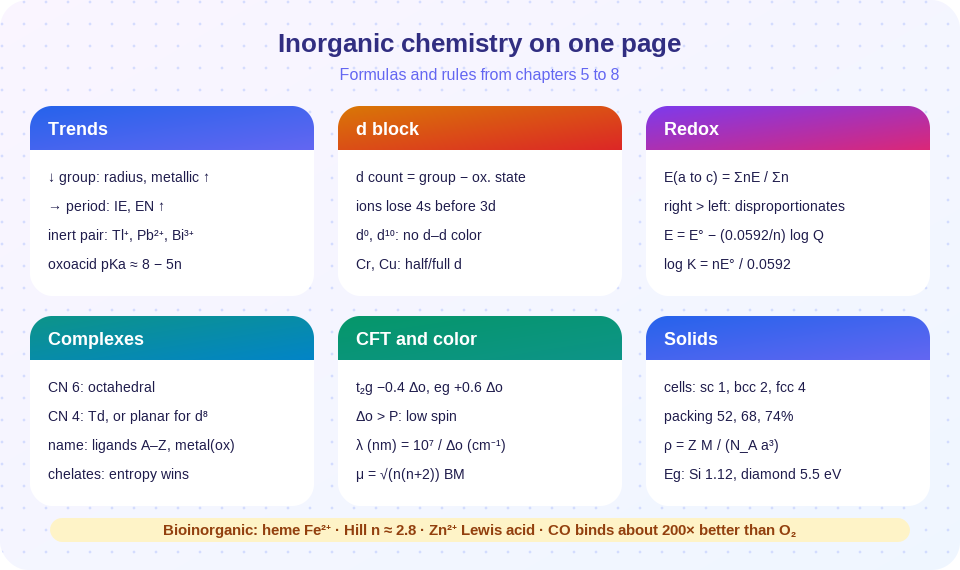
Cheat Sheet: Inorganic Chemistry Formulas and Rules
A one-page recap of the key rules, formulas, constants and unit conversions from main-group, transition metal, coordination and solid-state chemistry.
Keep this page open while you solve problems. It collects the rules and numbers you will use over and over, organized by chapter, together with a conversion table for the energy units that inorganic chemists mix constantly: wavenumbers, nanometers, electronvolts and kilojoules per mole.
What you will learn
- Find any key formula or rule in seconds.
- Convert between energy and wavelength units without mistakes.
- Recall the typical values used in the worked problems.
Chapter 5: main group
| Idea | Rule |
|---|---|
| Down a group | radius, metallic character increase; IE and EN decrease |
| Across a period | IE and EN increase; radius decreases |
| First-row anomaly | period 2 forms strong π bonds, no hypervalence |
| Inert pair effect | heavy p-block prefer oxidation state two lower: Tl⁺, Pb²⁺, Bi³⁺ |
| Oxoacid strength | pKa ≈ 8 − 5n (n = non-hydroxyl oxygens) |
| Halogens | E°(X₂/X⁻): F₂ +2.87, Cl₂ +1.36, Br₂ +1.07, I₂ +0.54 V |
| Haber / Ostwald / contact | N₂ + 3H₂ ⇌ 2NH₃ (Fe); NH₃ → HNO₃ (Pt–Rh); SO₂ → SO₃ (V₂O₅) |
Chapter 6: transition metals
| Idea | Rule |
|---|---|
| d count | group number − oxidation state |
| Ions | 4s electrons are removed before 3d |
| Anomalies | Cr [Ar]3d⁵4s¹, Cu [Ar]3d¹⁰4s¹ |
| Latimer | E(a→c) = ΣnE / Σn; disproportionation if right > left |
| Frost | low point stable; point above chord disproportionates |
| Nernst (25 °C) | E = E° − (0.0592/n) log Q; MnO₄⁻/Mn²⁺: E = 1.51 − 0.0947 pH |
| Equilibrium | ΔG° = −nFE°; log K = nE°/0.0592 |
Chapter 7: coordination
| Idea | Rule |
|---|---|
| Oxidation state | charge of complex − sum of ligand charges |
| Geometry | CN 6 octahedral; CN 4 tetrahedral, or square planar for d⁸ |
| Naming | ligands alphabetical; Roman numeral; anionic complex ends in -ate |
| Octahedral splitting | t₂g −0.4 Δo; eg +0.6 Δo |
| Spin state | Δo > P: low spin; Δo < P: high spin (d⁴ to d⁷ only) |
| CFSE | (−0.4 n(t₂g) + 0.6 n(eg)) Δo + pairing corrections |
| Tetrahedral | Δt ≈ 4/9 Δo, almost always high spin |
| Color | λ (nm) = 10⁷ / Δo (cm⁻¹) for d¹ and d³ |
| Magnetism | μ = √(n(n+2)) Bohr magnetons |
Chapter 8: solids and bioinorganic
| Idea | Rule |
|---|---|
| Atoms per cubic cell | sc 1, bcc 2, fcc 4 |
| Packing efficiency | 52%, 68%, 74% |
| Density | ρ = Z M / (N_A a³) |
| Touching | fcc: 4r = a√2; bcc: 4r = a√3 |
| Radius ratio | 0.225–0.414 CN 4; 0.414–0.732 CN 6; 0.732–1.0 CN 8 |
| Born–Haber (NaCl, kJ/mol) | 107 + 122 + 496 − 349 + U = −411, so U = −787 |
| Bands | metal: partly filled; semiconductor: Eg about 0.5–3 eV; insulator: larger |
| LED | λ (nm) = 1239.84 / Eg (eV) |
| Hemoglobin | Hill n ≈ 2.8, P50 ≈ 26 mmHg; myoglobin P50 ≈ 2.8 mmHg |
Constants and conversions
| Quantity | Value |
|---|---|
| Avogadro constant | 6.02214 × 10²³ mol⁻¹ |
| Faraday constant | 96,485 C/mol |
| 0.0592 V | (RT ln 10)/F at 25 °C |
| 1 eV | 96.485 kJ/mol = 8,065.5 cm⁻¹ |
| 1 cm⁻¹ | 0.011963 kJ/mol |
| hc | 1239.84 eV·nm |
| kT at 300 K | 0.02585 eV |
| Bohr magneton | μB = 9.274 × 10⁻²⁴ J/T |
Common misconceptions
"A cheat sheet replaces understanding." The formulas only help if you know when each applies; use the practice lesson to build that judgment.
"The units in a formula are optional." Wavenumbers, nanometers, electronvolts and kJ/mol are different measures; convert deliberately.
Try it
First, a unit converter for wavelength, wavenumber, energy in eV and energy in kJ/mol. Start from any one of them.
Press Run (or Ctrl + Enter) to see the console output here.
No output.
Second, check the constants against each other: the relation between 0.0592 V, RT/F and the energy conversions.
Press Run (or Ctrl + Enter) to see the result here.
Program input · what you'd type while the program runs
Type the answers before you press Run, one per line. Each time the program reads a line (with input()), it gets the next line from this box.
Check your understanding
Quick check · 4 questions
of 4 answered You scored / 4 · perfect!
-
1. A band at 500 nm corresponds to what wavenumber?
10⁷ / 500 = 20,000 cm⁻¹. -
2. Roughly how many kJ/mol is 1 eV?
1 eV per particle is 96.485 kJ/mol. -
3. What does the 0.0592 in the Nernst equation represent?
It equals (RT/F) × ln 10 at 298 K, about 0.0592 V. -
4. What is the density formula for a cubic metal?
Mass of Z atoms divided by cell volume.
Summary
- Rules and formulas for each chapter fit on a page; knowing when to use each is the real skill.
- Convert units deliberately: λ = 10⁷/ν̃, E = 1239.84/λ, 1 eV = 96.485 kJ/mol.
- The constants table links electrochemistry (0.0592), spectroscopy and thermal energy (kT).
Next: Further Study
Theo dõi tiến độ của bạn
Tạo tài khoản miễn phí để đánh dấu bài đã học và tiếp tục từ chỗ bạn dừng lại trên mọi thiết bị.