
























Bài 20 · Enzymes and Kinetics
Chapter 4 review: Enzymes and Kinetics
Review chapter 4: transition-state catalysis, Michaelis-Menten kinetics, kcat and Km, inhibitor types and enzyme regulation, with a ten-question quiz.
Enzymes are where chemistry becomes biology: they decide which reactions happen, how fast and when. This review gathers chapter 4 into one page. Try the quiz first without looking back, then use the recap table to find gaps.
What you will learn
- Recall the key concepts and equations of chapter 4.
- Practice kinetic calculations and inhibitor identification.
- Prepare for chapter 5 (carbohydrates and lipids) and chapter 6 (metabolism).
Recap table
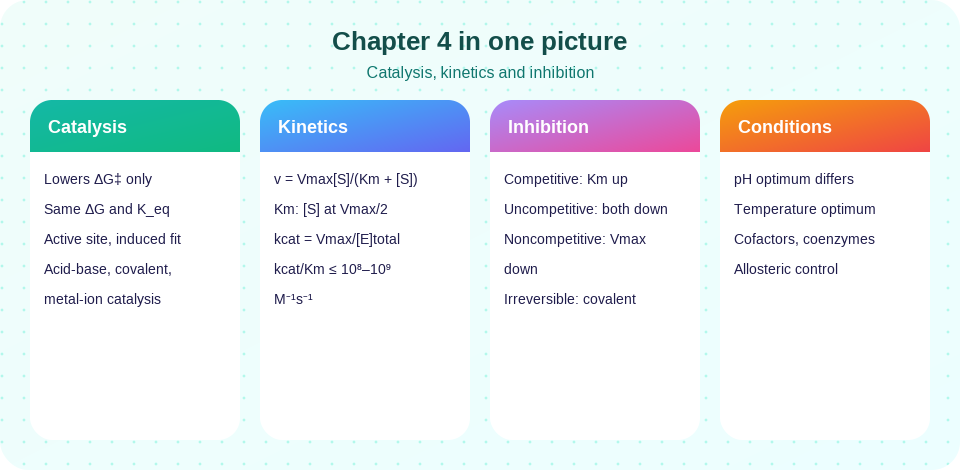
| Topic | What to remember |
|---|---|
| Catalysis | enzymes lower ΔG‡ by stabilizing the transition state; ΔG and K unchanged; 5.7 kJ/mol ≈ factor 10 at 25 °C |
| Active site | induced fit; proximity, strain, acid-base, covalent and metal-ion catalysis |
| Chymotrypsin | Ser195-His57-Asp102 triad, oxyanion hole, acyl-enzyme intermediate |
| Michaelis–Menten | v = Vmax[S]/(Km + [S]); Vmax = kcat[E]t; Km = [S] at Vmax/2 |
| Efficiency | kcat/Km; diffusion limit about 10⁸ to 10⁹ M⁻¹ s⁻¹ |
| Lineweaver–Burk | slope Km/Vmax; y-intercept 1/Vmax; x-intercept −1/Km |
| Competitive | Km up, Vmax same; overcome by [S] |
| Uncompetitive | Km and Vmax both down; parallel lines |
| Noncompetitive | Vmax down, Km same |
| Regulation | allostery, feedback, phosphorylation, zymogens, pH, temperature, cofactors |
Key terms
Transition state: the highest-energy point on the reaction path.
Km / Vmax / kcat: half-saturation substrate concentration, maximum rate, turnover number.
Ki: inhibitor dissociation constant.
Zymogen: inactive precursor of an enzyme.
Holoenzyme: apoenzyme plus its cofactor.
Common misconceptions
"Enzymes change the equilibrium." They only change how fast equilibrium is reached.
"Km measures speed." Km is a concentration; kcat measures speed.
"All inhibitors can be overcome with more substrate." Only competitive ones.
Try it
Compare enzymes by catalytic efficiency. The numbers are typical literature-style values rounded to powers of ten (approximate); the code computes kcat/Km and checks against the diffusion limit.
Press Run (or Ctrl + Enter) to see the result here.
Program input · what you'd type while the program runs
Type the answers before you press Run, one per line. Each time the program reads a line (with input()), it gets the next line from this box.
Self-test with flashcards. Click to flip.
Check your understanding
Quick check · 10 questions
of 10 answered You scored / 10 · perfect!
-
1. What is the effect of an enzyme on the equilibrium constant?
Enzymes speed both directions equally; K depends only on delta G. -
2. An enzyme has Vmax = 60 µmol/min and Km = 3 mM. What is v at [S] = 9 mM?
v = 60 × 9/(3 + 9) = 45 µmol/min. -
3. Which parameter is proportional to total enzyme concentration?
Vmax = kcat [E]t, whereas Km and kcat are per-enzyme properties. -
4. A drug that binds only the ES complex and gives parallel Lineweaver-Burk lines is:
Uncompetitive inhibitors lower both Km and Vmax equally, giving parallel lines. -
5. In chymotrypsin the oxyanion hole stabilizes:
Backbone N-H groups hydrogen-bond the developing negative oxygen of the transition state. -
6. Lowering ΔG‡ by 11.4 kJ/mol at 25 °C speeds a reaction by about:
11.4 kJ/mol is two times 5.7, i.e. a factor of 10^2. -
7. Aspirin inhibits cyclooxygenase by:
Aspirin irreversibly acetylates a serine in the enzyme. -
8. Which describes feedback inhibition?
The final product of a pathway shuts down an early step. -
9. The Lineweaver-Burk y-intercept equals:
At 1/[S] = 0, 1/v = 1/Vmax. -
10. Which enzyme is catalytically near the diffusion limit?
Values around 10^8 to 10^9 M^-1 s^-1 are at the diffusion limit.
Summary
- Enzymes lower activation energy by stabilizing the transition state; thermodynamics is unchanged.
- Michaelis–Menten kinetics describe saturation; Km, Vmax, kcat and kcat/Km summarize an enzyme.
- Inhibitor type is revealed by how Km and Vmax change and by Lineweaver–Burk patterns.
- Cells regulate enzymes by allostery, feedback, modification, zymogens, pH, temperature and cofactors.
- You have now finished the first four chapters of this track; chapters 5 to 9 continue with carbohydrates, lipids, metabolism, nucleic acids, signaling and projects.
Theo dõi tiến độ của bạn
Tạo tài khoản miễn phí để đánh dấu bài đã học và tiếp tục từ chỗ bạn dừng lại trên mọi thiết bị.