
























Bài 35 · Language, Religion and Art
Chapter 7 Review: Language, Religion and Art
Review chapter 7 with a one-picture summary, a recap table, a self-check tool and a ten-question quiz on language, ritual, belief, art and material culture.
Chapter 7 followed meaning through three systems: language, ritual and religion, and art and objects. Read the picture, scan the table and take the quiz before you look back at the lessons.
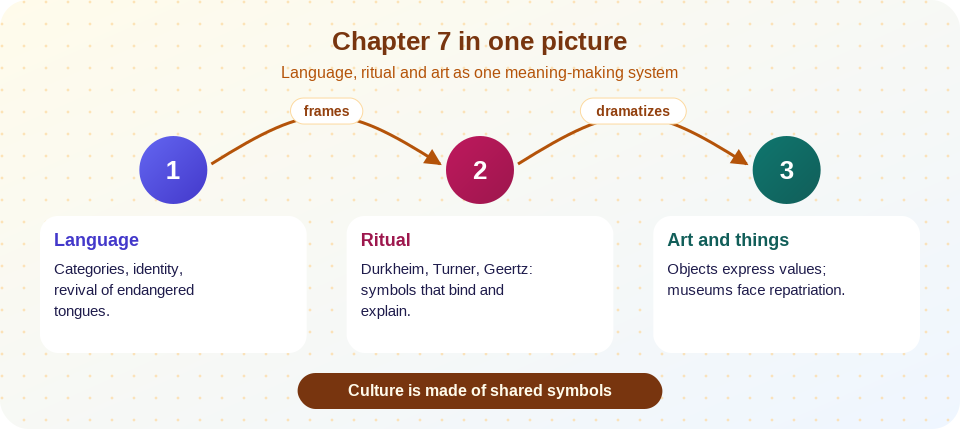
The chapter in a table
| Topic | Key idea | Names and cases |
|---|---|---|
| Linguistic relativity | Weak influence on attention, not a prison | Sapir, Whorf, Malotki |
| Color terms | A proposed sequence of basic terms, later revised | Berlin and Kay |
| Directions | Absolute versus relative frames of reference | Guugu Yimithirr, Levinson |
| Speech in context | Register, code-switching, honorifics | Hymes |
| Language endangerment | Shift and revival | Kōhanga Reo, Pūnana Leo |
| Religion | Social solidarity, uncertainty, explanation, symbols | Durkheim, Malinowski, Evans-Pritchard, Geertz |
| Rites of passage | Separation, liminality, incorporation | Van Gennep, Turner |
| Art | Skill, agency and meaning | Boas, Gell |
| Objects | Biographies, tourist art, repatriation | Kopytoff, Appadurai, NAGPRA |
Try it
Check yourself with a simple tracker. Replace the numbers with your quiz scores.
Press Run (or Ctrl + Enter) to see the result here.
Program input · what you'd type while the program runs
Type the answers before you press Run, one per line. Each time the program reads a line (with input()), it gets the next line from this box.
Check your understanding
Quick check · 10 questions
of 10 answered You scored / 10 · perfect!
-
1. Most researchers today accept which version of linguistic relativity?
Weak relativity has some empirical support; strong determinism does not. -
2. What do Guugu Yimithirr speakers use to describe locations?
They use compass-like terms regardless of which way they face. -
3. What is code-switching?
Speakers shift languages for social and expressive reasons. -
4. According to Durkheim, what does collective effervescence do?
Gathering in ritual produces a feeling of unity that strengthens the group. -
5. Malinowski connected magic with
Magic clustered around risky, uncertain activities such as open-sea fishing. -
6. Which is the correct order of Van Gennep's phases?
People leave an old status, pass through an in-between phase and join the new status. -
7. Evans-Pritchard showed that Azande witchcraft beliefs
They answer 'why me, why now' alongside ordinary causes. -
8. Gell asked of art:
Gell treated art as a system of action that affects people. -
9. What does NAGPRA govern?
The 1990 law created a process for repatriation in the United States. -
10. Language shift is best described as
Shift happens as children stop learning the heritage language.
Summary
- Language shapes attention gently; context, register and ideology shape speech.
- Religion and ritual provide explanation, solidarity, ways to manage uncertainty and change of status.
- Art and objects express identity, hold memory, build relations and can act.
- Debates over repatriation connect meaning to power and ownership.
Next: Chapter 8 Overview: Globalization and Applied Anthropology
Theo dõi tiến độ của bạn
Tạo tài khoản miễn phí để đánh dấu bài đã học và tiếp tục từ chỗ bạn dừng lại trên mọi thiết bị.