
























บทเรียนที่ 27 · Daily Life and Questions
Time and dates
Tell the time, say the days of the week, months and days of the month in Japanese, and use the particle に correctly with time words.
Time words are the part of Japanese that most often trips up beginners, because they mix three things: the numbers you just learned, a few irregular readings, and a particle, に (ni), that is used with some time words and not with others. The good news is that the clock is very regular once you learn the hour word 時 (じ, ji) and the minute word 分 (ふん/ぷん, fun/pun). Dates are mostly regular too, apart from a famous set of special words for the first ten days of the month.
What you will learn
- Read and say clock times, including half past and minutes.
- Say the days of the week, months and days of the month.
- Use relative time words (today, tomorrow, last week).
- Know when to add に and when not to.
Key terms
時 (じ, ji): the hour counter, as in さんじ (sanji, three o'clock).
分 (ふん/ぷん, fun/pun): the minute counter; it changes sound after some numbers.
曜日 (ようび, youbi): day of the week; every weekday name ends in this.
に (ni): the particle that marks a specific point in time.
ごろ (goro): "around"; used with a clock time or date.
Telling the time
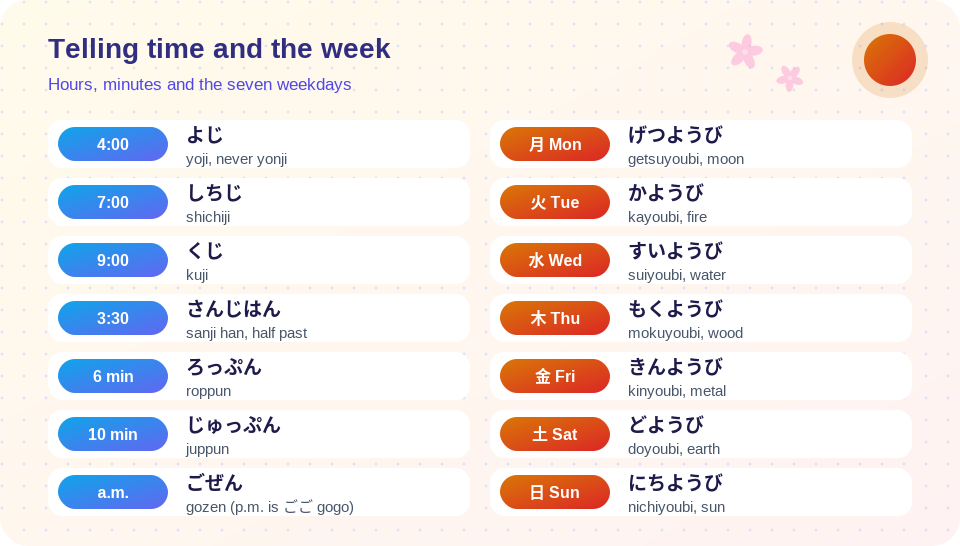
The hour is the number plus じ (ji). Most hours are regular, but three are special: 4 is よじ (yoji), 7 is しちじ (shichiji), and 9 is くじ (kuji). Never say yonji, nanaji or kyuuji.
| Time | Reading | Romaji |
|---|---|---|
| 1:00 | いちじ | ichiji |
| 2:00 | にじ | niji |
| 3:00 | さんじ | sanji |
| 4:00 | よじ | yoji |
| 5:00 | ごじ | goji |
| 6:00 | ろくじ | rokuji |
| 7:00 | しちじ | shichiji |
| 8:00 | はちじ | hachiji |
| 9:00 | くじ | kuji |
| 10:00 | じゅうじ | juuji |
| 11:00 | じゅういちじ | juuichiji |
| 12:00 | じゅうにじ | juuniji |
For minutes, you add ふん (fun) or ぷん (pun) to the number. The rule is the same one you saw with 本: after 1, 3, 4, 6, 8 and 10 the sound is ぷん, and after other numbers it is ふん. In addition, 1, 6, 8 and 10 shorten to いっ, ろっ, はっ and じゅっ. So five past is ごふん (gofun) but six past is ろっぷん (roppun), and ten is じゅっぷん (juppun). Half an hour is simply 半 (はん, han), which is why 3:30 is さんじはん (sanji han), and exact hours are often marked with ちょうど (choudo), "exactly."
| Minutes | Reading | Romaji |
|---|---|---|
| 1 | いっぷん | ippun |
| 2 | にふん | nifun |
| 3 | さんぷん | sanpun |
| 4 | よんぷん | yonpun |
| 5 | ごふん | gofun |
| 6 | ろっぷん | roppun |
| 7 | ななふん | nanafun |
| 8 | はっぷん | happun |
| 9 | きゅうふん | kyuufun |
| 10 | じゅっぷん | juppun |
Larger minutes combine tens and ones: 15 is じゅうごふん (juugofun), 25 is にじゅうごふん (nijuugofun), 20 is にじゅっぷん (nijuppun), and 45 is よんじゅうごふん (yonjuugofun). Notice that the tens carry the shortening in 10, 20, 30, 40 and 50: さんじゅっぷん (sanjuppun) for 30 and so on.
To say a.m. and p.m., put 午前 (ごぜん, gozen) or 午後 (ごご, gogo) before the time. So 7:15 a.m. is ごぜん しちじ じゅうごふん (gozen shichiji juugofun), and 2:45 p.m. is ごご にじ よんじゅうごふん (gogo niji yonjuugofun). Timetables, trains and broadcasts often use the 24-hour clock, so you may hear じゅうはちじ (juuhachiji, 18:00) at a station.
To ask the time, say なんじですか (nanji desu ka, "What time is it?") and answer with the time plus です. Use いま (ima, "now"): いま さんじはんです (ima sanji han desu), "It is half past three."
Days, months and dates
Every weekday ends in 曜日 (ようび, youbi) and is named after the sun, the moon and the five classical planets, which in Japanese tradition are linked to elements. That explains the kanji, and the kanji are worth knowing because the days are usually written with the first character only (月 for Monday).
| Day | Reading | Romaji | Element |
|---|---|---|---|
| Monday | げつようび | getsuyoubi | moon |
| Tuesday | かようび | kayoubi | fire |
| Wednesday | すいようび | suiyoubi | water |
| Thursday | もくようび | mokuyoubi | wood |
| Friday | きんようび | kinyoubi | metal |
| Saturday | どようび | doyoubi | earth |
| Sunday | にちようび | nichiyoubi | sun |
Months are the number plus 月 (がつ, gatsu): いちがつ (January), にがつ, さんがつ, しがつ (April), ごがつ, ろくがつ, しちがつ (July), はちがつ, くがつ (September), じゅうがつ, じゅういちがつ, じゅうにがつ (December). This is where the special readings of 4, 7 and 9 appear again: しがつ, しちがつ and くがつ, never yongatsu, nanagatsu or kyuugatsu.
Days of the month use 日 (にち, nichi), but the first ten are irregular, plus three others:
| Day | Reading | Romaji |
|---|---|---|
| 1 | ついたち | tsuitachi |
| 2 | ふつか | futsuka |
| 3 | みっか | mikka |
| 4 | よっか | yokka |
| 5 | いつか | itsuka |
| 6 | むいか | muika |
| 7 | なのか | nanoka |
| 8 | ようか | youka |
| 9 | ここのか | kokonoka |
| 10 | とおか | tooka |
| 14 | じゅうよっか | juuyokka |
| 20 | はつか | hatsuka |
| 24 | にじゅうよっか | nijuuyokka |
All the other days are number + にち: じゅういちにち (juuichinichi, the 11th), じゅうごにち (the 15th), にじゅうにち (the 22nd), さんじゅういちにち (the 31st). The dates order is large to small: 2026年3月4日 reads にせんにじゅうろくねん さんがつ よっか (nisen nijuuroku nen sangatsu yokka), year, month, day.
Relative time words and に
| Word | Reading | Meaning |
|---|---|---|
| 今日 | きょう (kyou) | today |
| 明日 | あした (ashita) | tomorrow |
| 昨日 | きのう (kinou) | yesterday |
| 毎日 | まいにち (mainichi) | every day |
| 今週 | こんしゅう (konshuu) | this week |
| 来週 | らいしゅう (raishuu) | next week |
| 先週 | せんしゅう (senshuu) | last week |
| 来月 | らいげつ (raigetsu) | next month |
| 今年 | ことし (kotoshi) | this year |
Use に with a specific point on the clock or calendar: しちじに おきます (shichiji ni okimasu), "I get up at seven"; にちようびに ともだちに あいます (nichiyoubi ni tomodachi ni aimasu), "I meet a friend on Sunday." Do not use に with relative words that already say "when": あした いきます (ashita ikimasu), "I will go tomorrow," not あしたに. With ごろ (around) the に is optional: しちじごろ おきます (shichiji goro okimasu), "I get up around seven."
To say "from ... until ..." use から (kara) and まで (made): くじから ごじまで はたらきます (kuji kara goji made hatarakimasu), "I work from nine to five." This is a clock time, not a length of time; to say "for three hours" use じかん (jikan): さんじかん (sanjikan).
Putting it together
Japanese word order puts the time first, then the place, then the other details, with the verb last. A full sentence can therefore be built from the lesson in layers: らいしゅうの にちようびの ごご さんじに、えきで ともだちに あいます (Raishuu no nichiyoubi no gogo sanji ni, eki de tomodachi ni aimasu), "Next Sunday at three in the afternoon, I will meet a friend at the station." Notice the small の between the time words, which links them like "of" in English, and the single に after the final clock time.
Here are two more sentences to practice reading aloud: まいにち しちじはんに おきます (Mainichi shichiji han ni okimasu), "I get up at seven thirty every day," and どようびは くじから ごじまで はたらきます (Doyoubi wa kuji kara goji made hatarakimasu), "On Saturdays I work from nine to five." If you wish to invite someone, use the negative question: にちようびに あいませんか (Nichiyoubi ni aimasen ka), "Would you like to meet on Sunday?" Say the time and the day clearly, and repeat them back when your friend agrees, to be sure you both understood.
A short dialogue
A: ぎんこうは なんじから なんじまでですか。 (Ginkou wa nanji kara nanji made desu ka.) What hours is the bank open? B: くじから さんじまでです。 (Kuji kara sanji made desu.) From nine to three. A: どようびは やすみですか。 (Doyoubi wa yasumi desu ka.) Is it closed on Saturdays? B: はい、やすみです。 (Hai, yasumi desu.) Yes, it is closed.
Common misconceptions
"Four o'clock is yonji." It is よじ (yoji). Remember the triplet よじ, しちじ, くじ.
"Always add に after time words." Add に for clock times, dates and weekdays. Skip it for きょう, あした, きのう, らいしゅう and similar words.
"Two days is ににち." Days of the month 1 to 10 are special words: ふつか is the 2nd and also "two days." The same words double as durations up to ten days.
Try it
This program reads any clock time. Try 4:00, 7:00, 9:00 and 12:30, and then add minutes that need ぷん, like 6 and 8.
Press Run (or Ctrl + Enter) to see the result here.
Program input · what you'd type while the program runs
Type the answers before you press Run, one per line. Each time the program reads a line (with input()), it gets the next line from this box.
The second program turns a date into Japanese, including the weekday, using the special words for the first ten days.
Press Run (or Ctrl + Enter) to see the result here.
Program input · what you'd type while the program runs
Type the answers before you press Run, one per line. Each time the program reads a line (with input()), it gets the next line from this box.
Check your understanding
Quick check · 5 questions
of 5 answered You scored / 5 · perfect!
-
1. How do you say 4:00?
4 o'clock is よじ (yoji). The hour words for 4, 7 and 9 are よじ, しちじ and くじ. -
2. Which sentence is correct?
Relative words like あした do not take に. Use に only with clock times, dates and weekdays. -
3. What is the 3rd day of the month?
Days 1 to 10 use special words: ついたち, ふつか, みっか (mikka), よっか and so on. -
4. How do you read 3:30?
Half past is 半 (はん): さんじはん (sanji han). -
5. Which month is しちがつ?
しちがつ (shichigatsu) is July. April is しがつ and September is くがつ.
Summary
- Hours use じ with the special readings よじ, しちじ and くじ; minutes use ふん or ぷん with shortened 1, 6, 8, 10.
- 半 means half past, and 午前 and 午後 mean a.m. and p.m.
- Weekdays end in ようび; months are number + がつ with しがつ, しちがつ and くがつ.
- Days 1 to 10, 14, 20 and 24 are special; others are number + にち.
- Use に with clock times, dates and weekdays, but not with きょう, あした or らいしゅう.
Next: Question words
ติดตามความคืบหน้าของคุณ
สร้างบัญชีฟรีเพื่อติ๊กบทเรียนที่เรียนแล้วและเรียนต่อจากจุดเดิมได้บนทุกอุปกรณ์