
























Lektion 19 · Drag and Performance
The drag polar and maximum L/D
Learn the parabolic drag polar, what CD0 and K mean, how to find the best lift-to-drag ratio and the speed to fly for it, with worked examples and live plots.
Every aircraft has a relationship between the drag it produces and the lift it makes. Plot lift coefficient against drag coefficient and you get a curve called the drag polar. It is the most useful single picture of an aircraft's aerodynamic performance. From it you can read the best lift-to-drag ratio, the speed for the longest glide, and the drag at any condition.
What you will learn
- The parabolic polar
CD = CD0 + K CL²and its two parts. - How the induced-drag factor K relates to span and efficiency.
- How to find the maximum L/D and the lift coefficient at which it occurs.
- How to compute the speed for best glide.
Key terms
Drag polar: the curve (or equation) giving CD as a function of CL for a given aircraft.
CD0: zero-lift drag coefficient, the parasite drag.
K: the lift-induced drag factor, K = 1 / (π e AR).
Aspect ratio (AR): wingspan squared divided by wing area, AR = b² / S.
Oswald efficiency factor (e): a number near 0.7 to 0.9 that says how close the wing is to ideal elliptical loading.
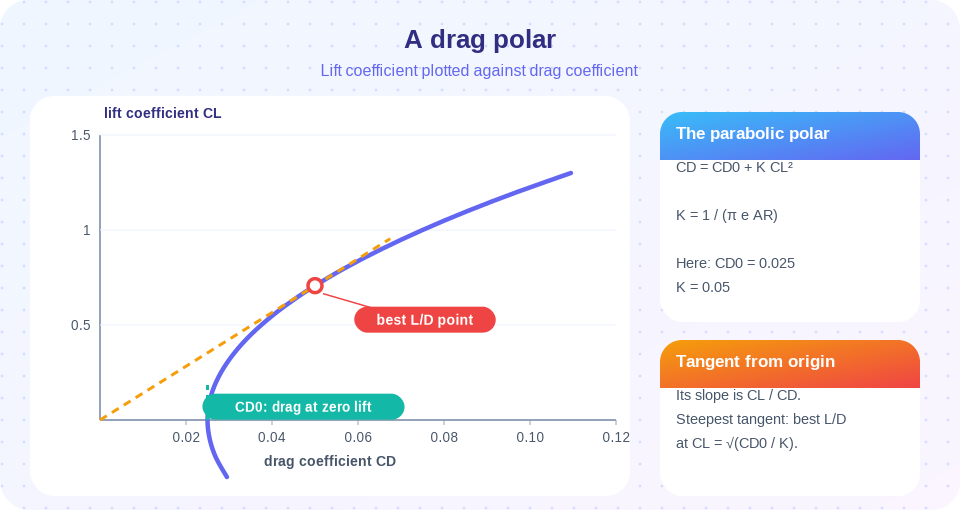
The parabolic polar
Experiments and theory agree on a simple model over the useful range of lift coefficients:
CD = CD0 + K CL²
CD0is what remains when lift is zero: the parasite drag of the previous lesson.K CL²is the lift-induced drag coefficientCDi. A wing that produces lift has to bend the air downward, and the tilt of the lift vector relative to the flight path creates a drag component. On a finite wing it isCDi = CL² / (π e AR), so
K = 1 / (π e AR)
A long, slender wing (large aspect ratio) has small K and low induced drag, which is why gliders and long-range airliners have long wings. Chapter 5 derives this. For now, take K as given. Typical values: light aircraft AR ≈ 7 to 8 and e ≈ 0.75, giving K ≈ 0.055; an airliner AR ≈ 9 and e ≈ 0.8 gives K ≈ 0.044; a high-performance glider AR ≈ 25 gives K ≈ 0.017.
Reading L/D from the polar
The lift-to-drag ratio at any point is
L/D = CL / CD = CL / (CD0 + K CL²)
On the polar, CL/CD is the slope of the line from the origin to the point. The steepest such line is the tangent from the origin. To find the optimum, differentiate L/D with respect to CL and set the result to zero. This gives
CL* = √(CD0 / K) CD* = 2 CD0 (L/D)max = 1 / (2 √(CD0 K))
Note the beautiful result CD* = 2 CD0: at the best L/D, the induced drag equals the parasite drag (each is CD0).
Worked example. CD0 = 0.025 and K = 0.05. Then CL* = √(0.025/0.05) = 0.707, CD* = 0.050, and (L/D)max = 0.707/0.050 = 14.1. Check with the formula: 1/(2√(0.025 × 0.05)) = 1/(2 × 0.0354) = 14.1. ✓
The speed for best L/D
In level flight L = W, so V = √(2W / (ρ S CL)). At best L/D:
V(L/D)max = √( 2 W / (ρ S CL*) )
For W = 10,791 N, S = 16.2 m², ρ = 1.225 kg/m³ and CL* = 0.707: V = √(2 × 10,791 / (1.225 × 16.2 × 0.707)) = √1,538 = 39.2 m/s. That is the speed at which this aircraft glides farthest in still air, and minimum thrust is needed in level flight: Dmin = W / (L/D)max = 10,791 / 14.1 = 763 N. Heavier aircraft must fly faster to be at CL*, since V ∝ √W; but the best L/D itself does not depend on weight.
Limits of the parabolic polar
- At high CL near stall the real polar steepens because of separation.
- At high Mach numbers, wave drag adds a term to CD0 (Chapter 6).
- Cambered wings have their minimum drag at a positive CL, so a more general polar is
CD = CD0 + K (CL − CLmd)². - Flaps and landing gear change CD0 and e; every configuration has its own polar.
Common misconceptions
"Best L/D means minimum drag coefficient." Minimum CD occurs near CL = 0. Best L/D occurs at a higher CL where the ratio CL/CD peaks.
"A heavier aircraft has a worse glide ratio." The maximum L/D does not depend on weight. A heavier aircraft glides at the same angle, but at a higher speed, and so it descends faster.
"Induced drag is a defect of poor wings." Even a perfect wing has induced drag. A perfect (elliptical) wing has e = 1; real wings are slightly worse.
Try it
Press Run (or Ctrl + Enter) to see the result here.
Program input · what you'd type while the program runs
Type the answers before you press Run, one per line. Each time the program reads a line (with input()), it gets the next line from this box.
Check your understanding
Quick check · 5 questions
of 5 answered You scored / 5 · perfect!
-
1. At the speed for maximum L/D (parabolic polar), induced drag is:
CL* = sqrt(CD0/K) gives K CL² = CD0, so CDi = CD0 and CD = 2 CD0. -
2. With CD0 = 0.02 and K = 0.05, what is (L/D)max?
1 / (2 √(0.02 × 0.05)) = 1 / (2 × 0.0316) = 15.8. -
3. Increasing aspect ratio at constant e does what to K?
K = 1/(π e AR), so a larger AR gives a smaller K and less induced drag. -
4. Which aircraft has the largest maximum L/D?
Long, slender wings and a very clean surface give gliders L/D values of 40 or more. -
5. Does the maximum L/D of an aircraft depend on its weight?
(L/D)max = 1/(2√(CD0 K)) depends only on the polar; the speed for it scales with √W.
Summary
- The parabolic polar is
CD = CD0 + K CL²withK = 1/(π e AR). (L/D)max = 1/(2√(CD0 K))atCL* = √(CD0/K), where induced and parasite drag are equal.- Best-glide speed is
√(2W/(ρ S CL*)); it rises with √W. - Long, clean wings give high L/D.
Följ dina framsteg
Skapa ett gratis konto för att bocka av lektioner och fortsätta där du slutade, på vilken enhet som helst.