
























Lição 46 · Projects and Practice
Project: a diary in Japanese
Write a short daily diary in Japanese using the past tense and te-form: vocabulary for weather and feelings, linking words, model entries and an error-fixing game.
Keeping a diary is one of the best ways to turn what you know into what you can use. A diary entry is about yourself, so you already know the content: you only need to find the words. It is short, so you can finish it in ten minutes. And it uses exactly the grammar from the middle of this course: the polite past for what happened, and the te-form for linking one action to the next. In this project you will build a seven-day diary habit, with a template, a model text, and exercises for finding and fixing your own mistakes.
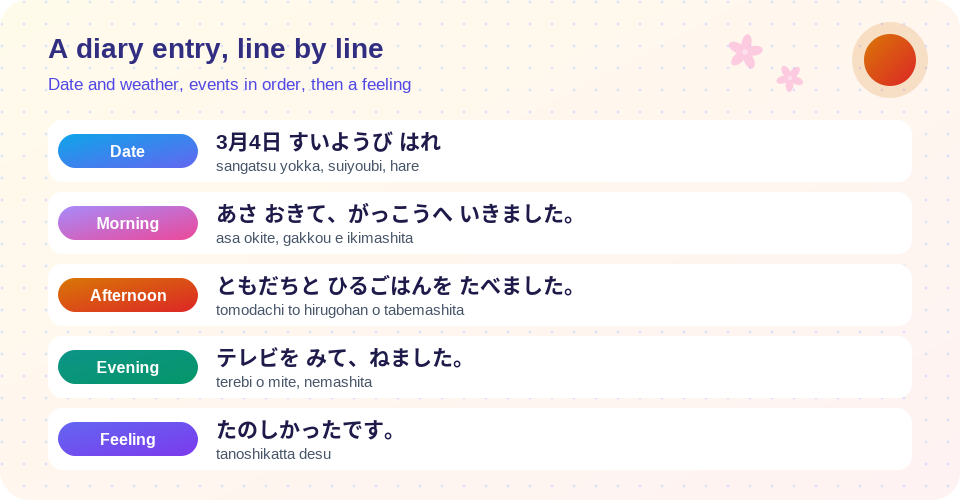
What you will learn
- Write a diary entry with the date, weather, events and feelings.
- Use the polite past and the te-form to link events.
- Use linking words such as それから, そして and でも.
- Find and correct typical mistakes in a draft.
Key terms
日記 (にっき, nikki): a diary.
てんき (tenki): weather.
つなぎことば (tsunagi kotoba): linking words such as そして (and) and でも (but).
〜ました (mashita): polite past ending for verbs.
〜て (te): the linking form that chains events.
The frame of a diary entry
A diary entry needs four parts, each of which you already know how to build.
- Date and weather. For example, 3月4日 すいようび はれ (Sangatsu yokka, suiyoubi, hare): "March 4, Wednesday, sunny." The date uses the number + 月 (がつ) and the special day words from chapter 5 (よっか for the 4th).
- Events in order. Use the te-form to chain actions within one sentence, and the past tense on the last verb: あさ おきて、あさごはんを たべて、がっこうへ いきました。
- Opinions and feelings. Use the past tense of い-adjectives: おいしかったです, たのしかったです, むずかしかったです.
- A closing line. A short wish or plan: あしたも がんばります (Ashita mo ganbarimasu), "I will do my best tomorrow too."
Weather and feelings
| Japanese | Romaji | Meaning |
|---|---|---|
| はれ | hare | sunny |
| くもり | kumori | cloudy |
| あめ | ame | rain |
| ゆき | yuki | snow |
| あつい | atsui | hot (weather) |
| さむい | samui | cold (weather) |
| すずしい | suzushii | cool |
| あたたかい | atatakai | warm |
| たのしい | tanoshii | fun |
| うれしい | ureshii | glad, happy |
| むずかしい | muzukashii | difficult |
| やさしい | yasashii | easy, kind |
| つかれました | tsukaremashita | I got tired (つかれる) |
| ねむい | nemui | sleepy |
To form the past tense of an adjective: おいしい becomes おいしかった (です); the weather is the same: さむかったです (samukatta desu), "It was cold."
Linking words
| Word | Romaji | Meaning |
|---|---|---|
| そして | soshite | and, and then |
| それから | sorekara | after that |
| でも | demo | but |
| だから | dakara | so, therefore |
| あとで | ato de | later |
| まだ + negative | mada | not yet |
A model diary
3月4日 すいようび はれ きょうは あさ ろくじはんに おきました。 あさごはんを たべて、がっこうへ いきました。 がっこうで にほんごの しけんが ありました。 むずかしかったです。 でも、たのしかったです。 ひるごはんは ともだちと たべました。 よるは うちで テレビを みて、ねました。 (Sangatsu yokka, suiyoubi, hare. Kyou wa asa rokujihan ni okimashita. Asagohan o tabete, gakkou e ikimashita. Gakkou de nihongo no shiken ga arimashita. Muzukashikatta desu. Demo, tanoshikatta desu. Hirugohan wa tomodachi to tabemashita. Yoru wa uchi de terebi o mite, nemashita.) March 4, Wednesday, sunny. Today I got up at six thirty in the morning. I ate breakfast and went to school. We had a Japanese test at school. It was difficult. But it was fun. I ate lunch with a friend. In the evening I watched TV at home and went to bed.
Look at how the entry uses the grammar of earlier chapters:
- Time and に: ろくじはんに おきました uses に with a clock time, while きょうは and よるは use topic markers.
- Te-form chain: あさごはんを たべて、がっこうへ いきました: only the last verb takes the past ending.
- Existence in the past: ありました (arimashita), "there was" (for events or objects).
- い-adjective past: むずかしかったです, たのしかったです.
- でも: a short contrast between two feelings.
A weekend entry
3月7日 どようび くもり ともだちと こうえんへ いって、さんぽしました。 さくらは まだ さきませんでした。 おべんとうを たべました。 おいしかったです。 うちへ かえって、シャワーを あびて、ねました。 (Sangatsu nanoka, doyoubi, kumori. Tomodachi to kouen e itte, sanpo shimashita. Sakura wa mada sakimasen deshita. Obentou o tabemashita. Oishikatta desu. Uchi e kaette, shawaa o abite, nemashita.) March 7, Saturday, cloudy. I went to the park with a friend and took a walk. The cherry blossoms had not bloomed yet. We ate a packed lunch. It was delicious. I went home, took a shower and went to bed.
Notice the negative past in さきませんでした (sakimasen deshita) and the word まだ (mada, "not yet").
The seven-day plan
- Day 1. Write only three sentences: date and weather, one event, one feeling.
- Day 2. Add the te-form to join two events.
- Day 3. Add a time (clock time or morning, afternoon) with に.
- Day 4. Add a person (ともだちと, かぞくと) and a place (で).
- Day 5. Add a reason with から: ねむかったですから、はやく ねました.
- Day 6. Add a plan for tomorrow (あした ... ます).
- Day 7. Re-read the week and underline mistakes using the checklist below.
Keep each entry short. Five or six correct sentences are worth more than twelve uncertain ones.
The error checklist
Before you finish an entry, ask yourself:
- Does every verb in the past end in ました or ませんでした (and only the last one in a te-chain)?
- Is every い-adjective in the past in かったです, with いい as よかったです?
- Do nouns and な-adjectives in the past use でした?
- Did I use に with clock times and dates but not with きょう, きのう or あした?
- Are the te-forms right (かえって, のんで, かいて, いって)?
- Did I write the particles を, は, で, と correctly?
Fix the mistakes
Here are typical errors. Try to correct them before you read the answers.
| Wrong | Problem | Right |
|---|---|---|
| きのう えいがを みます。 | non-past with きのう | きのう えいがを みました。 (Kinou eiga o mimashita.) |
| ラーメンは おいしいでした。 | でした after い-adjective | ラーメンは おいしかったです。 (Raamen wa oishikatta desu.) |
| あさ おきました、シャワーを あびました。 | no te-form link | あさ おきて、シャワーを あびました。 (Asa okite, shawaa o abimashita.) |
| うちへ かえるて ねました。 | wrong te-form | うちへ かえって、ねました。 (Uchi e kaette, nemashita.) |
| きのうに ともだちに あいました。 | に with きのう | きのう ともだちに あいました。 (Kinou tomodachi ni aimashita.) |
| べんきょうしませんでしたです。 | double ending | べんきょうしませんでした。 (Benkyou shimasen deshita.) |
Working with a partner
A diary becomes a conversation when someone else reads it. If you have a tutor or an exchange partner, send two or three entries a week and ask for only the three most important corrections. When the corrected entry comes back, compare it with your original line by line and write the corrections in your error log. Reading the corrected text aloud is a good exercise too, because you notice rhythm as well as grammar. If you have no partner, put the entry aside for a day and then revise it yourself with the checklist, as if it had been written by a stranger.
Common misconceptions
"A diary must be long." A few correct sentences every day beat one long entry per month.
"I must use words I do not know." Use the words you know. When a word is missing, look it up once and add it to your list.
"Each verb in a chain needs the past tense." Only the last verb carries the tense: おきて、たべて、いきました.
"I will fix it later." Check each entry against the list, and then fix it while the sentence is fresh.
Try it
The first tool is a printable diary template for a whole week: it lists the dates and the weekdays in Japanese and leaves lines for the weather and the entry.
Press Run (or Ctrl + Enter) to see the result here.
Program input · what you'd type while the program runs
Type the answers before you press Run, one per line. Each time the program reads a line (with input()), it gets the next line from this box.
The second tool is a correction game. Type the corrected sentence (copy from the answers above to practice) and check it.
Check your understanding
Quick check · 5 questions
of 5 answered You scored / 5 · perfect!
-
1. Which is the correct past tense of おいしい (delicious)?
い-adjectives change to かったです. -
2. In 'あさ おきて、シャワーを あびて、ねました', which verb carries the past tense?
Only the last verb carries the tense. -
3. Which sentence is correct?
Relative time words like きのう take no に. -
4. What does 'まだ さきませんでした' say about the cherry blossoms?
まだ + negative means not yet. -
5. Which closing line is typical in a diary?
あしたも がんばります means I will do my best tomorrow too.
Summary
- A diary entry has four parts: date and weather, events in order, feelings, and a closing line.
- Chain events with the te-form and put the past tense on the last verb.
- Use かったです for い-adjectives and でした for nouns and な-adjectives.
- Check each entry against the six-point error list and keep it short.
Next: Practice: mixed drills
Acompanhe seu progresso
Crie uma conta gratuita para marcar lições como concluídas e retomar de onde parou em qualquer dispositivo.