
























Lição 30 · Stories and Presentations
Telling Stories in English
Tell clear, interesting stories in English with a simple shape, past tenses, time linkers and listener reactions that keep a conversation alive.
"You won't believe what happened on the way here." Stories are a large part of friendly talk. They explain why you are late, share a funny moment and help people get to know you.
A story does not need to be dramatic. A lost key can be enough if the listener can follow it. This lesson gives you a shape, the main tenses and some small words that make a story feel alive.
Start
Middle
End
What you will learn
- Open a story and get permission to tell it.
- Use past tenses for events and background.
- Link events with time words.
- React well to other people's stories.
The story shape
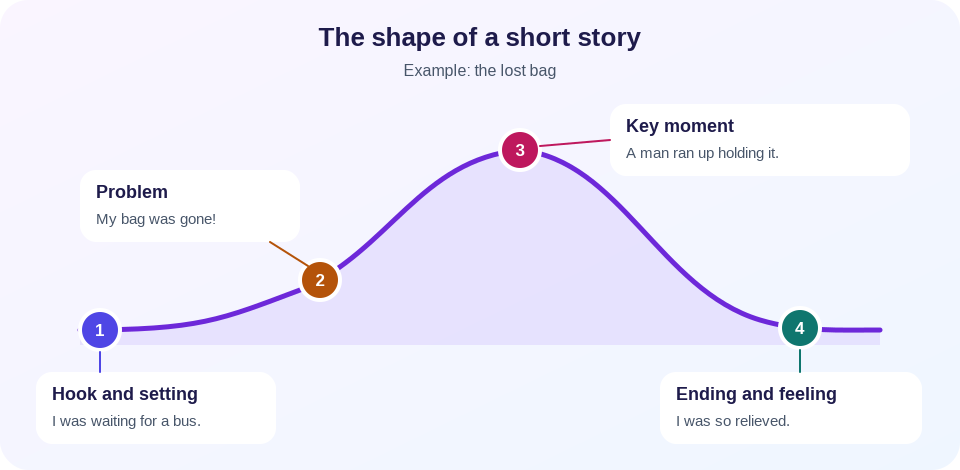
- Hook: "Something funny happened yesterday."
- Setting: "I was waiting for the bus outside the library."
- Events and problem: "Then I realized my bag was gone."
- Key moment: "Just then, a man ran up holding it."
- Ending and feeling: "I'd left it on the bench. I was so relieved."
The hook does not need to be exciting. "Did I tell you about my train yesterday?" gives the listener a chance to say "No, what happened?"
Three past forms
| Form | Use | Example |
|---|---|---|
| Past simple | main events, in order | I opened the door and saw a cat. |
| Past continuous | background action in progress | It was raining and I was carrying boxes. |
| Past perfect | something that happened earlier | I realized I had forgotten my keys. |
Compare "When we arrived, the film started" with "When we arrived, the film had started." In the first, the film starts at about the time of arrival. In the second, it started before you got there.
You will also hear "used to" for past habits that have stopped: "We used to walk to school together."
Linking events
- Start: "At first," "One day," "A few years ago,"
- Sequence: "Then," "After that," "A bit later,"
- Sudden change: "Suddenly," "All of a sudden,"
- At the same time: "While I was looking, my phone rang."
- End: "In the end," "Eventually," "Finally,"
"In the end" means "after everything" or "finally." "At the end" refers to a position: "at the end of the film."
Make it lively
Add one or two details that the listener can picture: "a tiny red suitcase" is better than "a bag." Say how you felt: "I was shocked," "I was embarrassed," "I couldn't stop laughing." Remember "embarrassed" and "embarrassing": you feel embarrassed, and the situation is embarrassing.
You can report speech simply: "She said, 'Is this yours?'" In casual speech, some people say "She was like, 'Is this yours?'" It is informal.
Use your voice. Slow down before the key moment, pause and then say it. You do not need to act; a small pause is enough.
Being a good listener
Stories work in two directions. Show that you are following:
- "Really?"
- "No way! What did you do?"
- "Oh no, that's awful."
- "How funny!"
- "So what happened in the end?"
Choose the reaction to match the story. A cheerful "Great!" after bad news sounds strange. If you have a similar story, wait until the other person has finished, then say "Something like that happened to me once."
A model story
"A strange thing happened last week. I was walking home, and it was getting dark. I heard a noise from a garden. At first I thought it was a person. Then a goat came to the fence and stared at me! Somebody had left the gate open. I rang the bell, and in the end the neighbor led it home. I laughed all the way back."
Telling it twice
Tell a story once. Then think about it for a minute and tell it again. The second version is often shorter and clearer. Check three things: did you give the setting before the problem, did you use past forms consistently and did you finish with a clear ending? Choose only one thing to improve each time. You can also make the story shorter for a listener who is in a hurry: keep the hook, the problem and the result.
Be careful with other people's stories. Do not share private or embarrassing details about someone without their permission.
Short stories in everyday talk
Many everyday stories take only three sentences: what was happening, what went wrong or changed, and how it ended. "I was cooking dinner. Suddenly the power went off. We ate sandwiches by candlelight." Practice these tiny stories first. They are easy to fit into a chat, and you can add detail if the listener asks.
Common mistakes
- Mixing tenses: "I walked home and I see a goat" should be "and I saw a goat." Some speakers use the present on purpose, but keep one choice until you are confident.
- "I was boring" means you made others bored. Say "I was bored."
- "Suddenly" used for every event. It loses its effect.
- Giving so much background that the story never starts.
Try it
Check your understanding
Quick check · 4 questions
of 4 answered You scored / 4 · perfect!
-
1. Which sentence uses the past continuous for background?
"Was opening" shows an action in progress when something else happened. -
2. What does "When we arrived, the film had started" mean?
The past perfect shows the earlier event. -
3. A friend says their phone was stolen. What is a good reaction?
It matches the bad news and invites the friend to continue. -
4. Which sentence is correct for how you felt during a dull talk?
"-ed" describes a feeling. "-ing" describes what causes it.
Summary
- Use a hook, setting, problem, key moment and ending.
- Use past simple for events, past continuous for background and past perfect for earlier events.
- Add time linkers, one or two details and a feeling.
- React with a response that matches the news.
Acompanhe seu progresso
Crie uma conta gratuita para marcar lições como concluídas e retomar de onde parou em qualquer dispositivo.