
























Lição 26 · English at Work
Speaking English at Work
Learn everyday workplace English: asking for help, checking tasks, giving short updates and choosing the right level of formality with colleagues.
Much of the English used at work is not in big meetings or speeches. It is a quick question at a desk, a short update in a corridor or a request for help on a busy shift. These small moments affect how smoothly work goes.
This lesson gives you phrases for daily tasks in offices, shops, kitchens, clinics, building sites and remote teams. Your workplace has its own words and habits, so listen to how people around you speak.
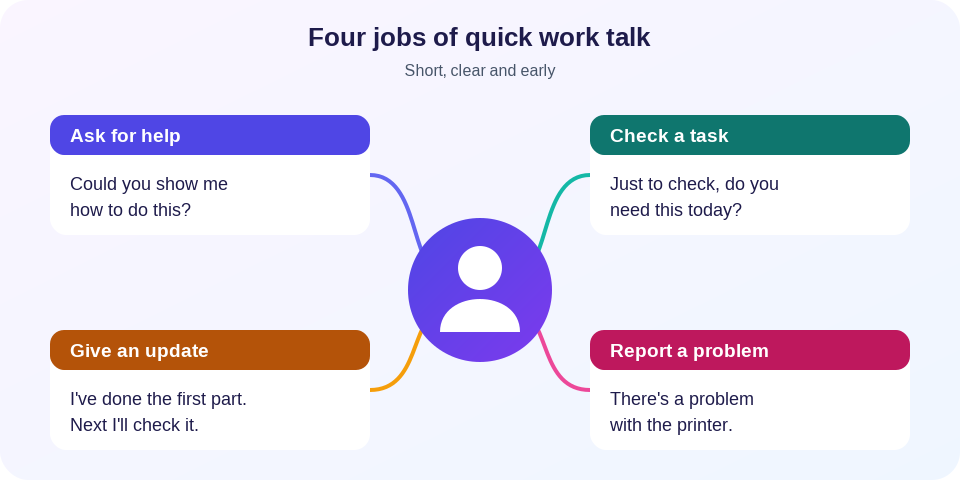
Daily work talk
Keep people informed
What you will learn
- Choose a formal or relaxed style.
- Make and answer requests.
- Check that you understand a task.
- Give an update and report a problem.
How formal should you be?
Workplaces differ a lot. In some, everyone uses first names; in others, titles matter. When you are new, a polite, neutral style is usually a safe start. Then follow what others do.
| Relaxed | Neutral | More formal |
|---|---|---|
| Can you send me that? | Could you send me that, please? | Would you mind sending me that? |
| No idea. | I'm not sure. I'll find out. | I'm afraid I don't know, but I'll check. |
| Got it. | OK, I understand. | Certainly, I'll take care of it. |
Notice the grammar in "Would you mind sending...?" It uses the -ing form. A positive answer is "Not at all" or "No problem", because "mind" asks whether it bothers you. Many people also answer "Sure."
Asking for help
Say what you need and how much time it may take.
- "Have you got a minute?"
- "Could you show me how to do this?"
- "I'm stuck on the second step. Could you take a look when you're free?"
- "Who would be the best person to ask about this?"
It helps to say what you have tried: "I restarted it, but the message is still there." The helper does not need to repeat your steps.
When someone asks you, answer clearly: "Sure," "Give me ten minutes," or "I can't right now, but I can after lunch."
Checking a task
If an instruction is unclear, ask early. It is much cheaper than doing the wrong thing.
- "Just to check, do you need this today?"
- "So you want me to count the boxes first and then label them. Is that right?"
- "Sorry, which file do you mean?"
- "What should I do if I can't reach the customer?"
Repeating the task in your own words is one of the most useful habits. It shows what you understood, not only that you heard something.
For safety instructions, never guess. Ask again, ask for a demonstration, or ask for written instructions until you are sure.
Giving a short update
A good update answers three questions: What is done? What is next? Is anything in the way?
"I've finished the first draft. Next I'll check the figures. The only problem is that I'm still waiting for the prices."
Use the present perfect for finished work with a result now ("I've sent it"), and "will" or "going to" for next steps. If you give a finished past time, use the past simple: "I sent it yesterday."
Reporting a problem or mistake
Be quick, factual and constructive.
- "There's a problem with the printer. It keeps jamming."
- "I've made a mistake on the order. I typed 50 instead of 15."
- "I've already told the customer, and I can correct it now."
- "I'm not going to finish by noon. Could we move it to three?"
Warning someone before a deadline gives them time to act. You do not need a long apology. One clear "I'm sorry about that" and a fix are usually more useful. For your legal duties or safety reporting rules, follow your workplace's official procedure.
Saying no or not yet
- "I'd love to help, but I'm finishing something urgent."
- "I can do it tomorrow. Would that work?"
- "I'm not trained to use that machine yet."
If you are asked to do two urgent things, ask for a priority: "I can do either A or B this morning. Which should come first?"
A model exchange
Ruth: Kofi, could you update the stock list?
Kofi: Sure. Just to check, the whole list or only the new items?
Ruth: Only the new ones. By four, please.
Kofi: OK, the new items by four. I'll let you know if anything is missing.
Learning your workplace's words
Every job has its own vocabulary: names of tools, forms, rooms, products and short codes. Keep a small list. For each item, write the word, what it means at your workplace and one sentence you have heard with it. Ask a colleague how to say any word that you have only seen in writing: "How do you say this one?"
You will also hear everyday work expressions. "On it" means "I'm doing it now." "Heads up" is a warning or early notice. "Can you cover for me?" asks someone to do your duties for a while. These are informal, so listen for who uses them before you try them with a customer or a manager. When you are unsure of an expression, ask "What does that mean here?"
Common mistakes
- "Can you explain me?" is wrong. Say "Can you explain it to me?"
- Saying "Yes" when you did not understand. Ask, or repeat the task back.
- "I will finish it until Friday." For a deadline say "by Friday". "Until" describes something that continues.
- Using a very direct "Send it to me" with no softener. "Could you send it to me?" is usually better.
Try it
Check your understanding
Quick check · 4 questions
of 4 answered You scored / 4 · perfect!
-
1. Which request is the most formal?
"Would you mind" plus -ing is a polite, more formal request. -
2. Which three things help make a clear update?
These answers give a listener what is needed to plan. -
3. You are not sure about a safety instruction. What should you do?
Safety instructions must be understood before you act. -
4. Which sentence is correct?
The pattern is "explain something to someone."
Summary
- Start polite and neutral, then follow local habits.
- Ask for help with what you need and what you have tried.
- Repeat tasks back and never guess about safety.
- Update with done, next and blockers, and report problems early.
Acompanhe seu progresso
Crie uma conta gratuita para marcar lições como concluídas e retomar de onde parou em qualquer dispositivo.