
























Lição 10 · Small Talk and Social English
Small Talk Basics: How to Start and Enjoy a Light Chat
Learn what small talk is for, which topics are usually safe, how to open a light chat in English, and how to read whether the other person wants to talk.
You are waiting for a meeting to start. The person next to you says, "Busy week?" They probably do not need a full report. They are making small talk: light, friendly conversation about everyday things.
Small talk can feel pointless, but it does a real job. It fills awkward silence, shows that you are friendly and helps people become comfortable before longer or more serious conversations.
What you will learn
- What small talk is for
- Three reliable ways to open a chat
- Which topics are usually easier and which need care
- How to read signals from the other person
Chapter 3: social English
Kind words
Finish well
Three ways to open
1. Talk about something you can both see or share
- "This line is moving slowly today."
- "It's a nice room, isn't it?"
- "Something smells good. Is that the bakery?"
A shared situation is useful because the other person already knows what you mean.
2. Ask an easy question
- "How do you know the host?"
- "Is this your first time at this class?"
- "Have you had a busy day?"
3. Make a friendly comment, then wait
- "I've never been to this event before."
A comment puts less pressure on the other person than a direct question.
Question tags
A question tag is a short question added to the end of a sentence. It often invites agreement.
| Sentence | Tag |
|---|---|
| It's cold today, | isn't it? |
| The food was great, | wasn't it? |
| You work with Lee, | don't you? |
| We haven't met, | have we? |
A positive sentence usually takes a negative tag, and a negative sentence takes a positive tag. When you mostly want agreement, your voice usually falls on the tag. When you really want to check, it usually rises.
If tags feel difficult, add "right?" to many casual checks: "You work with Lee, right?"
Easier topics
| Topic | Opening line |
|---|---|
| Weather | What a lovely morning! |
| Weekend | Do you have any plans for the weekend? |
| Food | Have you tried any good places around here? |
| Free time | What do you like doing after work? |
| Travel | Did you have far to come? |
| The event | What did you think of the talk? |
Weekends, free time, food and the current event often give people something to say without asking them to share much.
Topics that need care
What counts as private differs between cultures, workplaces and individuals. With people you do not know well, it is usually safer to avoid direct questions about:
- money, such as pay or the price of someone's home
- age, body size or health
- relationships and plans to have children
- religion and politics
- immigration status or legal matters
If the other person raises one of these topics, you can listen. You do not have to give your own view or answer a personal question. Try: "I'd rather not go into that. How was your trip here?"
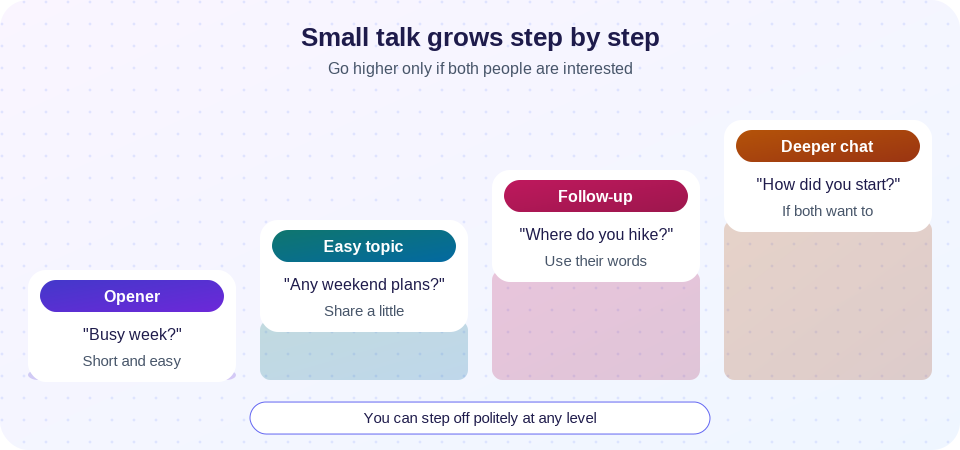
From opener to conversation
Small talk grows through details. Use the answer, add, ask pattern.
A: Did you have far to come? B: About an hour. I took the train. A: An hour! Do you do that every day? B: Only twice a week. I usually read on the way. A: That sounds like a good use of time. What are you reading?
In five turns, a travel question becomes a conversation about books. Neither speaker planned that.
Read the signals
| The person may want to chat | The person may want quiet |
|---|---|
| Gives longer answers | Gives one-word answers several times |
| Asks you questions | Keeps looking at a phone, book or screen |
| Turns toward you | Turns away or puts headphones on |
These are only clues, and people show interest in different ways. When in doubt, finish with a friendly line such as "Well, I'll let you get on," and give them space.
If you have nothing to say
Prepare two things you could mention this week: something you did and something you are looking forward to. They do not need to be exciting. "I tried to fix my bicycle on Sunday" is an excellent opener for the right listener.
You can also be honest in a light way: "I'm not very good at starting conversations. How is your day going?"
Practice with your own week
Take one real fact from your week and build three openers around it. Suppose you tried a new recipe.
- Comment: "I finally cooked something new this week."
- Question: "Do you cook much? I'm looking for easy ideas."
- Link to the moment: "This soup reminds me of something I tried to make on Sunday."
Then imagine two reactions. If the listener says, "Oh, what did you make?", tell them in one or two sentences and ask what they like to eat. If the listener says only "Nice," you can try one easy question or let the topic rest. Practicing both reactions helps you stay relaxed, because a short reply no longer feels like a failure. It is simply information about what to do next.
Common mistakes
- Expecting small talk to be deep. Its main purpose is to connect.
- Giving a very long answer to a light question. Offer one or two details and see whether they ask for more.
- Using the wrong tag. "You like tea, isn't it?" should be "You like tea, don't you?"
- Pushing after a vague answer. If someone says "Oh, this and that," change topic.
Try it
Which opener or reply fits each moment?
Add the correct tag or missing word.
Check your understanding
Quick check · 4 questions
of 4 answered You scored / 4 · perfect!
-
1. What is the main job of small talk?
It builds comfort between people. -
2. Which tag completes "You are coming tonight, ___"?
The tag matches the verb "are" and the subject "you". -
3. Which topic is usually easier with a new acquaintance?
They can choose how much to share. -
4. What can you do if the signals suggest someone wants quiet?
Respecting their signals is polite.
Summary
- Small talk is light conversation that builds comfort.
- Open with a shared situation, an easy question or a friendly comment.
- Question tags often invite agreement.
- Take care with private and sensitive topics.
- Watch for signals and give space when needed.
Acompanhe seu progresso
Crie uma conta gratuita para marcar lições como concluídas e retomar de onde parou em qualquer dispositivo.