
























Lekcja 38 · Kanji and Reading
Everyday kanji for verbs, places and directions
Learn over thirty practical kanji: number kanji for prices, common verbs, directions, adjectives and the characters you meet on signs, with sample sentences.
Now that you know how kanji work, it is time to meet the characters that pay off fastest in daily life. This lesson groups them by use rather than by difficulty: the number kanji you will see on price tags, the verbs from the first chapters of this course, the direction words that appear on signs, and a handful of adjectives and useful nouns. For each group you will see the kanji with its readings and then sentences you can read for real.
What you will learn
- Read number kanji and write prices such as 一万二千円.
- Recognize the kanji of common verbs together with their okurigana.
- Read direction words and the kanji on signs.
- Read short sentences that combine these characters.
Key terms
Number kanji (漢数字): 一, 二, 三 ... used in vertical text, formal documents and prices.
Okurigana: the hiragana tail after a verb or adjective kanji, such as べる in 食べる.
On / kun: Chinese-derived and native readings; see the previous lesson.
口 (kuchi/guchi): "mouth", also used as "opening," as in 出口 and 入口.
休み (yasumi): rest, holiday, or "closed" on a shop sign.
Number kanji and prices
Kanji numbers are built just like the spoken numbers you know. A few characters are all you need:
| 一 | 二 | 三 | 四 | 五 | 六 | 七 | 八 | 九 | 十 | 百 | 千 | 万 | 円 |
|---|---|---|---|---|---|---|---|---|---|---|---|---|---|
| いち | に | さん | よん | ご | ろく | なな | はち | きゅう | じゅう | ひゃく | せん | まん | えん |
To write a number, place the digits before the unit characters: 二百円 (にひゃくえん, 200 yen), 三千円 (さんぜんえん, 3,000 yen), 一万二千円 (いちまんにせんえん, 12,000 yen). For 十, 百 and 千 the "one" is normally left out (千円, not 一千円), but 一万 keeps its 一, just as in speech. Everyday signs and receipts usually write prices with Arabic digits (500円), so the kanji appear most in menus, formal documents and vertical text.
Sound changes from the counters lesson apply here too: 三百 is さんびゃく and 六百 is ろっぴゃく, even though the kanji look regular. The kanji give you the number; the sound changes come from the spoken language.
Verbs you already know
You have used these verbs in kana for a while. Here they are with their kanji. Learn each as a unit, kanji plus okurigana, and notice that the dictionary form shows the okurigana.
| Verb | Reading | Meaning | Polite form | Related word |
|---|---|---|---|---|
| 食べる | たべる | eat | 食べます | 食事 しょくじ (meal) |
| 飲む | のむ | drink | 飲みます | 飲み物 のみもの (drink) |
| 見る | みる | see, watch | 見ます | |
| 行く | いく | go | 行きます | 銀行 ぎんこう (bank) |
| 来る | くる | come | 来ます | 来週 らいしゅう (next week) |
| 出る | でる | go out, leave | 出ます | 出口 でぐち (exit) |
| 入る | はいる | enter | 入ります | 入口 いりぐち (entrance) |
| 話す | はなす | speak | 話します | 電話 でんわ (telephone) |
| 聞く | きく | listen, ask | 聞きます | |
| 読む | よむ | read | 読みます | |
| 書く | かく | write | 書きます | |
| 買う | かう | buy | 買います | 買い物 かいもの (shopping) |
| 会う | あう | meet | 会います | 会社 かいしゃ (company) |
| 休む | やすむ | rest | 休みます | 休み やすみ (holiday) |
Look at the pairs of verbs and kanji for patterns. 話 contains 言 (speech); 聞 contains the 門 gate with the 耳 ear inside, a person "listening at the door." 読 and 話 both carry the speech radical, which hints at their meaning. The te-forms that you practiced in chapter 6 apply unchanged: 食べて, 飲んで, 見て, 行って, 読んで, 書いて, 買って.
Notice the reading of 来る: くる, but 来ます is きます and 来週 is らいしゅう. The kanji 来 has the same irregular verb behavior as くる in kana, and the okurigana tell you which form it is.
Directions and positions
| Kanji | Reading | Meaning | Example |
|---|---|---|---|
| 上 | うえ (ue) | up, above, top | 上手 じょうず (skilled) |
| 下 | した (shita) | down, below, bottom | 下手 へた (unskilled) |
| 前 | まえ (mae) | front, before | 午前 ごぜん (a.m.) |
| 後 | あと (ato), うしろ (ushiro) | after, behind | 午後 ごご (p.m.) |
| 右 | みぎ (migi) | right | 右手 みぎて (right hand) |
| 左 | ひだり (hidari) | left | 左手 ひだりて (left hand) |
The characters 前 and 後 also appear in time expressions (三年前, さんねんまえ, "three years ago") and 午前 and 午後 for a.m. and p.m., which you met in the time lesson. Because the kun and on readings differ (まえ and ぜん), the pair 午前 is a good example of a compound with an on reading.
Describing things: adjectives and useful words
| Kanji | Reading | Meaning | Example |
|---|---|---|---|
| 高い | たかい | high, expensive | 高校 こうこう (high school) |
| 安い | やすい | cheap | |
| 新しい | あたらしい | new | 新聞 しんぶん (newspaper) |
| 白い | しろい | white | 白 しろ (white) |
| 今 | いま | now | 今日 きょう (today) |
| 毎 | まい | every | 毎日 まいにち (every day) |
| 何 | なに, なん | what | 何ですか なんですか |
| 時 | じ, とき | time, o'clock | 時間 じかん (time, hours) |
| 友 | とも | friend | 友達 ともだち (friend) |
| 駅 | えき | station | 駅 えき (station) |
| 電 | でん | electricity | 電車 でんしゃ (train), 電話 でんわ |
| 車 | くるま, シャ | car, vehicle | 車 くるま (car), 電車 でんしゃ |
Notice that 安い (やすい, cheap) and 休む (やすむ, rest) start with the same sound, やす, although the kanji (安 and 休) are different, a classic pair of look-alike sounds that you will meet often. Also see that 白い (しろい, white) and 新しい (あたらしい, new) show okurigana in different places.
Signs and real sentences
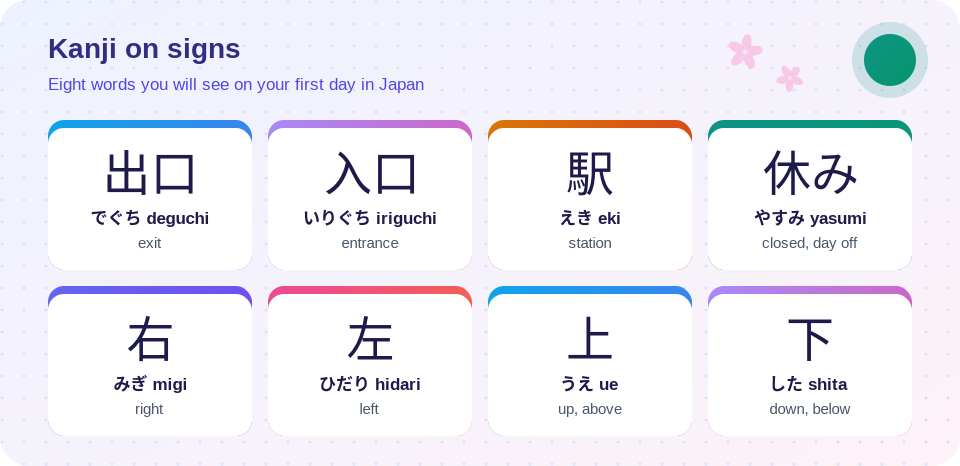
Here are kanji on signs that you will meet on your first day in Japan:
| Sign | Reading | Meaning |
|---|---|---|
| 出口 | でぐち | exit |
| 入口 | いりぐち | entrance |
| 駅 | えき | station |
| 休み | やすみ | closed, day off |
| 右 / 左 | みぎ / ひだり | right / left |
| 上 / 下 | うえ / した | up / down |
And a few sentences made from the characters of this lesson:
- 駅で友達に会います。 (Eki de tomodachi ni aimasu.) I meet a friend at the station.
- 毎日 本を読みます。 (Mainichi hon o yomimasu.) I read books every day.
- 今日は何を食べますか。 (Kyou wa nani o tabemasu ka.) What will you eat today?
- 日本語の本を買いました。 (Nihongo no hon o kaimashita.) I bought a Japanese book.
- 水を飲んで、休みます。 (Mizu o nonde, yasumimasu.) I drink water and rest.
- 駅の前で会いましょう。 (Eki no mae de aimashou.) Let's meet in front of the station.
- この本は高いです。 (Kono hon wa takai desu.) This book is expensive.
- 白い車は新しいです。 (Shiroi kuruma wa atarashii desu.) The white car is new.
Memory hooks
Some of these characters carry a little story that helps you remember them. These hooks are aids to memory, so do not treat them as the full history of each character.
- 買 (かう, buy) has a net on top of 貝, a shell. Shells were once used as money, and 貝 appears in many kanji about money and value.
- 駅 (えき, station) has the horse radical 馬 on its left. In early times, stations were places where messengers changed horses.
- 電 (でん, electricity) has the rain radical 雨 on top, a reminder that lightning was the first electricity people saw. 電車 (でんしゃ) is "electric vehicle," the train, and 電話 (でんわ) is "electric talk," the telephone.
- 時 (じ, とき, time) combines the sun 日 with 寺, whose sound is じ. The sun tells you the meaning (time) and the other part gives the sound, a typical phono-semantic character.
- 聞 (きく, listen) shows an ear 耳 inside a gate 門, as if someone were listening at the door.
How to practice these characters
A short routine makes thirty-odd kanji manageable. Make a card for each word and not for each character: write 出口 on the front and でぐち (deguchi), "exit," plus an example sentence on the back. Say the reading aloud before you turn the card. Next, write each character by hand three times, following the stroke order. Then read every sign you can find: label a few things at home with the kanji for door, up or down, and look at them whenever you pass. Finally, read the example sentences of this lesson aloud, splitting them at the hiragana, and then try to write one of your own, such as 駅で友達に会います but with a different place or person. Five minutes a day for two weeks will make most of these characters feel familiar.
Common misconceptions
"The kanji for a word and its sound are linked one to one." Many different kanji share one sound (安い and 休む both contain やす), and one kanji has many sounds. Always learn kanji inside a word.
"Okurigana can be dropped to save space." 食べる written as 食る is wrong. The okurigana are part of the spelling.
"Number kanji are only for old books." They appear in vertical text, formal documents, store signs, dates in names (三月, 一月) and many compound words (三人, 一日).
"口 only means mouth." It also means an opening, as in 出口 and 入口.
Try it
First, a matching game: click a kanji word and then its reading. Correct pairs turn green.
The second tool writes any price up to 99,999 in kanji numbers and reads it in hiragana with romaji. Change the list to test yourself first.
Press Run (or Ctrl + Enter) to see the result here.
Program input · what you'd type while the program runs
Type the answers before you press Run, one per line. Each time the program reads a line (with input()), it gets the next line from this box.
Check your understanding
Quick check · 5 questions
of 5 answered You scored / 5 · perfect!
-
1. How is 出口 read, and what does it mean?
出口 is でぐち, exit. 入口 (いりぐち) is the entrance. The 口 reads ぐち after a voiced sound. -
2. How do you write 12,000 yen in kanji?
The unit 万 comes first: 一万 (10,000) plus 二千 (2,000). -
3. What is the okurigana pattern of 食べる?
食 is the kanji and べる the hiragana tail; 食べます keeps 食べ and changes the ending. -
4. Which pair is a classic homophone with the sound やす?
安い (cheap) and 休む (to rest) share やす but use different kanji. -
5. How is 午後 read?
午後 (ごご) means p.m. and 午前 (ごぜん) means a.m.
Summary
- Number kanji (一 to 九, 十, 百, 千, 万, 円) write prices such as 一万二千円.
- Verb kanji come with okurigana: 食べる, 飲む, 見る, 行く, 来る, 出る, 入る, 話す, 聞く, 読む, 書く, 買う, 会う, 休む.
- Sign kanji such as 出口, 入口, 駅 and 休み, and direction kanji 上 下 前 後 右 左, make travel easier.
- Many kanji share sounds (安い, 休む), so learn them inside words.
Next: Chapter 7 review
Śledź swoje postępy
Załóż darmowe konto, aby odhaczać lekcje i wracać do miejsca, w którym skończyłeś, na dowolnym urządzeniu.