
























Les 22 · Faults and Protection
Symmetrical components
Learn Fortescue's method: split unbalanced three-phase voltages and currents into positive, negative and zero sequence sets, with worked examples and a live calculator.
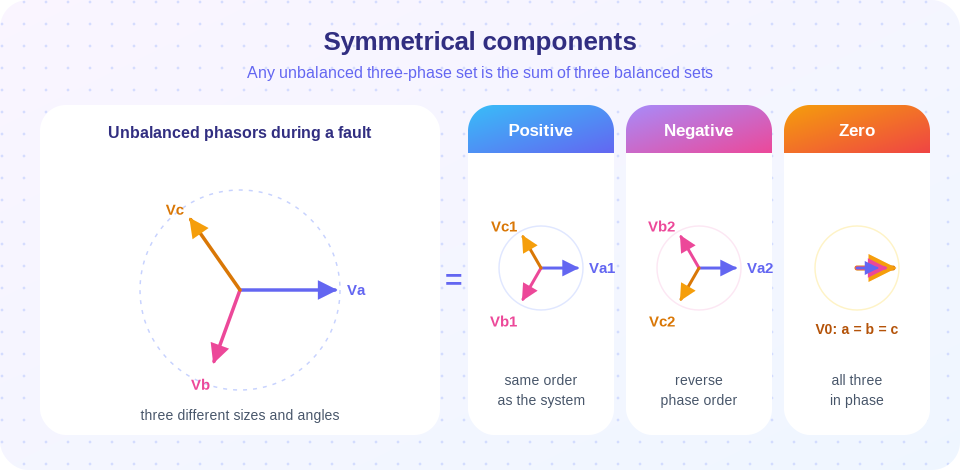
A balanced three-phase system is easy: analyze one phase and the other two follow by a 120° shift. A fault usually destroys that balance. A single line-to-ground fault loads one phase and leaves the other two alone, so the usual one-line method no longer applies. In 1918 Charles Fortescue showed that any unbalanced set of three phasors can be written as the sum of three balanced sets, called symmetrical components. Each balanced set can then be analyzed with the single-phase tools you already have, and the answers are added back together.
This is the standard language of fault analysis and relay design. Once you see why it works, unbalanced faults become a recipe: draw three networks, connect them in the way the fault dictates, solve one loop.
What you will learn
- Define the operator
aand write the transformation between phase and sequence quantities. - Describe positive, negative and zero sequence sets and what physical effect each has.
- Decompose a given unbalanced set by hand and with code.
- Explain why the neutral current equals
3·I0and why sequence impedances differ.
Key terms
Positive sequence (1): three equal-magnitude phasors 120° apart in the normal order a, b, c.
Negative sequence (2): three equal-magnitude phasors 120° apart in the reverse order a, c, b.
Zero sequence (0): three equal phasors in phase with each other.
Operator a: the complex number 1∠120° that rotates a phasor by 120°.
Sequence impedance: the impedance a piece of equipment offers to one sequence set (Z1, Z2, Z0).
The operator a and the three sets
Define a = 1∠120° = −0.5 + j0.866. Multiplying a phasor by a rotates it 120° counterclockwise; a² = 1∠240° = 1∠−120°, and a³ = 1. A very useful identity follows from adding three equally spaced unit vectors:
1 + a + a² = 0
Now take phase a as the reference. The three sets are:
| Set | Phase a | Phase b | Phase c | Rotates as |
|---|---|---|---|---|
| Positive | V1 | a²·V1 | a·V1 | a, b, c (normal) |
| Negative | V2 | a·V2 | a²·V2 | a, c, b (reverse) |
| Zero | V0 | V0 | V0 | all equal |
Adding the three sets gives the actual phase voltages:
Va = V0 + V1 + V2
Vb = V0 + a²·V1 + a·V2
Vc = V0 + a·V1 + a²·V2
Three unknowns (V0, V1, V2) and three equations: they can be solved. Using 1 + a + a² = 0 the inverse is:
V0 = (Va + Vb + Vc) / 3
V1 = (Va + a·Vb + a²·Vc) / 3
V2 = (Va + a²·Vb + a·Vc) / 3
The same formulas hold for currents. The zero-sequence component is simply the average of the three phasors. For a perfectly balanced set the average is zero, so V0 = V2 = 0 and V1 = Va. The more unbalanced the set, the larger V2 and V0 become, which is why the ratio V2/V1 is used as a voltage unbalance factor.
A worked decomposition
A simple case first. A fault leaves current only in phase a: Ia = 90 A, Ib = Ic = 0. Then
I0 = (90 + 0 + 0)/3 = 30 A
I1 = (90 + a·0 + a²·0)/3 = 30 A
I2 = 30 A
All three sequence currents are equal to one third of the fault current. That is the signature of a single line-to-ground fault: I0 = I1 = I2 = Ia/3. The current in the neutral or ground is In = Ia + Ib + Ic = 3·I0 = 90 A.
Zero-sequence current is the only component that can flow through the neutral or the earth, because it is the only one that adds up instead of cancelling. Neutral current is 3·I0. Wherever there is no neutral or ground path (for example a delta winding or an ungrounded wye), I0 cannot flow.
For a less obvious case, take the phasors drawn in the figure: Va = 1∠0°, Vb = 0.8∠−110°, Vc = 0.9∠125° per unit. The runnable example below gives the three components and verifies that they add back to the original set.
Why sequences behave differently
The decomposition is useful only because equipment treats each set differently, and each set sees a simple single-phase network.
- Rotating machines. Positive-sequence currents make a field that rotates with the rotor, so the machine responds with its synchronous, transient or subtransient reactance,
X1. Negative-sequence currents make a field that rotates against the rotor at twice the speed relative to it, so the machine sees a smaller, roughly constantX2(close to the subtransient reactanceX''d). Zero-sequence currents produce no net rotating field:X0is smallest. - Transformers and static equipment do not care which way the phases are ordered:
Z1 = Z2. For a transformerZ0is also about the same asZ1, but only if a path for zero-sequence current exists. A grounded-wye to delta transformer lets zero-sequence current flow on the wye side and circulates it inside the delta; a delta bank on the other side stops it from going further. - Transmission lines.
Z1 = Z2again.Z0is larger because the zero-sequence current returns through the earth and ground wires: for overhead lines a typicalZ0is between two and four timesZ1.
The network drawn for each sequence therefore has the same structure as the positive one, with its own impedance values:
Positive:  V1 = Ea − Z1·I1       (the only network with a source)
Negative:  V2 =    − Z2·I2
Zero:      V0 =    − (Z0 + 3Zn)·I0
The generator emf Ea only appears in the positive network, because the machine only generates a balanced positive set. A neutral impedance Zn appears as 3Zn in the zero-sequence network, since 3·I0 flows through it.
Power in sequence components
Complex power is the same whether you work in phase or sequence quantities: S = Va·Ia* + Vb·Ib* + Vc·Ic* = 3(V0·I0* + V1·I1* + V2·I2*). The factor 3 is the price of defining components with a 1/3 average. Some books scale the transformation by 1/√3 so that power is invariant without the 3.
Common misconceptions
"Sequence components are physical currents." They are a calculation device. You cannot put an ammeter on I2. Only phase currents (and 3·I0 in the neutral) can be measured directly, although relays compute I2 and I0 internally.
"Negative sequence means negative current." It means a set rotating in the reverse order. The magnitudes are positive numbers.
"Zero sequence is the same as DC." It is a set of three 50 or 60 Hz phasors that are equal, so it is an AC quantity.
Try it
The first example decomposes the phasors from the figure, verifies the reconstruction and checks the single-line-to-ground case. Everything is computed with complex numbers.
Press Run (or Ctrl + Enter) to see the result here.
Program input · what you'd type while the program runs
Type the answers before you press Run, one per line. Each time the program reads a line (with input()), it gets the next line from this box.
The second example is a live calculator. Drag the magnitude and angle of phases b and c (phase a is fixed at 1∠0°). The balanced setting (1∠−120° and 1∠120°) gives zero V0 and V2.
Check your understanding
Quick check · 5 questions
of 5 answered You scored / 5 · perfect!
-
1. What is the value of 1 + a + a^2?
The three unit phasors at 0, 120 and 240 degrees are symmetric and add to zero. -
2. A set of currents is Ia = 60 A, Ib = 0, Ic = 0. What is the zero sequence current I0?
I0 is the average of the three phase currents: (60 + 0 + 0)/3 = 20 A. -
3. Which sequence set can flow in the neutral of a wye connection?
Only zero-sequence currents add in the neutral (In = 3 I0); positive and negative sets sum to zero. -
4. Which statement about sequence impedances of a static transmission line is correct?
Static equipment does not care about phase order, so Z1 = Z2; zero-sequence current returns through earth, which raises Z0. -
5. Why does the generator emf appear only in the positive sequence network?
A synchronous generator's internal emf is balanced and in positive order; unbalance only arises from the fault or load.
Summary
- Any unbalanced three-phase set equals a positive, a negative and a zero sequence set:
Va = V0 + V1 + V2, and so on. - The operator
a = 1∠120°gives the transformation;V0is the average and1 + a + a² = 0. - Neutral current equals
3·I0; a delta or an ungrounded wye blocks zero-sequence current. - Static equipment has
Z1 = Z2; rotating machines have differentX1,X2,X0; lineZ0is typically larger thanZ1. - The generator source exists only in the positive network.
Volg je voortgang
Maak een gratis account om lessen af te vinken en op elk apparaat verder te gaan waar je gebleven was.