Test yourself with four mixed sets on phrasal verbs, idioms, academic and work words and confusing pairs, with explanations and a plan for review.
This lesson brings together the words from chapters 5 to 8. Mixed practice is harder than practicing one topic at a time, because you must first decide which kind of word you need. That extra effort helps you prepare for real conversations and writing, where nobody tells you the topic in advance.
The exercises check your answers against a list in the page. They cannot judge your speaking or your free writing, so use a teacher or a study partner for that.
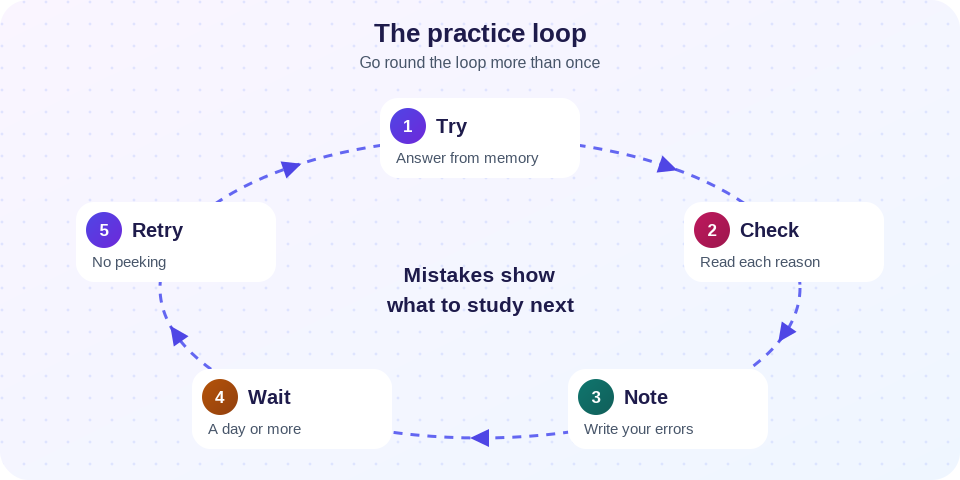
The loop of try, check, note, wait and retry turns exercises into long-term memory.
Before you try, remember the main word order rule: with separable verbs a pronoun goes in the middle. If you missed this, read how phrasal verbs work again.
Set 1: phrasal verbs
<style>body{margin:0;padding:14px;font-family:system-ui,sans-serif;background:linear-gradient(135deg,#faf5ff,#eff6ff);color:#1e1b4b}.card{background:#fff;border-radius:14px;padding:12px 14px;margin-bottom:10px;box-shadow:0 6px 18px rgba(30,27,75,.10)}button{font:inherit;cursor:pointer;border:1px solid #c7d2fe;background:#eef2ff;color:#1e1b4b;border-radius:10px;padding:6px 12px;margin:4px 6px 0 0}button.main{background:#4f46e5;border-color:#4f46e5;color:#fff}input{font:inherit;border:2px solid #c7d2fe;border-radius:8px;padding:4px 8px;width:11em;max-width:100%;color:#1e1b4b;background:#fff}.good{background:#d1fae5;border-color:#059669}.bad{background:#fee2e2;border-color:#dc2626}.fb{margin:6px 0 0;font-size:.95em}.score{font-weight:700}</style><divid="app"></div><script>constDATA=[["The meeting is too early. Can we put it ___ until Friday?",["off","back"],"Put off or put back means move to a later time."],["Please fill ___ this form.",["in","out"],"Both fill in and fill out are used."],["I can't figure ___ how to open this box.",["out"],"Figure out means work out the method."],["We have run ___ of milk.",["out"],"Run out of means have none left."],["She was tired, but she didn't give ___.",["up","in"],"Give up means stop trying; give in means surrender."]];const app = document.getElementById('app');const$=(tag, parent, text, cls)=>{const el = document.createElement(tag);if(text !==undefined) el.textContent = text;if(cls) el.className = cls;
parent.appendChild(el);return el;};constnorm=s=> s.toLowerCase().replace(/\u2019/g,"'").replace(/\s+/g,' ').trim();const rows =DATA.map((d, i)=>{const c =$('div', app,undefined,'card');const parts = d[0].split('___');$('span', c,(i +1)+'. '+ parts[0]);const inp =$('input', c);
inp.setAttribute('aria-label','Answer '+(i +1));$('span', c, parts[1]);return{ d, inp,fb:$('p', c,'','fb')};});const bar =$('div', app,undefined,'card');const check =$('button', bar,'Check answers','main');const show =$('button', bar,'Show answers');const score =$('p', bar,'','score');
check.onclick=()=>{let n =0;
rows.forEach(r=>{const ok = r.d[1].some(a=>norm(a)===norm(r.inp.value));if(ok) n++;
r.inp.className = ok ?'good':'bad';
r.fb.textContent = ok ?'Matches. '+ r.d[2]:'Not in the answer list. Try again or choose Show answers.';});
score.textContent = n +' of '+ rows.length +' match the answer list.';};
show.onclick=()=> rows.forEach(r=>{ r.fb.textContent ='Answer: '+ r.d[1].join(' / ')+'. '+ r.d[2];});</script>
<style>body{margin:0;padding:14px;font-family:system-ui,sans-serif;background:linear-gradient(135deg,#faf5ff,#eff6ff);color:#1e1b4b}.card{background:#fff;border-radius:14px;padding:12px 14px;margin-bottom:10px;box-shadow:0 6px 18px rgba(30,27,75,.10)}button{font:inherit;cursor:pointer;border:1px solid #c7d2fe;background:#eef2ff;color:#1e1b4b;border-radius:10px;padding:6px 12px;margin:4px 6px 0 0}button.main{background:#4f46e5;border-color:#4f46e5;color:#fff}input{font:inherit;border:2px solid #c7d2fe;border-radius:8px;padding:4px 8px;width:11em;max-width:100%;color:#1e1b4b;background:#fff}.good{background:#d1fae5;border-color:#059669}.bad{background:#fee2e2;border-color:#dc2626}.fb{margin:6px 0 0;font-size:.95em}.score{font-weight:700}</style><divid="app"></div><script>constDATA=[["Your friend passed an exam. What do you say?",["Never mind.","That's great news! Good for you.","I'm sorry to hear that."],1,"Good news calls for a warm reply."],["The tickets were much too expensive.",["They cost an arm and a leg.","They were a piece of cake.","They broke the ice."],0,"The idiom means very expensive."],["We finally arrived, just before the doors closed.",["in the nick of time","once in a blue moon","around the clock"],0,"It means just before it was too late."],["You and your team now understand the plan in the same way.",["down in the dumps","under the weather","on the same page"],2,"On the same page means shared understanding."],["You did not hear your teacher.",["Fair enough.","Take care.","Sorry, could you say that again?"],2,"This asks politely for repetition."]];const app = document.getElementById('app');const$=(tag, parent, text, cls)=>{const el = document.createElement(tag);if(text !==undefined) el.textContent = text;if(cls) el.className = cls;
parent.appendChild(el);return el;};functionstart(){
app.textContent ='';let done =0, right =0, score;DATA.forEach((d, i)=>{const c =$('div', app,undefined,'card');$('div', c,(i +1)+'. '+ d[0]);const buttons = d[1].map(o=>$('button', c, o));const fb =$('p', c,'','fb');let answered =false;
buttons.forEach((b, k)=> b.onclick=()=>{if(answered)return;
answered =true;
done++;if(k === d[2]) right++;else b.className ='bad';
buttons[d[2]].className ='good';
fb.textContent =(k === d[2]?'Yes. ':'Not this one. ')+ d[3];
score.textContent ='Score: '+ right +' of '+ done +' answered.';});});
score =$('p', app,'','score');$('button', app,'Start again','main').onclick = start;}start();</script>
<style>body{margin:0;padding:14px;font-family:system-ui,sans-serif;background:linear-gradient(135deg,#faf5ff,#eff6ff);color:#1e1b4b}.card{background:#fff;border-radius:14px;padding:12px 14px;margin-bottom:10px;box-shadow:0 6px 18px rgba(30,27,75,.10)}button{font:inherit;cursor:pointer;border:1px solid #c7d2fe;background:#eef2ff;color:#1e1b4b;border-radius:10px;padding:6px 12px;margin:4px 6px 0 0}button.main{background:#4f46e5;border-color:#4f46e5;color:#fff}input{font:inherit;border:2px solid #c7d2fe;border-radius:8px;padding:4px 8px;width:11em;max-width:100%;color:#1e1b4b;background:#fff}.good{background:#d1fae5;border-color:#059669}.bad{background:#fee2e2;border-color:#dc2626}.fb{margin:6px 0 0;font-size:.95em}.score{font-weight:700}</style><divid="app"></div><script>constDATA=[["___ the heavy traffic, we arrived on time.",["Despite","In spite of"],"A noun follows despite."],["The results ___ that exercise may help. (a careful verb starting with s)",["suggest"],"Suggest is a careful reporting verb."],["We need to ___ the deadline. (finish on time)",["meet"],"Meet a deadline is the usual collocation."],["I look forward to ___ your reply. (receive)",["receiving"],"Use an -ing form after look forward to."],["The first item on the ___ is the budget.",["agenda"],"An agenda lists meeting topics."]];const app = document.getElementById('app');const$=(tag, parent, text, cls)=>{const el = document.createElement(tag);if(text !==undefined) el.textContent = text;if(cls) el.className = cls;
parent.appendChild(el);return el;};constnorm=s=> s.toLowerCase().replace(/\u2019/g,"'").replace(/\s+/g,' ').trim();const rows =DATA.map((d, i)=>{const c =$('div', app,undefined,'card');const parts = d[0].split('___');$('span', c,(i +1)+'. '+ parts[0]);const inp =$('input', c);
inp.setAttribute('aria-label','Answer '+(i +1));$('span', c, parts[1]);return{ d, inp,fb:$('p', c,'','fb')};});const bar =$('div', app,undefined,'card');const check =$('button', bar,'Check answers','main');const show =$('button', bar,'Show answers');const score =$('p', bar,'','score');
check.onclick=()=>{let n =0;
rows.forEach(r=>{const ok = r.d[1].some(a=>norm(a)===norm(r.inp.value));if(ok) n++;
r.inp.className = ok ?'good':'bad';
r.fb.textContent = ok ?'Matches. '+ r.d[2]:'Not in the answer list. Try again or choose Show answers.';});
score.textContent = n +' of '+ rows.length +' match the answer list.';};
show.onclick=()=> rows.forEach(r=>{ r.fb.textContent ='Answer: '+ r.d[1].join(' / ')+'. '+ r.d[2];});</script>
Run your tests: expand it's, check direction for borrow and lend, and look for an object with rise and raise. The previous chapter explains each test.
Set 4: confusing pairs
<style>body{margin:0;padding:14px;font-family:system-ui,sans-serif;background:linear-gradient(135deg,#faf5ff,#eff6ff);color:#1e1b4b}.card{background:#fff;border-radius:14px;padding:12px 14px;margin-bottom:10px;box-shadow:0 6px 18px rgba(30,27,75,.10)}button{font:inherit;cursor:pointer;border:1px solid #c7d2fe;background:#eef2ff;color:#1e1b4b;border-radius:10px;padding:6px 12px;margin:4px 6px 0 0}button.main{background:#4f46e5;border-color:#4f46e5;color:#fff}input{font:inherit;border:2px solid #c7d2fe;border-radius:8px;padding:4px 8px;width:11em;max-width:100%;color:#1e1b4b;background:#fff}.good{background:#d1fae5;border-color:#059669}.bad{background:#fee2e2;border-color:#dc2626}.fb{margin:6px 0 0;font-size:.95em}.score{font-weight:700}</style><divid="app"></div><script>constDATA=[["Which sentence is correct?",["The weather had a big effect on our plans.","The weather had a big affect on our plans.","The weather had big effected on our plans."],0,"Effect is the noun here."],["Which sentence is correct?",["Can you borrow me your calculator?","Can you lend from me your calculator?","Can you lend me your calculator?"],2,"Lend means give for a while."],["Which sentence is correct?",["He said me that he was busy.","He told that me he was busy.","He told me that he was busy."],2,"Tell takes a person directly."],["Which sentence is correct?",["The company rose its prices.","The company raised its prices.","The company raised it's prices."],1,"Raise takes an object, and its shows possession."],["Which sentence is correct?",["I'm interesting in history.","I'm interested in history.","I'm interested on history."],1,"The feeling takes -ed, with the preposition in."]];const app = document.getElementById('app');const$=(tag, parent, text, cls)=>{const el = document.createElement(tag);if(text !==undefined) el.textContent = text;if(cls) el.className = cls;
parent.appendChild(el);return el;};functionstart(){
app.textContent ='';let done =0, right =0, score;DATA.forEach((d, i)=>{const c =$('div', app,undefined,'card');$('div', c,(i +1)+'. '+ d[0]);const buttons = d[1].map(o=>$('button', c, o));const fb =$('p', c,'','fb');let answered =false;
buttons.forEach((b, k)=> b.onclick=()=>{if(answered)return;
answered =true;
done++;if(k === d[2]) right++;else b.className ='bad';
buttons[d[2]].className ='good';
fb.textContent =(k === d[2]?'Yes. ':'Not this one. ')+ d[3];
score.textContent ='Score: '+ right +' of '+ done +' answered.';});});
score =$('p', app,'','score');$('button', app,'Start again','main').onclick = start;}start();</script>
For every miss, write three lines: the item, why your answer was wrong, and a new example of your own. A reason is more useful than just the right letter. For example: I wrote "said me". Say needs words, not a person right after it. New sentence: My aunt told me a story.
Then group your errors. Many errors in phrasal verbs suggest that you should return to word order. Many errors in confusing pairs suggest that you need a personal test list.
Once a set feels easy, raise the level. Cover the choices and say your answer first. Then write a new sentence for each item without looking at the examples. Finally, use three of the words in a short voice note or a message to a study partner. Producing a word is harder than recognizing it, which is exactly why it builds stronger memory.
You can also reverse a set. Look at the explanation, such as means stop trying, and recall the phrasal verb. If you can move in both directions, from word to meaning and from meaning to word, you are much closer to using it in real life.
If you cannot answer after a real attempt, read the explanation and say the full sentence aloud with the right word. Do not simply move on. Then, a little later, try the item again without looking. A short struggle followed by feedback is a normal part of learning.
All four sets above are your practice. For one more round, shuffle your own error list into a short quiz and ask a friend to read the questions to you.
Quick final recall
<style>body{margin:0;padding:14px;font-family:system-ui,sans-serif;background:linear-gradient(135deg,#faf5ff,#eff6ff);color:#1e1b4b}.card{background:#fff;border-radius:14px;padding:12px 14px;margin-bottom:10px;box-shadow:0 6px 18px rgba(30,27,75,.10)}button{font:inherit;cursor:pointer;border:1px solid #c7d2fe;background:#eef2ff;color:#1e1b4b;border-radius:10px;padding:6px 12px;margin:4px 6px 0 0}button.main{background:#4f46e5;border-color:#4f46e5;color:#fff}input{font:inherit;border:2px solid #c7d2fe;border-radius:8px;padding:4px 8px;width:11em;max-width:100%;color:#1e1b4b;background:#fff}.good{background:#d1fae5;border-color:#059669}.bad{background:#fee2e2;border-color:#dc2626}.fb{margin:6px 0 0;font-size:.95em}.score{font-weight:700}</style><divid="app"></div><script>constDATA=[["Meaning of call off","cancel"],["Meaning of break the ice","help people relax"],["Careful reporting verb (starts with i)","indicate"],["Give for a while","lend"],["Meaning of eventually","in the end, after some time"],["Written record of a meeting","minutes"]];const app = document.getElementById('app');const$=(tag, parent, text, cls)=>{const el = document.createElement(tag);if(text !==undefined) el.textContent = text;if(cls) el.className = cls;
parent.appendChild(el);return el;};let deck =DATA.map((d, i)=> i), back =false, cleared =0;const c =$('div', app,undefined,'card');
c.style.cssText ='min-height:110px;text-align:center';const front =$('h2', c,''), answer =$('p', c,''), info =$('p', app,'','score');const flip =$('button', app,'Show answer','main');const yes =$('button', app,'I knew it');const no =$('button', app,'Practice again');const re =$('button', app,'Restart');functiondraw(){if(!deck.length){
front.textContent ='Deck finished';
answer.textContent ='Come back tomorrow and try again from memory.';
info.textContent ='Cards cleared: '+ cleared;return;}
front.textContent =DATA[deck[0]][0];
answer.textContent = back ?DATA[deck[0]][1]:'Say your answer aloud, then check.';
info.textContent ='Cards left: '+ deck.length;}
flip.onclick=()=>{ back =true;draw();};
yes.onclick=()=>{if(deck.length){ deck.shift(); cleared++; back =false;draw();}};
no.onclick=()=>{if(deck.length){ deck.push(deck.shift()); back =false;draw();}};
re.onclick=()=>{ deck =DATA.map((d, i)=> i); cleared =0; back =false;draw();};draw();</script>