
























レッスン 12 · Everyday Vocabulary
Everyday Words for Home and Routines
Learn English words for rooms, furniture, chores and daily routines, with natural verb partners, example sentences and British variants.
You spend a lot of your life at home, so home words are very useful. They help you describe your day, ask a roommate for help or tell a repair person what is broken.
The best way to learn them is to connect each thing with the actions you do with it.
What you will learn
- words for rooms and common objects
- verbs for daily routines and chores
- natural phrases such as get dressed and do the laundry
- some differences between American and British English
Rooms, things and actions
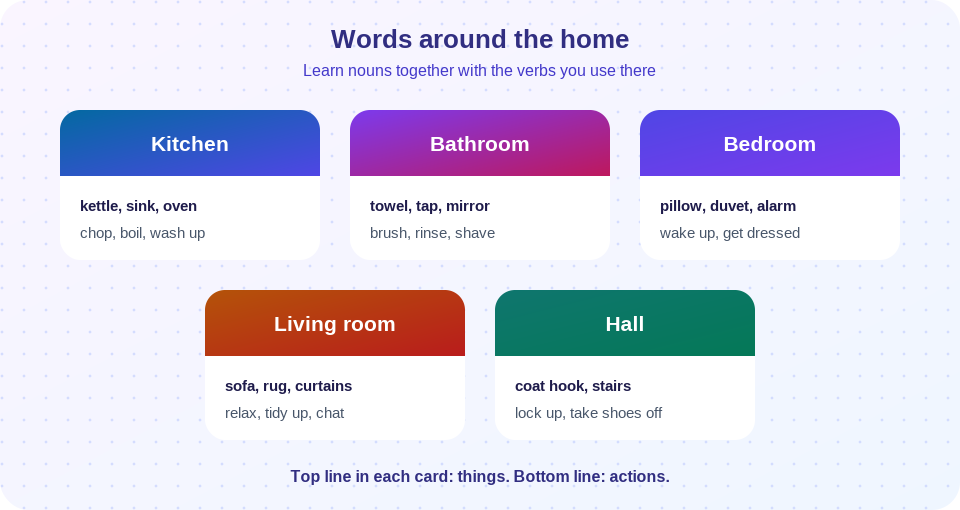
Name the room
Name the things
Add the actions
Say a sentence
Furniture and objects
| Word | Meaning or note | Example |
|---|---|---|
| wardrobe | tall cupboard for clothes (Americans often say closet) | Hang your coat in the wardrobe. |
| drawer | box that slides out of furniture | The keys are in the top drawer. |
| cupboard | closed storage with shelves | Put the plates in the cupboard. |
| shelf (plural shelves) | flat board for storing things | The book is on the shelf. |
| rug | small floor covering | There is a rug by the bed. |
| curtain | cloth that covers a window | Close the curtains, please. |
| faucet (British: tap) | where water comes out | The faucet is dripping. |
| sink | bowl with a drain | Rinse the cup in the sink. |
| outlet (British: socket) | place to plug in a device | Is there an outlet near the desk? |
Morning and evening routines
Many routine phrases use get, take, make and do.
- wake up: stop sleeping
- get up: leave your bed
- take a shower (British people often say have a shower)
- brush your teeth
- get dressed: put on clothes
- make breakfast
- leave the house
- get home
- have dinner
- go to bed: get into bed
- fall asleep: start sleeping
Notice the difference: you can wake up at six, get up at six thirty and go to bed at ten, but fall asleep at eleven.
A sample day
"I usually wake up at seven and get up about ten minutes later. I take a shower, get dressed and make breakfast. After work, I get home around six. I cook dinner, wash up and relax. I go to bed at eleven."
Wash up means "wash the dishes" in British English. In American English, wash up often means "wash your hands and face," so Americans usually say do the dishes.
Chores
| Phrase | Meaning |
|---|---|
| do the laundry | wash clothes |
| do the dishes | wash plates, cups and pans |
| make the bed | arrange the sheets and covers neatly |
| vacuum the floor | clean it with a vacuum cleaner |
| take out the trash | take the garbage outside (British: take out the rubbish) |
| tidy up | put things in order |
| water the plants | give plants water |
| mop the floor | clean it with a wet mop |
Note that you do the laundry and the dishes, but you make the bed. The make and do lesson explains this pattern.
When something is broken
These phrases help when you need repairs:
- "The faucet is leaking."
- "The light bulb has burned out."
- "The toilet is clogged."
- "The heating is not working."
- "I locked myself out."
To be polite, add a request: "Could you send someone to take a look, please?" For gas smells or electrical dangers, leave the area if needed and contact the right emergency service. Do not try to fix them yourself.
A short conversation
Maya: "Can you take out the trash? It's full." Leo: "Sure. Did you do the dishes?" Maya: "Not yet. I'll do them after I put away the laundry." Leo: "Thanks. I'll water the plants too."
Put away means to put something back in its usual place.
Saying how often
Routine sentences often need a word that tells how often you do something. Put these before the main verb: always, usually, often, sometimes, rarely, never. With the verb be, put them after it.
- "I usually shower in the morning."
- "She never skips breakfast."
- "He is often late."
You can also use time phrases at the end or start of a sentence: every day, twice a week, on weekends (British: at weekends), once a month. "We clean the fridge once a month."
Describing where things are
Position words help someone find things at home: in the drawer, on the shelf, under the bed, behind the door, next to the sink and above the desk. For example: "Your charger is on the shelf above the desk."
Make the words yours
Choose one room in your home. Write six nouns for things in it and six verbs for what you do there. Then write five sentences about your own day. If you do not know a word for something, look it up and add it to your notebook with a short description.
Common mistakes
Saying "make the laundry." The usual phrase is do the laundry. Mixing up wake up and get up. One is about sleep, the other about leaving bed. Saying "I go to home." Say I go home or I get home.
Try it
Choose the best word or phrase.
Check your understanding
Quick check · 4 questions
of 4 answered You scored / 4 · perfect!
-
1. What does 'fall asleep' mean?
Falling asleep is the moment you start to sleep. -
2. Which phrase is correct?
Do the dishes means to wash plates and cups. -
3. Which word is the American term for what British speakers often call a tap?
Americans commonly say faucet. -
4. What should you do if you smell gas?
A gas leak can be dangerous, so get expert help quickly.
Summary
- Learn home nouns with the verbs you use with them.
- Wake up, get up, go to bed and fall asleep are different.
- You do the laundry and the dishes, but you make the bed.
- American and British English use some different home words.