
























レッスン 21 · Nouns, Gender and Definiteness
Adjectives and Simple Sentences
Learn how Arabic adjectives agree with nouns in gender and definiteness, how to build sentences with no verb 'to be', and the key difference between phrase and sentence.
You now have nouns with gender, number and definiteness. The next step is to describe them and to say something about them. Arabic does both with an elegant economy: an adjective follows its noun and copies its properties, and a complete sentence can be nothing more than two words side by side, with no verb "to be". There is one small trap that every learner meets, the difference between a phrase and a sentence, and it all comes down to a single al-. By the end of this lesson you can say "the house is big", "a big house", "this is a new school" and dozens more, and you will know exactly why each one is spelled the way it is.
What you will learn
- Where Arabic puts adjectives and what they must match.
- Twelve common adjectives with masculine and feminine forms.
- How to build a sentence with no verb: subject plus predicate.
- The difference between "the big house" and "the house is big".
- How "this" fits into phrases and sentences.
Key terms
Adjective (ṣifa): a word that describes a noun; in Arabic it follows the noun.
Agreement: the adjective matches the noun's gender, number and definiteness.
Nominal sentence (jumla ismiyya): a sentence that begins with a noun and has no verb.
Subject (mubtadaʾ) and predicate (khabar): the thing talked about and what is said about it.
Pausal form: a word as pronounced at the end of a phrase, without the final case vowels. This lesson writes sentences this way, which is how most spoken Arabic sounds.
Adjectives follow their nouns
In English the adjective comes first: "a big house". In Arabic it comes second: بَيْت كَبِير (bayt kabīr), literally "house big". It must match its noun in three ways:
- Gender: a feminine noun needs the feminine adjective.
- Number: singular with singular, dual with dual (for people, plural with plural; for things, feminine singular, as in the last lesson).
- Definiteness: if the noun has ال, the adjective has ال too.
| Masculine | Feminine | Meaning |
|---|---|---|
| كَبِير kabīr | كَبِيرَة kabīra | big |
| صَغِير ṣaghīr | صَغِيرَة ṣaghīra | small |
| جَدِيد jadīd | جَدِيدَة jadīda | new |
| قَدِيم qadīm | قَدِيمَة qadīma | old (things) |
| جَمِيل jamīl | جَمِيلَة jamīla | beautiful |
| طَوِيل ṭawīl | طَوِيلَة ṭawīla | long, tall |
| قَصِير qaṣīr | قَصِيرَة qaṣīra | short |
| سَهْل sahl | سَهْلَة sahla | easy |
| صَعْب ṣaʿb | صَعْبَة ṣaʿba | difficult |
| سَرِيع sarīʿ | سَرِيعَة sarīʿa | fast |
| حَارّ ḥārr | حَارَّة ḥārra | hot |
| بَارِد bārid | بَارِدَة bārida | cold |
The feminine is built, as with nouns, by adding ة. Some adjectives have different feminine forms, especially colors: أَحْمَر (aḥmar, red) becomes حَمْرَاء (ḥamrāʾ), and أَبْيَض (abyaḍ, white) becomes بَيْضَاء (bayḍāʾ). You will meet them in later chapters.
Noun phrases
Combine a noun and an adjective, matching all three properties:
| Phrase | Reads | Meaning |
|---|---|---|
| بَيْت كَبِير | bayt kabīr | a big house |
| الْبَيْت الْكَبِير | al-bayt al-kabīr | the big house |
| مَدْرَسَة جَدِيدَة | madrasa jadīda | a new school |
| الْمَدْرَسَة الْجَدِيدَة | al-madrasa al-jadīda | the new school |
| بِنْت صَغِيرَة | bint ṣaghīra | a small girl |
| الْبِنْت الصَّغِيرَة | al-bint aṣ-ṣaghīra | the small girl |
| كِتَابَانِ جَدِيدَانِ | kitābān jadīdān | two new books |
Notice that in the definite phrases, both words carry the article. This double marking is typical of Arabic and gives the phrase its rhythm. Also notice that ṣaghīra, which starts with the sun letter ص, becomes aṣ-ṣaghīra.
Sentences with no verb
In the present tense, Arabic does not use a word for "is" or "are". A sentence like "The house is big" is built from two parts: the subject (what you talk about, usually definite) and the predicate (what you say about it, usually indefinite). The predicate agrees with the subject in gender and number.
| Sentence | Reads | Meaning |
|---|---|---|
| الْبَيْت كَبِير. | al-bayt kabīr. | The house is big. |
| الْمَدْرَسَة جَدِيدَة. | al-madrasa jadīda. | The school is new. |
| الْكِتَاب سَهْل. | al-kitāb sahl. | The book is easy. |
| السَّيَّارَة سَرِيعَة. | as-sayyāra sarīʿa. | The car is fast. |
| هُوَ طَالِب. | huwa ṭālib. | He is a student. |
| هِيَ مُعَلِّمَة. | hiya muʿallima. | She is a teacher. |
| أَنَا مِصْرِيّ. | anā miṣrī. | I am Egyptian (a man speaking). |
These two-word sentences are complete. The pronouns huwa, hiya and anā work as subjects in the same way.
The most important contrast: phrase or sentence?
Compare these two:
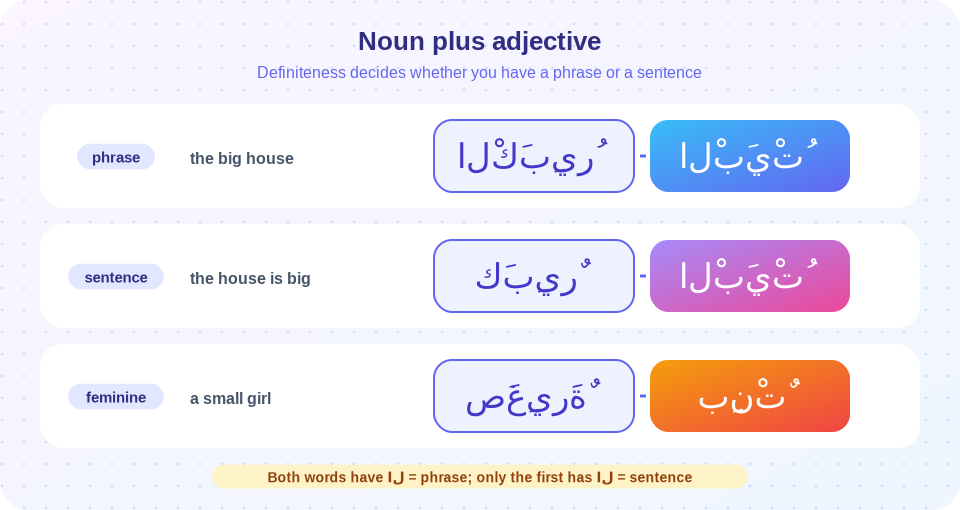
- الْبَيْت الْكَبِير (al-bayt al-kabīr) = the big house. A phrase: the house + the big. It is a noun and its description; it says nothing yet.
- الْبَيْت كَبِير (al-bayt kabīr) = the house is big. A sentence: the house (subject) + big (predicate). It makes a statement.
The only difference is the ال on the adjective. If the adjective has ال, it describes; if it has none, it is the predicate. Whenever you see two definite words in a row, think "phrase". When the second word is indefinite, think "sentence".
| Structure | Subject | Adjective | Result |
|---|---|---|---|
| Phrase | الْبَيْت | الْكَبِير | the big house |
| Sentence | الْبَيْت | كَبِير | the house is big |
| Phrase | بَيْت | كَبِير | a big house |
The third row is tricky: both words are indefinite, so bayt kabīr could also be a very short sentence, "a house is big", but in practice, context settles it, and the phrase meaning is far more common.
This, that and sentences
هَٰذَا (hādhā) and هَٰذِهِ (hādhihi) can start either a phrase or a sentence, and again the ال decides:
- هَٰذَا بَيْت كَبِير. (hādhā bayt kabīr.) This is a big house. (Indefinite noun: a sentence naming a thing.)
- هَٰذَا الْبَيْت كَبِير. (hādhā l-bayt kabīr.) This house is big. (Definite noun: "this house" is the subject.)
- هَٰذِهِ مَدْرَسَة جَدِيدَة. (hādhihi madrasa jadīda.) This is a new school.
- تِلْكَ السَّيَّارَة قَدِيمَة. (tilka s-sayyāra qadīma.) That car is old.
A short dialogue
Two students in a classroom.
| Speaker | Arabic | Transliteration | English |
|---|---|---|---|
| Sara | هَٰذِهِ الْمَدْرَسَة جَمِيلَة. | hādhihi l-madrasa jamīla. | This school is beautiful. |
| Omar | نَعَمْ، وَهِيَ كَبِيرَة. | naʿam, wa hiya kabīra. | Yes, and it is big. |
| Sara | وَالْكِتَاب؟ | wa l-kitāb? | And the book? |
| Omar | الْكِتَاب جَدِيد وَسَهْل. | al-kitāb jadīd wa sahl. | The book is new and easy. |
The word وَ (wa, "and") attaches to the next word without a space. Notice that the school (feminine) takes jamīla and kabīra, but the book (masculine) takes jadīd and sahl.
Stacking descriptions and building bigger sentences
You can describe a noun with more than one adjective. Each adjective follows the noun and copies its gender, number and definiteness. With an indefinite noun, the adjectives are usually joined by وَ (wa, "and"): بَيْت كَبِير وَجَمِيل (bayt kabīr wa jamīl), "a big and beautiful house". With a definite noun, the adjectives stack up with no "and", each one carrying ال: الْبَيْت الْكَبِير الْجَمِيل (al-bayt al-kabīr al-jamīl), "the big, beautiful house".
Dual nouns need dual adjectives. "The two girls are small" is الْبِنْتَانِ صَغِيرَتَانِ (al-bintāni ṣaghīratān): the subject is the feminine dual bintān, and the predicate is the feminine dual ṣaghīratān. "Two new students" (male) is طَالِبَانِ جَدِيدَانِ.
A whole phrase can serve as the subject of a sentence. Take "The new teacher (a woman) is tall". Break it into two pieces:
- The subject is a definite phrase: الْمُعَلِّمَة الْجَدِيدَة (al-muʿallima l-jadīda), "the new teacher".
- The predicate is an indefinite feminine adjective: طَوِيلَة (ṭawīla), "tall".
Together: الْمُعَلِّمَة الْجَدِيدَة طَوِيلَة. Both pieces are feminine singular, the subject has ال on both of its words (it is a phrase) and the predicate has none (so the whole thing is a sentence). If you ever feel unsure, build the sentence in steps: first the phrase, then the predicate. The same recipe gives الْكِتَاب الْقَدِيم صَعْب (al-kitāb al-qadīm ṣaʿb), "the old book is difficult".
You can also check your sentence by reading it aloud and asking one question at each word: "Does this word have the same gender as the noun? Does it have the same ال status as I intend?" Within a few weeks, you will build agreement without thinking.
Try it
Press Run (or Ctrl + Enter) to see the result here.
Program input · what you'd type while the program runs
Type the answers before you press Run, one per line. Each time the program reads a line (with input()), it gets the next line from this box.
The builder and the program implement the same rule: pick the adjective form that matches the noun's gender, then add ال to the adjective only if you want a phrase.
Mistakes to avoid when stacking
Learners often drop the second ال when they stack two definite adjectives, or add it to a predicate by habit. Say each word's status out loud: "noun with ال, adjective with ال, adjective with ال" for a phrase; "noun with ال, adjective without" for a sentence. And remember that the feminine marker must appear on every adjective: al-madrasa l-kabīra l-jamīla, not al-madrasa l-kabīra l-jamīl.
Common misconceptions
"The adjective goes before the noun, as in English." In Arabic it follows the noun.
"I need a verb for 'is'." In the present tense, Arabic omits it. Al-bayt kabīr is a complete sentence.
"Definite noun plus definite adjective is a sentence." It is a phrase. For a sentence, leave ال off the adjective.
"Feminine nouns can take masculine adjectives." The adjective must agree: madrasa kabīra, not madrasa kabīr.
Check your understanding
Quick check · 5 questions
of 5 answered You scored / 5 · perfect!
-
1. How do you say 'the house is big'?
Only the noun has ال, so it is a sentence. -
2. How do you say 'a new school'?
Both words are indefinite and the adjective is feminine to match. -
3. What does الْبَيْت الْكَبِير mean?
Both words have ال, which makes a phrase. -
4. Which adjective goes with سَيَّارَة?
Sayyāra is feminine singular, so you need the feminine adjective. -
5. Which sentence means 'This is a new book'?
Hādhā matches the masculine noun, and the noun is indefinite.
Summary
- Adjectives follow their nouns and match gender, number and definiteness.
- The feminine adjective usually adds ة.
- Present-tense sentences have no verb "to be": subject plus predicate.
- Both words with ال make a phrase; ال on the noun only makes a sentence.
- Hādhā and hādhihi start sentences naming a thing or modify a definite noun.
Next: Chapter 4 Review: Nouns