
























लेसन 15 · Entropy, Free Energy and Equilibrium
The equilibrium constant and the reaction quotient
Link Gibbs energy to the equilibrium constant with ΔG = ΔG° + RT ln Q and ΔG° = -RT ln K, define Kp and Kc, and calculate equilibrium compositions from thermodynamic data.
Most reactions do not run to completion. Mix nitrogen dioxide and its dimer N₂O₄ in a flask, and the mixture settles at a definite composition and then stops changing. The composition depends on temperature and pressure, but not on which side you started from. That composition is the equilibrium, and the equilibrium constant K is a single number that summarizes it.
Thermodynamics makes this precise. The equilibrium constant is not an empirical curiosity; it is determined by the standard Gibbs energy of the reaction. If you can look up ΔfG° values, you can predict equilibria without ever running the experiment.
What you will learn
- The relation between
ΔG,ΔG°and the reaction quotientQ. - How
ΔG° = -RT ln Kconnects thermodynamic tables to equilibrium. - How to write K for gases, solutions and heterogeneous systems.
- How to calculate an equilibrium composition from K.
Key terms
Reaction quotient (Q): the product of activities of products over reactants, each raised to its stoichiometric power, at any moment.
Equilibrium constant (K): the value of Q at equilibrium; dimensionless.
Activity (a): the effective concentration relative to the standard state; for an ideal gas p/p°, for an ideal solute c/c°, for pure solids and liquids 1.
Extent of reaction (ξ): the amount reacted, measured in moles of reaction.
Kp, Kc: equilibrium constants written with partial pressures or concentrations.
Why a minimum?
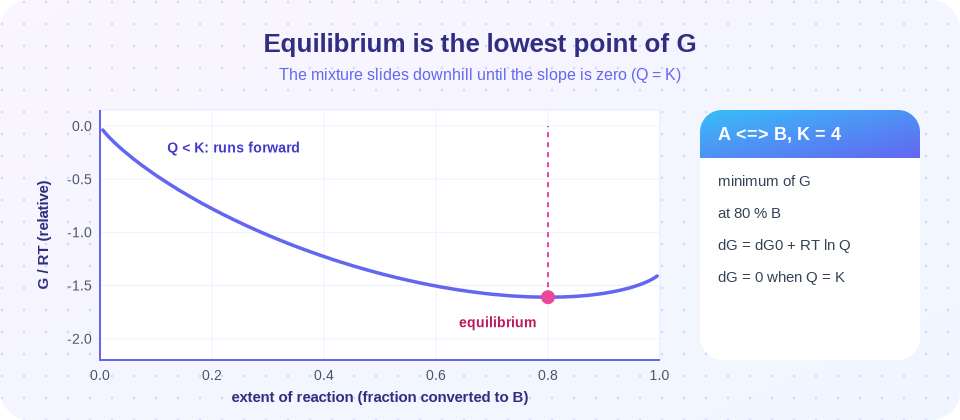
Suppose one mole of A turns into B: A ⇌ B. Let ξ be the fraction converted. The mixture has (1-ξ) of A and ξ of B, so the Gibbs energy of the mixture (per mole, ideal) is
G/RT = (1-ξ) μ°_A/RT + ξ μ°_B/RT + (1-ξ) ln(1-ξ) + ξ ln ξ
The last two terms are the Gibbs energy of mixing: always negative, steepest near the ends. So G falls as the first few molecules of B appear (mixing wins), then climbs back as pure B is approached. There is always a minimum inside the range: reactions "stop" before completion because a mixture is more stable than either pure state. The slope of G with respect to ξ is the reaction Gibbs energy:
ΔG = (∂G/∂ξ)_{T,P} = ΔG° + RT ln Q
and at the minimum the slope is zero. So at equilibrium ΔG = 0 and Q = K:
ΔG° = -RT ln K or K = exp(-ΔG°/RT)
Reading the equation
ΔG° < 0givesK > 1: products favored. Each -5.7 kJ/mol (at 298 K) multiplies K by 10.ΔG° = 0givesK = 1.ΔG° > 0givesK < 1: reactants favored. It does not mean the reaction never goes: a tiny but non-zero amount of product always forms.- Away from equilibrium
ΔG = RT ln(Q/K): ifQ < K,ΔG < 0and the reaction runs forward; ifQ > K, it runs backward.
| ΔG° at 298 K | K |
|---|---|
| -40 kJ/mol | 1 x 10⁷ |
| -10 kJ/mol | 57 |
| 0 | 1 |
| +10 kJ/mol | 0.018 |
| +40 kJ/mol | 1 x 10⁻⁷ |
Writing K
For aA + bB ⇌ cC + dD:
K = (a_C^c a_D^d) / (a_A^a a_B^b)
with activities, which makes K dimensionless.
- Ideal gases:
a = p/p°withp° = 1 bar, soK_p = (p_C/p°)^c (p_D/p°)^d / .... - Dilute solutes:
a = c/c°withc° = 1 mol/L:K_c. - Pure solids and liquids:
a = 1. ForCaCO₃(s) ⇌ CaO(s) + CO₂(g),K = p_CO₂/p°only. - Solvent in dilute solution:
a ≈ 1. - If you multiply the equation by 2, K is squared; reversing inverts K; adding reactions multiplies their K's.
For gases K_p = K_c (c° RT/p°)^Δn, where Δn is the change in moles of gas and c°RT/p° = 24.8 at 298 K (c° = 1 mol/L = 1000 mol/m³, p° = 10⁵ Pa).
Worked example: N₂O₄ dissociation
N₂O₄(g) ⇌ 2 NO₂(g). Data at 298 K: ΔfG°(N₂O₄) = 97.9 kJ/mol, ΔfG°(NO₂) = 51.3 kJ/mol.
ΔrG° = 2(51.3) - 97.9 = +4.7 kJ/mol.K = exp(-4700/(8.3145 x 298.15)) = exp(-1.896) = 0.150.- Start with 1.00 mol N₂O₄ and let a fraction
αdissociate at a total pressure of 1.00 bar. Moles: N₂O₄1-α, NO₂2α, total1+α. Partial pressures:p(N₂O₄) = (1-α)/(1+α)bar,p(NO₂) = 2α/(1+α)bar. ThenK = 4α² / (1 - α²) = 0.150, soα² = 0.150/4.150 = 0.0361andα = 0.19.
About 19 percent has dissociated. Compressing the mixture (higher P) would lower α, a preview of Le Chatelier's principle.
ICE tables
For solution equilibria, set up an Initial-Change-Equilibrium table with amounts and solve for x. If K is small, x is small compared with the initial concentration and you can simplify, then check the assumption.
Common misconceptions
"At equilibrium the concentrations of products and reactants are equal." Only when K = 1. What is equal is the forward and backward rate.
"A reaction with K < 1 never produces products." It produces a smaller amount; K = 10⁻⁷ still gives product molecules.
"K depends on the concentrations." K depends only on temperature (for a given standard state). The composition changes with conditions; K does not.
"Catalysts increase K." They speed up approach to equilibrium but leave K (and ΔG°) unchanged.
"Include solids in K." Pure solids and liquids have activity 1.
Try it
Compute K from ΔG° and solve for the composition of the N₂O₄ equilibrium at different total pressures.
Press Run (or Ctrl + Enter) to see the result here.
Program input · what you'd type while the program runs
Type the answers before you press Run, one per line. Each time the program reads a line (with input()), it gets the next line from this box.
Now see the Gibbs energy landscape for different K values. Each curve is the model A ⇌ B from the text, with ΔG°/RT = -ln K.
Press Run (or Ctrl + Enter) to see the result here.
Program input · what you'd type while the program runs
Type the answers before you press Run, one per line. Each time the program reads a line (with input()), it gets the next line from this box.
Check your understanding
Quick check · 5 questions
of 5 answered You scored / 5 · perfect!
-
1. ΔG° = -11.4 kJ/mol at 298 K. K is approximately
ln K = 11400/(8.3145 x 298) = 4.6, so K = 100. -
2. If Q < K for a reaction, which way does it run?
ΔG = RT ln(Q/K) < 0 so the forward reaction is spontaneous. -
3. In K for CaCO3(s) = CaO(s) + CO2(g), which activities appear?
Pure solids have activity 1, so K = p(CO2)/p°. -
4. Doubling all coefficients of a balanced equation changes K to
K for the doubled equation is K^2. -
5. What does a catalyst do to K?
K depends on ΔG°, which a catalyst does not change; it only speeds up approach to equilibrium.
Summary
ΔG = ΔG° + RT ln Q; at equilibriumΔG = 0andQ = K, soΔG° = -RT ln K.- At 298 K, every -5.7 kJ/mol multiplies K by 10.
- K uses activities:
p/p°for gases,c/c°for solutes, 1 for pure solids and liquids. Q < Kruns forward,Q > Kbackward;ΔG = RT ln(Q/K).- K depends on temperature only; catalysts do not change it.
अपनी प्रगति ट्रैक करें
मुफ़्त अकाउंट बनाएँ, लेसन पूरे के रूप में चिह्नित करें और किसी भी डिवाइस पर वहीं से शुरू करें जहाँ छोड़ा था।