
























लेसन 40 · Wireless and Optical Systems
Chapter 8 Review: Wireless and Optical Systems
Review chapter 8 with a one-page picture, recap table, a comparison of Wi-Fi, LTE, satellite and fiber losses, a fade-margin tool and a ten-question quiz.
Chapter 8 moved from abstract noise to physical channels. Radio has path loss, shadowing, multipath fading and Doppler; fiber has attenuation and dispersion. All of them reduce to the same ledger, the link budget, plus a few tricks (OFDM, diversity, coding) for the variable parts.
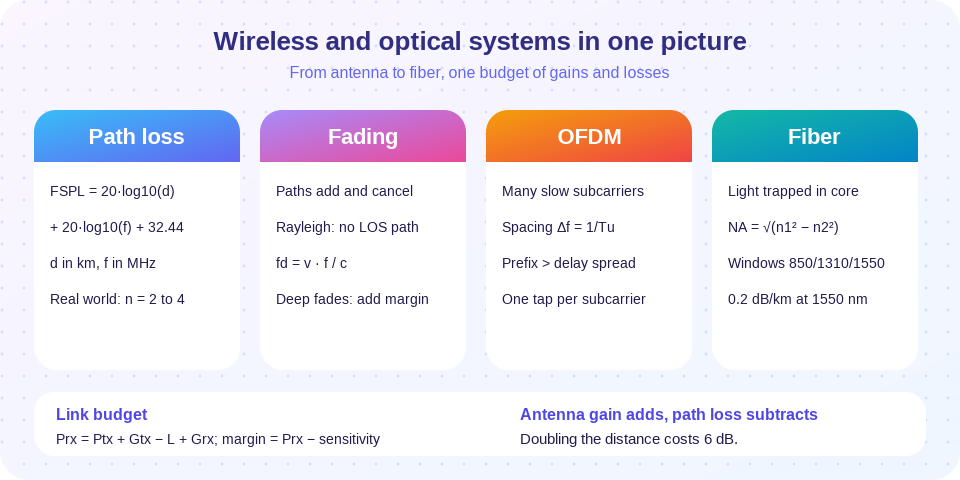
Chapter in one table
| Topic | Key formula | Rule of thumb |
|---|---|---|
| Free-space loss | 20·log10(d_km) + 20·log10(f_MHz) + 32.44 |
doubling distance or frequency: +6 dB |
| Log-distance model | PL = PL0 + 10·n·log10(d/d0) |
n is 2 in free space, 3 to 4 in cities |
| Received power | Pr = Ptx + Gtx + Grx − L (dB) |
0 dBm = 1 mW; −174 dBm/Hz at 290 K |
| Margin | SNR − SNR_required |
shadowing 2.33σ for 99 % |
| Rayleigh fading | `P( | h |
| Doppler | fd = v·f/c |
185 Hz at 100 km/h and 2 GHz |
| Coherence bandwidth | Bc ≈ 1/(5·τrms) |
200 kHz for 1 µs |
| OFDM | Δf = 1/Tu; prefix > delay spread |
Wi-Fi 312.5 kHz; LTE 15 kHz |
| Fiber | NA = √(n1² − n2²); α ≈ 0.2 dB/km at 1550 nm |
5 µs/km delay |
| Chromatic dispersion | Δτ = D·L·Δλ |
D = 17 ps/(nm·km) |
Mistakes to avoid
- Using the wrong units in the free-space formula (kilometers and megahertz, not meters and hertz).
- Adding dBm values together.
- Forgetting that a path loss exponent above 2 shortens range much more than the free-space formula suggests.
- Believing OFDM removes fading; it only makes fading simple to equalize.
Try it
First, compare typical systems: how much path loss does each have to overcome? The fiber figure counts attenuation only.
Press Run (or Ctrl + Enter) to see the result here.
Program input · what you'd type while the program runs
Type the answers before you press Run, one per line. Each time the program reads a line (with input()), it gets the next line from this box.
Second, a fade-margin tool. For a Rayleigh channel, the probability that the received power is lower than M dB below its average is 1 − e^(−10^(−M/10)). For shadowing with standard deviation σ, the margin for a target availability follows from the Gaussian.
Press Run (or Ctrl + Enter) to see the result here.
Program input · what you'd type while the program runs
Type the answers before you press Run, one per line. Each time the program reads a line (with input()), it gets the next line from this box.
Check your understanding
Quick check · 9 questions
of 9 answered You scored / 9 · perfect!
-
1. A free-space link at 3 GHz and 10 km. What is the path loss?
20·log10(10) + 20·log10(3000) + 32.44 = 20 + 69.54 + 32.44 = 122 dB. -
2. The distance of a free-space link is doubled. The path loss changes by:
20·log10(2) = 6.02 dB. -
3. What does the cyclic prefix do in OFDM?
The prefix is a copy of the symbol's tail that absorbs the delay spread. -
4. In Rayleigh fading, how often is the signal at least 30 dB below average?
1 − e^(−0.001) ≈ 0.1 %. -
5. A fiber has loss 0.2 dB/km. After 50 km, what fraction of the launched power remains?
50 × 0.2 = 10 dB, which is a factor of 10, so 10 % remains. -
6. Which environment has the largest path loss exponent?
Indoor obstructed paths can reach exponents of 4 to 6. -
7. Chromatic dispersion of 17 ps/(nm·km) with a 0.1 nm source over 20 km gives:
17 × 20 × 0.1 = 34 ps. -
8. Doppler shift at 108 km/h (30 m/s) and 900 MHz is:
fd = 30 × 9×10⁸ / 3×10⁸ = 90 Hz. -
9. A link has Prx = −70 dBm, noise floor −92 dBm and the modem needs 15 dB SNR. What is the margin?
SNR = 22 dB; margin = 22 − 15 = 7 dB.
Summary
- Free-space loss follows
20·log10(d) + 20·log10(f) + 32.44(km, MHz); real environments use an exponentn. - Link budget: add gains, subtract losses, compare with the noise floor, keep margin for shadowing and fading.
- Fading is multiplicative and heavy-tailed; OFDM and coding make it manageable.
- Fiber trades tiny attenuation for dispersion; budgets follow the same ledger logic as radio.
अपनी प्रगति ट्रैक करें
मुफ़्त अकाउंट बनाएँ, लेसन पूरे के रूप में चिह्नित करें और किसी भी डिवाइस पर वहीं से शुरू करें जहाँ छोड़ा था।