
























लेसन 34 · Rigid Bodies and Small Oscillations
Chapter 8 Overview: Rigid Bodies and Small Oscillations
Preview of chapter 8: normal modes of coupled oscillators, the inertia tensor, Euler's equations and why a tennis racket tumbles when you spin it about one axis.
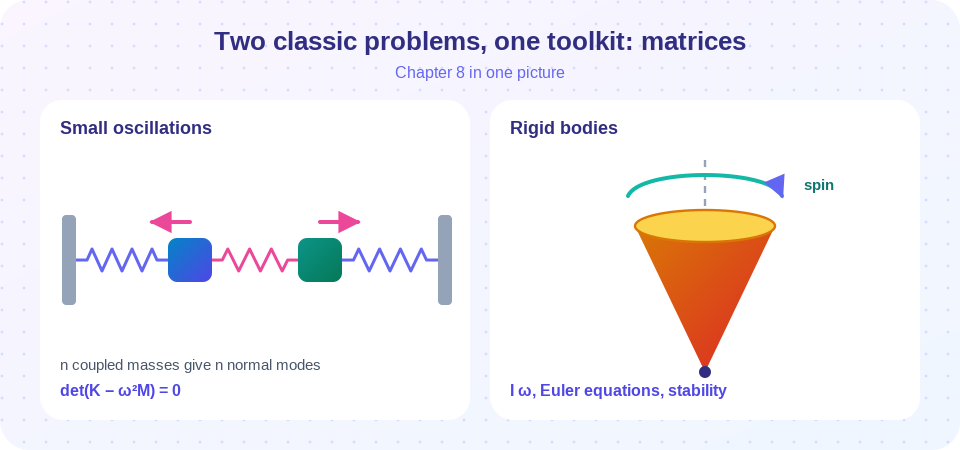
Two of the most useful applications of Lagrangian mechanics live in this chapter. The first is small oscillations: near any stable equilibrium, a complicated system behaves like a set of independent harmonic oscillators called normal modes. This is how engineers analyze bridges, how chemists understand molecular vibrations, and how physicists first treat a crystal.
The second is rigid-body rotation. A spinning top, a satellite and a thrown book all obey Euler's equations, and the equations hold a surprise: rotation about one of the three principal axes is unstable, which you can feel when you toss a book into the air.
Both topics are, underneath, the same piece of linear algebra: diagonalizing a symmetric matrix.
What you will learn
- How to turn a nonlinear system near equilibrium into
Mη̈ + Kη = 0. - What normal modes and normal frequencies are and how to find them.
- What the inertia tensor is and how it differs from a single moment of inertia.
- Why rotation about the middle principal axis is unstable.
The chapter at a glance
Near equilibrium, everything is a spring
Normal modes
Rotation needs a tensor
Euler's equations
What each lesson covers
- Small oscillations and normal modes: the matrix method, coupled masses and the double pendulum.
- The inertia tensor and Euler's equations: principal axes, torque-free rotation and the tennis-racket effect.
- Chapter review: a one-page picture and ten questions.
A first look: beats
Two identical masses joined by a weak coupling spring show beats: if you pull one aside and release, it swings, passes its energy to the other, and gets it back later. The reason is that the motion is a mix of two normal modes with slightly different frequencies. In the TryIt (m = 1 kg, wall springs k = 1 N/m, coupling κ = 0.05 N/m) mass 1 starts displaced and the plot shows both positions. The formula used is exact for this linear model: x₁ = ½(cos ω₁t + cos ω₂t) and x₂ = ½(cos ω₁t − cos ω₂t) with ω₁ = √(k/m) and ω₂ = √((k + 2κ)/m).
Press Run (or Ctrl + Enter) to see the result here.
Program input · what you'd type while the program runs
Type the answers before you press Run, one per line. Each time the program reads a line (with input()), it gets the next line from this box.
Check your understanding
Quick check · 4 questions
of 4 answered You scored / 4 · perfect!
-
1. What is a normal mode?
In a normal mode every coordinate oscillates with the same frequency and fixed relative amplitudes. -
2. How many normal modes does a system with n coupled coordinates have near a stable equilibrium?
n coordinates give an n × n eigenvalue problem and so n normal modes. -
3. Which two objects does the inertia tensor generalize?
The moment of inertia becomes a 3 × 3 symmetric matrix. -
4. When you toss a book spinning about its middle axis, what happens?
Rotation about the intermediate principal axis is unstable.
Summary
- Near equilibrium,
T ≈ ½ η̇ᵀMη̇andV ≈ ½ ηᵀKη; the normal modes solvedet(K − ω²M) = 0. - A rigid body needs an inertia tensor; torque-free motion follows Euler's equations.
- Rotation about the smallest and largest principal axes is stable, about the middle one unstable.
अपनी प्रगति ट्रैक करें
मुफ़्त अकाउंट बनाएँ, लेसन पूरे के रूप में चिह्नित करें और किसी भी डिवाइस पर वहीं से शुरू करें जहाँ छोड़ा था।