
























लेसन 42 · Projects and Practice
Biochemistry cheat sheet
A one-page recap of key biochemistry equations, constants, ATP yields, bond types and the genetic code, with a poster and a calculator for the main formulas.
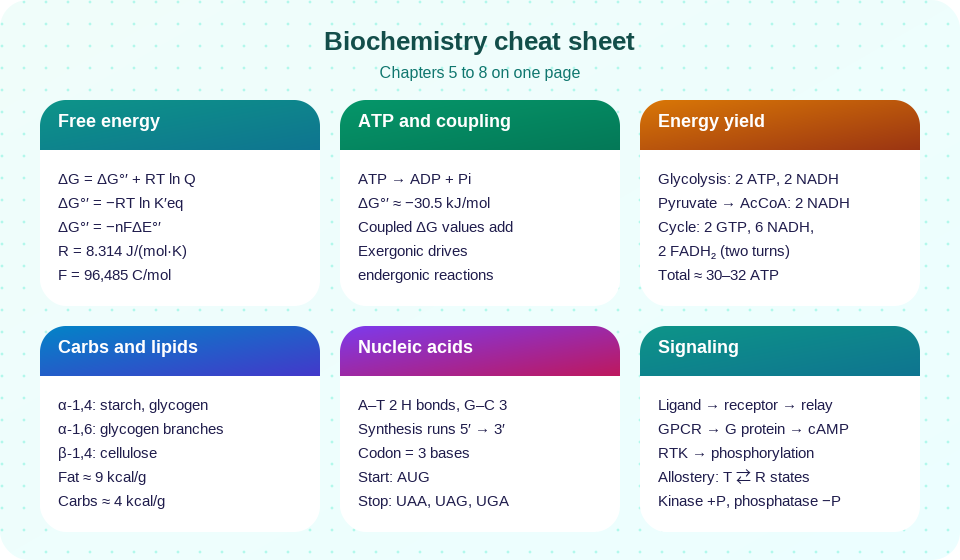
When revising, you want the essential numbers and rules on one page. The poster below collects them; the sections after it add the formulas with units, a few reminders, and a calculator you can reuse. Memorize the structure of the facts, not just the digits: most of the numbers follow from a handful of ideas.
What you will learn
- Recall the main equations and constants with their units.
- Find the right formula for a given problem type.
- Use a calculator to check free energy, equilibrium and redox values.
Equations and constants
| Quantity | Formula | Notes |
|---|---|---|
| Gibbs free energy | ΔG = ΔH − TΔS |
T in kelvin |
| Real free energy | ΔG = ΔG°′ + RT ln Q |
Q = products / reactants |
| Equilibrium | ΔG°′ = −RT ln K′eq |
factor of 10 in K′ per 5.7 kJ/mol at 25 °C |
| Redox | ΔG°′ = −nFΔE°′ |
ΔE°′ = E°′(acceptor) − E°′(donor) |
| Gas constant | R = 8.314 J mol⁻¹ K⁻¹ |
RT = 2.479 kJ/mol at 25 °C; 2.579 at 37 °C |
| Faraday constant | F = 96.485 kJ V⁻¹ mol⁻¹ |
96,485 C/mol |
| Hill equation | Y = pⁿ / (pⁿ + P₅₀ⁿ) |
Hb: n ≈ 2.8, P₅₀ ≈ 26 mmHg |
| ATP hydrolysis | ΔG°′ ≈ −30.5 kJ/mol |
much more negative in cells |
Pathway numbers
| Process | Result |
|---|---|
| Glycolysis | 2 ATP spent, 4 made: net 2 ATP, 2 NADH, 2 pyruvate |
| Pyruvate dehydrogenase | 1 NADH and 1 CO₂ per pyruvate |
| Citric acid cycle (one turn) | 3 NADH, 1 FADH₂, 1 GTP, 2 CO₂ |
| P/O ratios | about 2.5 ATP per NADH, 1.5 per FADH₂ |
| Total per glucose | about 30 to 32 ATP |
| Proton pumping | I: 4, III: 4, IV: 2 H⁺ per 2 e⁻; II: none |
Structure reminders
- Sugars: aldohexose has 16 stereoisomers; α anomer has C1 OH opposite the CH₂OH; equilibrium about 36 % α and 64 % β.
- Bonds: maltose α-1,4; lactose β-1,4; sucrose α-1,β-2; cellulose β-1,4; glycogen branches α-1,6.
- Lipids: cis double bonds kink and lower the melting point; fat about 9 kcal/g, carbohydrate about 4 kcal/g.
- DNA: A–T two hydrogen bonds, G–C three; strands antiparallel; polymerases extend 3′ ends only.
- Code: 64 codons, 61 sense and 3 stop (UAA, UAG, UGA); AUG starts.
Common misconceptions
"A negative ΔG°′ means the reaction runs in the cell." The real ΔG depends on concentrations. Use Q.
"ATP bonds store energy." Hydrolysis is favorable because the products are more stable.
"P/O ratios are exact integers." They are estimates; 30 to 32 is the modern range for ATP per glucose.
Try it
A free energy calculator. Enter ΔG°′ and the concentrations of products and reactants.
Press Run (or Ctrl + Enter) to see the result here.
Program input · what you'd type while the program runs
Type the answers before you press Run, one per line. Each time the program reads a line (with input()), it gets the next line from this box.
A yield and energy density table for quick comparison.
Press Run (or Ctrl + Enter) to see the console output here.
No output.
Check your understanding
Quick check · 3 questions
of 3 answered You scored / 3 · perfect!
-
1. Which equation links standard free energy to the equilibrium constant?
ΔG°′ = −RT ln K′eq. The others are the Gibbs equation and the redox relation. -
2. ATP yield per glucose with textbook P/O ratios is about
4 direct + 10 NADH × 2.5 + 2 FADH₂ × 1.5 = 32. -
3. Which codon is a stop codon?
UAA, UAG and UGA are the three stop codons.
Summary
- Keep five equations at hand: Gibbs, ΔG with Q, ΔG°′ and K, redox and Hill.
- Remember the stage numbers: 2, 2, then 3-1-1-2 per turn, and 30 to 32 ATP in total.
- Link bond types to structures: α-1,4, α-1,6, β-1,4.
- DNA pairing and the genetic code follow simple counting rules.
अपनी प्रगति ट्रैक करें
मुफ़्त अकाउंट बनाएँ, लेसन पूरे के रूप में चिह्नित करें और किसी भी डिवाइस पर वहीं से शुरू करें जहाँ छोड़ा था।